
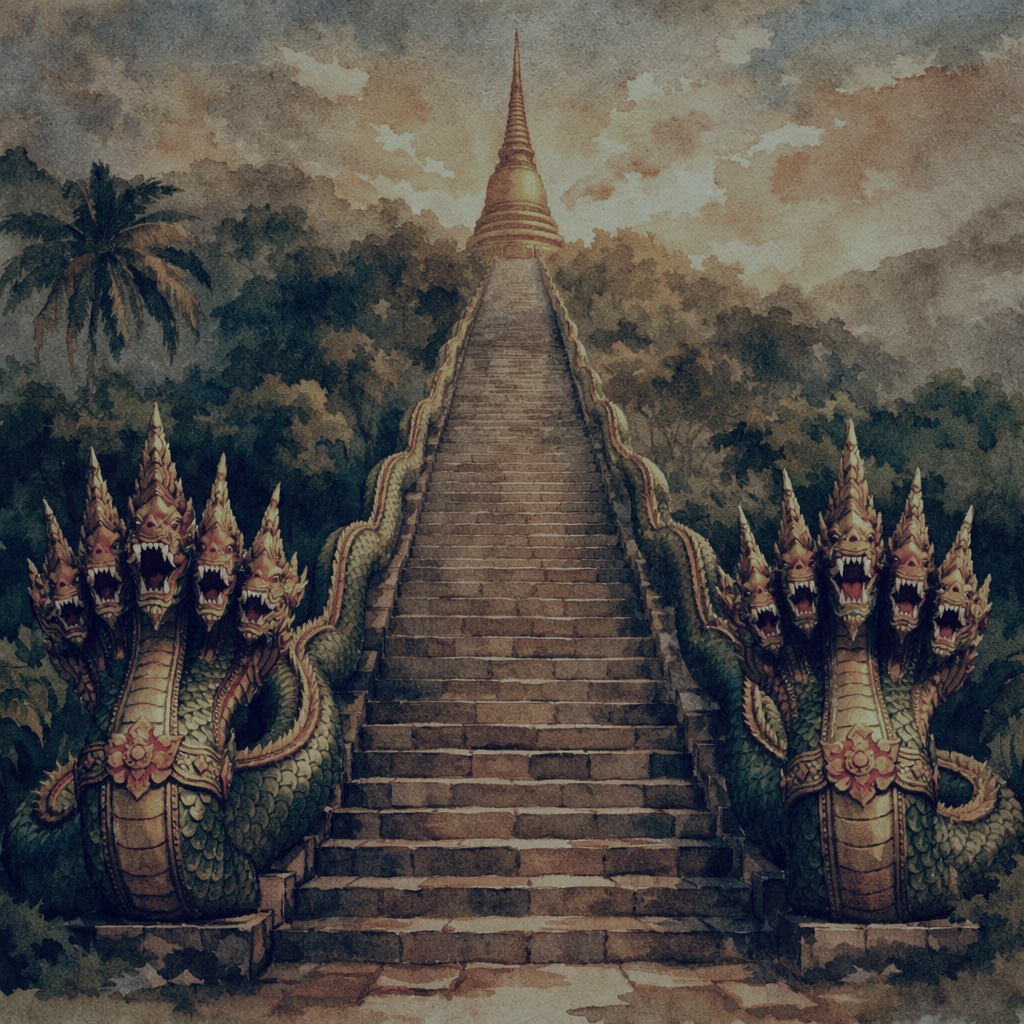
By Jack Gallagher
Chapter 1 The Old House

Koon Yai1 lived in a big house that her father built when she was a child. She had lived in the house since she was seven years old. Now she was eighty-seven years old. As she grew old, other than visits to a nearby Buddhist temple, she rarely left her family’s large plot of land on which the old house sat.
The land on which the old house was built was in rural northern Thailand, on the outskirts of a small village. The nearest town of any size was Lamphun City, about an hour’s drive away by way of the main road which bordered the property. Even though the villagers called it “Lamphun City”, it was really just a large town. Chiang Mai was a city. Lamphun was not. Still, Lamphun City was the closest town of some size to the village.
When Koon Yai was a young girl, the main road was gravel all the way to Lamphun City. Hardly any cars passed by during the day, and none at night. When a car did come down the main road, it was such an event that Koon Yai and her siblings would run out to the road to get a glimpse of it and wave. Several decades ago, the main road was paved and now at times was busy with traffic speeding by. Thankfully the old house was far enough from the road and shielded by trees that it was mostly silent during the day and dead silent at night.
There were mountains nearby that could be seen from the porch of the old house. Low mountains with gentle contours covered in lush green. Before the mountains lay the flat lands of paddy rice and fields of sugar cane, tapioca, cassava and tobacco. There were endless orchards of lumyai, mango, coconut. and tamarind.
The village folk kept mostly to themselves. Strangers were rarely seen. It wasn’t that the villagers held any animosity toward people not from these parts, as that would be against their Buddhist teachings. They were simply reserved by nature and minded their own business.
Buddhism ran deep in the rural north, maybe deeper than in any other part of the Kingdom. In and near the village were several Buddhist temples. If you drove the country roads, you’d soon realize that the region was dotted with temples and golden spires both ancient and new. On Sunday mornings, the villagers gathered along the streets to give food to a long procession of barefoot monks wrapped in burnt-orange robes.
The family plot of land was four rai, nearly three-quarter of a hectare. From the main road, a gravel road ran through the property, past a grove of huge lumyai trees to the house. The trees had been planted many decades ago and were now old with brittle limbs. Thunderstorms during rainy season would sometimes tear off a limb or two. The trees still produced longan, but nowhere the yield of decades ago when the trees were younger.
The land around the house had other fruit trees. Lime, lychee, guava, pomelo, banana, tamarind and coconut. The lime and lychee became sweeter with age. The pomelo and guava grew bitter. The bananas and coconuts seemed impervious to time.
Electricity came from a power line draped over wobbly, crooked cement poles. Black outs were frequent, especially during the rainy-season when storms pummeled the region. When the power went off at night, it was pitch black darkness. Koon Yai kept a good supply of candles at the house. Black outs could last an hour or a day. No one in these parts ever got angry that the power was off. It was accepted as part of living in the countryside.
Koon Yai’s father had bought this land for a trifle. Back then it was in the middle of nowhere, but now the outskirts of the village had crept near the property. Land was so cheap because there was so much of it and so few people. When her father built the house, the nearest farmstead was at least five kilometers away. Now there were a few houses only a twenty minute walk away.
Koon Yai easily remembered the day her father announced to their family that he had bought a piece of land outside the village and he was going to build a house. She was barely seven years old and was surprised when her mother cried and hugged her father at the news. At the time, the family was squeezed into a small house in the middle of the village where it seemed every trip to the outhouse was everyone’s business.
Day by day, Koon Yai watched her father build the house. Some days her father’s friends would help. Other days he worked alone. Trucks laden with teak, laterite bricks, cement, pipes, tiles and a whole assortment of building materials would make their deliveries to the property. Koon Yai couldn’t wait to get out of school to rush to their new home to see the progress. Always her father would be there, sweaty and dirty, building away.
When Koon Yai was a teenager, she had taken a school field trip to the ancient ruins of Sukothai, only a half-day drive away. As she walked among the ancient temple ruins she made an astounding realization-the stone blocks that were used to build the temples of Sukothai were the same stone blocks that her father had used to build the first floor of the house. It was laterite, a stone that could endure a thousand years. And so Koon Yai believed that her house would also stand against time like ancient Sukothai.
As the house rose up, the villagers marveled at its size-the biggest in their village. Two stories high with five bedrooms and a large kitchen, a fore room, and living room. But what had made the local folk marvel the most was that the house had an indoor bathroom. It was the first house in the village to have a bathroom inside. All the other houses had outhouses.
The toilet was a white porcelain slab on the floor with a basin connected to the sewer. A person squatted over the basin to use the toilet. You ladled water from a cistern to flush it. The “shower” was just a tiled enclosure with a drain in the corner that let the water run out into the backyard. A very large ceramic cistern inside the shower was used to ladle water over yourself. Most villagers had dark and dank outhouses, and used a garden hose outside to shower.
When Koon Yai was a school girl, her friends came over just to see the bathroom. How times were changing for their small village they thought. It was with great pride that she would show everyone the bathroom and brag that her father had built this house. Of course in this rural community, everyone’s father had built their house.
12-years ago, Koon Yai began having trouble squatting to use the old porcelain slab, so it was replaced with a modern flush toilet. But the shower still drained into the backyard. And she still used the old cistern to ladle water over herself. Now she had a chair in the shower and sat while bathing.
The bathroom, once considered bold and modern, was now badly outdated and dingy. What was once a source of pride, was now an embarrassment. Most houses in the village now had modern bathrooms with indoor plumbing and flush toilets. Very few still used the old-fashioned porcelain slab. Many even had hot water.
The house’s modern attempt at an indoor bathroom was countered by its doors and windows. They were old-fashioned Siamese style. The windows, and there were many big ones, had no glass. If you wanted to open or close a window, you opened or closed its shutters.
The front door entrance to the living room was nearly two meters wide. On each side of the entrance hung teak folding doors comprised of two panels hinged together. Each side swung outward and could be folded together against the outside wall of the house. From the outside, the doors could be locked with a rusty hasp and padlock. From the inside, Koon Yai placed a long iron rod across the doors to bar outside entry.
Above this door from the outside was her father’s name in large teak letters painted white- Enid Paitoon Utisee. The letters were nailed to a teak board painted bright blue and centered and hung over the front entrance. Although Koon Yai’s father never said so, building the old house was his greatest achievement in life. It provided refuge and comfort for his family, and it would stand long after his death.
The house had two stories. What made the interior of the house standout was that her father built each floor with fifteen foot ceilings. When you walked into the house, the ceilings towered above you. Such high ceilings kept the house cooler during the tropical year. Both floor and ceiling, throughout the entire house were made of teak. To this day, whenever Koon Yai looked up at the ceiling, she would think of her father precariously perched up there, carefully nailing one by one the teak planks.
The kitchen, as was the tradition in Siamese architecture, was originally detached from the main house by about twenty feet. Decades later, her father now in his early seventies, tore down the original kitchen and built a more modern one attached to the house. The new kitchen was large enough to easily place a large dining table with eight chairs right in its middle. Every night the dinner table was full of family and the table crowded with food. Now Koon Yai often ate alone at the table, occasionally joined by her son or grandson and family. The door to the kitchen led to a covered porch. During the day, this was Koon Yai’s favorite place to sit and wile away an afternoon.
Her father was not a carpenter or architect by trade. He was a farmer, business man, entrepreneur. The plans he drew up for the house were always slightly off. The pitch of the roof was slightly different than a usual house. The doorways were not standard sized making her father custom fit every door. The electrical wiring was never planned and resulted in a hodgepodge of an afterthought.
The worst error of the house was the stairway leading to the upstairs. It was too narrow. It was beautifully built of solid teak, but it was only three-quarters as wide as it should have been. The stairway first climbed to a landing halfway up, then doubled back to lead up to the second floor.
Typical of Siamese houses, there was a second stairway located outside in front of the house. This stairway was wide and also had a landing halfway up. You climbed the first flight of stairs facing the house to a landing, then upward to the left to the second floor. The outside stairway led to a small, covered porch with a doorway to enter the second floor. This stairway was used as much as the interior stairway, maybe more.
The second floor was the most beautiful area of the house, and it’s where Koon Yai slept as a child. The entire upstairs was made of teak. Teak floors, ceiling, walls, shutters, doors and window frames. The upstairs had a huge central room with two adjacent bedrooms. In this central room were two old-fashion ceiling fans hung from the fifteen foot ceiling. The fan’s wide blades were made of rattan and the metal parts all brass. Their style could be said to be British Colonial. Koon Yai’s father often mentioned that the Oriental Hotel in Bangkok had the same fans.
What made the upstairs special to Koon Yai was that growing up she and her brothers and sisters had lived up there. All five of them had each carved out a space for their mattress, dresser and personal belongings in the large common room. They arranged the furniture to give each other as much privacy as possible. Desks and bookcases were pushed together in such a way so as to give their beds a small pocket of privacy. Her mother and father stayed in the corner bedroom and an older cousin lived in the other.
At 10 p.m sharp every night, her father would climb the stairs to say goodnight to all his children. All five of the kids would be laying on their bed waiting for their father or mother to come up and check on them before turning out the lights. And after the lights went out, there were often whispers and giggling and sometimes crying as the children would confide their lives to each other.
Her father’s life was to be seen everywhere on the property. The remnants of his tapioca grinding business with its tall, red brick chimney where the oven had been to bake the tapioca. A large dilapidated storage building strewn with old tools, old clothes, discarded junk, and a tractor that hadn’t moved in 40 years. A teak shed out by the road where he tried his hand at selling ice, before anyone had refrigerators in these parts. Koon Yai could go nowhere on the property without seeing the remnants and debris of her father’s life.
At first, her father’s businesses were successful, which gave him the money to buy this land and build such a fine house. But as he grew older, his businesses failed. He died some twenty-five years ago broke, having to be supported by his children in the house he built.
The old house and its land also included a spirit house. The spirit house was located about twenty-five meters from the kitchen door. Its location was no casual decision. After the house was built and everyone had moved in, Koon Yai’s mother announced that they needed a spirit house. The next day her father returned from the village with a spirit house and a tall pedestal on which to place it. It was painted a deep red and gold and very much resembled a Thai temple-a wat. It was brand new and Koon Yai remembered smelling its fresh paint. She thought it looked like a doll house.
Her father unloaded the spirit house near the porch. On the following Sunday, three monks came to the house. They were barefoot and had walked onto the property from the main road. Koon Yai’s family was expecting them and rushed out of the house to greet them. Koon Yai had no idea as to why they had come.
The monks had come to find the proper place to put the spirit house. Its precise location would determine if the spirits that would soon dwell within would be happy. The monks walked around the house, sometimes together, sometimes alone. Koon Yai watched all this with the keen curiosity of a seven year-old. After a half-hour, they seemed to agree on a location-the same location where the spirit house sits today-near the tamarind tree off the kitchen porch.
Her father then retrieved the pedestal and firmly set it in place under the supervision of the monks. He then went back to get the spirit house and picked it up. Koon Yai could see that it was heavy and her father struggled a bit to handle its weight. He then placed the spirit house on its pedestal and made sure it wouldn’t fall over. He backed away and the monks made a semicircle around the little house. They began chanting and Koon Yai’s mother whispered in her ear that they were blessing the new spirit house.
After the blessing, Koon Yai’s mother and aunts brought flowers and a small bowl of rice and placed it on a flat skirt that ran on all sides of the spirit house. The monks began chanting again and her family joined in. The ceremony didn’t last long and the monks left as fast as they had come. Her family went back into the house, but Koon Yai lingered under the tamarind tree. She wasn’t quite sure what she had just witnessed.
Koon Yai sought out her oldest aunt to explain the spirit house and why the monks had come. Her aunt was the most soft spoken of all her mother’s sisters, and like her mother was a devout Buddhist. She took Koon Yai out to the spirit house and they stood under the shade of the tamarind tree. She explained that the land where their house now stood had a spirit that had lived there. Her family wanted the spirit to have a new house to live in. They didn’t want the spirit to be angry. An angry spirit might come live in the big house and cause mischief. The spirit house and making offerings soothed the spirit and kept it happy.
Now the spirit house was badly faded, its red no longer bright and its gold had mostly peeled away. The tamarind tree had grown quite large and its branches drooped over the spirit house and partially hid it. The skirt around it was splotched with wax from the many candles that had been lit over the decades. The ash from countless sticks of incense was everywhere.
Her mother and aunts had put food in the tiny house and lit candles or incense on its platform weekly. Koon Yai had kept up this tradition until a few years ago when it became too hard for her to walk there. Her mother had told her the little spirit house was for lost souls. Her aunts told her that Buddhists earn merit by welcoming and feeding the spirits. Better that spirits resided in their spirit house than in the old house. Koon Yai believed them. So to did her family and most of the villagers in their rural community.
The old house in winter could be very cold in the morning. The temperature could drop to seven or eight degrees Celsius, but by noon would warm to 20 degrees. When the temperature dipped, Koon Yai would bundle up like an Eskimo and patiently wait for the sun to rise to warm the land.
In Spring, the temperatures rose to over fourty degrees celsius. Water for the old house came from a nearby well and was pumped into a huge tank in back of the house. The heat was so inescapable that water came out the faucets warm, often very warm like bath water. If you wanted cool water, you found it in the refrigerator, not the faucet. Like all rural folk, Koon Yai, even in her old age, was impervious to heat.
Rainy season broke the heat. For that reason it was Koon Yai’s favorite time of year. She would sit on the porch and wait for the rain to come. Like clockwork, at the end of May the rain would come. The heat supercharged the humid air. Clouds forming at noon would make thunderstorms in late afternoon or evening. The deep rumbling of distant thunder approaching always made Koon Yai smile.
For a time, Koon Yai’s mother, father, her two sisters and two brothers, her aunt, and two cousins all lived in the house growing up. The house was noisy, rarely was the bathroom empty, the dinner table always crowded. Family and friends were coming and going. But one by one, over the years, a family member died or moved away, until Koon Yai was the only one still living in the house.
The last remaining family member to live in the house with Koon Yai was her oldest sister. She was also Koon Yai’s best friend. The day she died was the first day that Koon Yai had ever felt lonely in the old house.
Chapter 2: The Buddha Room
Koon Yai was raised a devout Buddhist. In her long life she had never questioned her faith or compared it to others. If you asked anyone in rural Siam about Buddhism, they would tell you that it was more than a religion, it was their culture. Without Buddhism, there would be no Siam.
Every house that Koon Yai had ever visited had an altar inside to worship Lord Buddha. Some resplendent and grand. Some simple and modest. Some had a single Buddha. Some had many Buddhas. Some also had carved elephants and brightly painted tigers, amulets and charms, and photos of deceased family members. Some didn’t. Some had statuettes of deceased monks. Some placed a locket of their hair or a tooth that had fallen out on their altar. Some had small twinkling lights strung across them. Some were dark. All home altars had space in front where a person prayed on a prayer mat or chair. And all home altars had a place to burn incense and candles. For Koon Yai, a home altar was not so much about religion as she could pray to Lord Buddha anywhere. It was about a way of life.
In the old house the altar was on the second floor and it faced eastward toward the rising sun. It contained a collection of eleven Buddha statues, with Lord Buddha standing, sitting, or reclining. The Buddhas were all set atop small white tables of different heights, the highest in the middle and the lowest on the ends.
There were also gold and silver amulets and charms scattered among the Buddhas. They had been passed down through family generations and were considered sacred family heirlooms that provided a link to the ancestor’s spirit who had worn it. There were two old, black and white photos in golden frames, faded and tattered of two elderly monks. Koon Yai’s grandmother had relied upon these monks for spiritual guidance. Two yellow candles that had been blessed by monks, were placed upon tall golden candle-holders which flanked the Buddhas.
The altar was unique for several reasons. Foremost was the room in which it was located. Instead of just simply dedicating a small corner of the upstairs to a Buddhist altar, Koon Yai’s father had constructed a small, second story alcove dedicated for this purpose. The Buddha room opened just off from the main room. The opening was about three meters long and only slightly more than a meter deep. A small room. It was supported by cantilevered teak joists that extended from the second story floor. The room had windows on all three of its sides. A curtain could be drawn to close off the room, although it was always left open.
Building this unique alcove was not easy, especially for an amateur house builder. What could suffice as a straight wall, now had to be built with a three sided alcove in it. It took her father almost a full week of work to put in this alcove. But when it was finished, it provided a secluded prayer area where the sun’s afternoon light struck the altar from behind. At sunset, the altar was bathed in soft, golden light.
Before the Buddha room was a low table. A prayer mat was placed in front of this table so a person could kneel or sit comfortably while praying. On the table was a small basket with a few more gold and silver amulets. An old bronze incense dish sat in the middle of table with a few sticks of incense next to it. The incense dish was bowl-shaped with sand in the bottom to hold the burning incense. Time had mottled it a blackish brown. If a person looked closely, an elaborate decoration of water lillies and vines could be seen etched onto the bowl.
Clearly the incense holder had been the work of a skilled artisan. The intricacy of its lilly and vine motif proved that. When Koon Yai was a young girl she would play with the incense dish. One day she held the bowl over her head and noticed a single line of engraving, so small she almost didn’t notice. She couldn’t read it, nor could she even recognize its letters. Later in life, she would learn the engraving was written in Sanskrit.
There were times in the life of the old house when the Buddha room was the most important room. When Koon Yai’s grandmother died, the upstairs was crowded with family and villagers as nine monks gathered around the altar and chanted their death blessings to the newly deceased. Family members in times of anguish or indecision would pray before the Buddha room. Monks who occasionally visited the house would bless the Buddha room.
Of the eleven Buddhas, one was far larger than the others, a Buddha sitting lotus style with an enigmatic smile, eyes cast downward. It was cast of bronze but age had mottled it dark brown with black flecks. It was placed in the middle of the altar and was easily the tallest. This sitting Buddha was nearly a meter tall.
On each side of the tallest Buddha resided the others in descending order of size. The smallest at the ends were only two hands tall. Some Buddhas had a hand extended with the palm outward as if commanding a person to stop. One had both hands extended. One Buddha was reclining. But what they all had in common was their expression-slightly smiling, their large almond eyes cast downward. They exuded a mind at peace.
Anyone could see that these Buddhas were old. They were all cast of bronze that had badly tarnished over time. The store that sold religious items in the village had new, shiny Buddhas, which is what people placed on their home altars. Koon Yai had been aware since she was a girl that no other house had Buddhas like those at the old house. She sensed that there was a hidden story for each of the Buddhas. What she couldn’t have imagined was that these Buddhas were from a past as old as Siam itself. As she grew older, she would begin to fit the puzzle pieces together and come to understand a family secret that these Buddhas held.
At the left side of the altar, on the lowest of the white tables, was another statuette. It was placed at the very end, slightly back from the line of Buddhas. Its placement suggested a subordinate importance to the altar. Anyone looking at the altar could easily overlook this small icon off to the side.
This small icon was no more than two hands tall. It wasn’t a Buddha. Koon Yai wasn’t sure exactly what it was. The small figurine was a woman to be sure. It had voluptuous breasts, wide hips, and her hair flowed down her back. But she also had four arms and a necklace of skulls dangled around her neck. If someone looked closely, they would see her waist was girded with a belt of severed arms, the hands dangling down to her thighs. In one of her arms she raised a sword. Her tongue lolled out of her mouth. Her expression was calm, not malicious or evil. She was also made of cast bronze like the Buddhas.
The bronze casting of this statuette was minutely detailed. Like the incense dish, the bronze casting was done by an accomplished artisan. And like the Buddhas, this statuette seemed from a long distant past. As a young girl, she had been tempted to pick up this strange icon and eye it closely. But that would have made her parents angry. Objects on the altar were not toys and the children were not to touch them.
If Koon Yai’s family even took notice of this small figurine is not known. They said nothing about it. Its diminutive size and being placed to the back made it hardly noticeable. The eleven Buddhas, many amulets and charms all colluded to draw attention away from it. Monks would come time from time to lead prayers and chants at the Buddha room. They never said a word about it. Surely if this little icon didn’t belong on the altar the monks would have admonished her father and he would have quickly taken it away.
The figurine made for twelve icons on the altar. It was a holy number of balance and completeness. Many rural folk though that twelve was a divine number and felt blessed if a child was born in December.
All the statues were brought to the old house by Koon Yai’s Uncle Wesoot. Her father’s oldest brother had studied archaeology at Chulalongkorn University in Bangkok before she was even born. He became a leading expert of Buddhist antiquities in the Kingdom. During his career he joined the Ministry of Culture and oversaw the antiquity collections of many of the country’s museums.
As a teenager she had memories of him recounting his adventures in his pursuit of ancient relics. He was adventurous, educated, daring and handsome, all the things a teenage girl adored. Her father thought his brother was pompous, even conceited.
Koon Yai had no specific memory of Uncle Wesoot bringing this strange statuette to the Buddha room. She was sure he did. He came many times to the old house, always unannounced. Only Uncle Wesoot seemed capable of finding such things.
Uncle Wesoot began bringing Buddhas to the house soon after her father finished building it. The first Buddha he brought was the largest one, the one now in the center of the altar. Wesoot had it tied down in the back of his pickup truck and covered in blankets. Koon Yai’s mother and father gathered around the truck and marveled at the statue. He said only that he had found it near Si Thep, an ancient Siamese ruin, to the south. He gave no more information. Its weight was enough that Koon Yai’s father and uncle struggled to lift it and carry it upstairs to the Buddha Room. They gently set it down on its white stand in the middle of the alter. The white stand creaked under its weight, but didn’t collapse. Another ten would fill the room within a couple years.
Koon Yai’s mother had asked her brother-in-law to find Buddhas for their altar. No one ever asked any questions about where or how he had acquired them. Wesoot never offered much if any explanations. The family was simply happy their home altar had Buddhas you couldn’t find anywhere else in the province. Wesoot was happy, almost relieved to bring the Buddhas to the old house. A couple times, he came to the house and left a statue and quickly drove off without talking to anyone.
On important occasions, monks would come upstairs to lead chants before the altar. At Songkran, the family would pray before the Buddhas and pour a thimble-full of water on them. More than once, a monk would stay after the chanting was over and closely inspect the Buddhas. The monks always remained silent giving no hint to their thoughts as they stared at the altar.
The monks’ keen interest in the Buddhas did not escape the notice of Koon Yai even though she was just a teenager. Even as a young girl she had begun to suspect the Buddha room contained a secret, but she couldn’t put her finger on it.
The low table that was placed before the altar carried a family story. Koon Yai’s father had told her that the table belonged to his grandmother and she had used it in front of her home’s altar. The table was scratched and the teak had turn a dark brown. To her father, this was the house’s most treasured piece of furniture, something that reached back to his childhood days.
On this table were more amulets and charms, no more than half a dozen. They were held in a small wicker basket. One of the amulets had belonged to her oldest sister. She had gotten it on a pilgrimage to see the Emerald Buddha in Bangkok. It was a small gold triangle that held a jade carving of the Emerald Buddha. Her sister would take this amulet to school whenever she had an examination. She always received the best school grades in the family, so Koon Yai and her sister credited this amulet. When her older sister died, Koon Yai took this amulet and placed it in front of the altar.
The other amulets and charms Koon Yai did not know where they had come from nor the stories they could tell. She guessed they came from her family’s long past. Most were made of silver or gold. But there were other amulets in this basket made from clay. On these amulets, you could barely perceive the image of the Buddha which had been worn away by the fingers of time. You needn’t be an expert in Siamese relics to assume these clay amulets might be even older than the Buddhas themselves.
Next to the basket of amulets was a round, black lacquered box with a tight fitting lid. The box was smallish and well crafted. Koon Yai’s mother had traveled to Burma many years ago and brought back this box as a momento from her trip. She had placed it on the prayer table without any explanation as to why. Inside the box were many old beads, so many that the lid could barely close. The beads were mostly made from green, purple, and dark red gemstones. They were of assorted sizes and shapes. Some round, some oblong, a few conical. The dark red beads all had white etchings on them. The purple beads were lapis lazuli, the green were malachite, and the dark red were carnelian. Also jumbled into the box were a few black onyx beads, smooth and shiney. Like the Buddhas and clay amulets, these beads seemed old. Little did Koon Yai know that these gemstone beads were by far the oldest objects in the Buddha Room.
Koon Yai sometimes looked closely at these beads when she was alone upstairs. She knew they were beads because every one had a hole drilled through it so they could be strung together. Koon Yai reckoned correctly that these were once pieces of jewelry. Her oldest sister had a necklace of similar beads that Uncle Wesoot had given her as a birthday present.
Wesoot had showed up unannounced at her sister’s twenty-second birthday and pulled a gemstone necklace from his coat pocket. It was made of many beads, some red carnelian, some lazuli, some malachite. The necklace was long enough to make two strands around the neck. It was anchored in the middle with a small golden disc. Her sister covered her mouth in shock when Uncle Wesoot dangled the necklace in front of her and said “Happy Birthday”. It became her most treasured possession after her golden amulet.
Also on the table was the incense holder filled with enough sand to hold the incense. Next to the incense holder, were a few josh sticks at the ready along with a box of stick matches. The table had a drawer underneath, where more incense was kept that her parents had collected over the years.
Many years ago, the altar was used often. Every Sunday the family gathered here. It was also used during all the religious festivals throughout the year or when someone died or was born. This altar over the years had heard sobbing pleas and heartfelt wishes of Koon Yai’s family. The family would gather here alone or together and pray to Lord Buddha.
One afternoon, when Koon Yai was seventeen-years old, Uncle Wesoot and one of his colleagues stopped by the house unannounced. Her mother and father had gone to the market and Koon Yai and her sisters were at home. Koon Yai met them as they got out her uncle’s pickup truck.
“Who’s home?” Wesoot asked.
“Just me and my sisters. Mom and Dad just left for the market.”
With that, her uncle ran up the outside stairs to the second floor with his friend hurrying behind. Koon Yai followed. She was disappointed he wasn’t bringing another Buddha. Her uncle went straight for the Buddha room and grabbed the small figurine from the left-end of the altar. He placed the figurine on the table next to the incense holder.
“I was right,” Koon Yai whispered to herself as she peered at the figurine from behind the two men. “There is a strange curiosity to that figurine”, she thought to herself. “I was right.”
She noticed details she hadn’t before. The belt of severed arms had detail down to the fingernails. Her breasts, slim waist, large eyes and flowing hair gave her a sensual appearance. And her tongue. It wasn’t that she was sticking it out at you in spite. It was as if she was showing you how big it was. She had one foot placed upon the body of a man laying under her.
Wesoot’s colleague carefully picked it up and examined it carefully. Koon Yai thought she saw the statuette glint blue when the sun struck it. Strange because it was tarnished bronze. The colleague then placed it gently down. The two men began talking in low voices. They were oblivious to Koon Yai’s presence.
“I found it by chance on the outskirts of Lopburi”, said Wesoot. “There was a report that an unknown temple had been discovered, and that looters might have already plundered it. I found the temple ruins. The site had indeed been looted, but the thieves had left much behind. I organized an official dig at the site.”
Wesoot let his colleague inspect the figurine in silence for a moment before continuing.
“I located a burial tomb nearby. Grave robbers had been there also. I found this statuette and lots of beads near the grave.” Wesoot pointed to the black lacquered box. “This is also where I found a complete necklace. The grave robbers in their haste overlooked many things.”
Wesoot then reached down and lifted the lid to the lacquered box filled with gemstone beads. The colleague reached down and picked up one of the beads and held it up. After a few seconds he placed it back in the box.
“These beads are Harappan. From India. That I’m sure. I don’t think it’s a coincidence that I found a necklace of Harappan beads and this statuette together,” Wesoot concluded.
His colleague reached into his satchel and pulled out a pair of tight fitting medical gloves. He stretched them on his hands and again picked up the figurine, this time more careful than the first. He inspected it more closely. He turned to Koon Yai.
“Bring me a slightly wet towel”, he ordered her.
“Right away,” her uncle added.
Koon Yai ran downstairs, retrieved a towel, and wetted it. She ran back upstairs and handed it to the man. He very gently rubbed the towel against the base of the statue. As if by magic, Koon Yai could see tiny writing appear. Both men strained their eyes at the writing.
“And so it is,” Koon Yai’s uncle said to the other man, clearly referring to an earlier discussion they had. “Do you agree?”
“Yes, by all means”, he replied. “It’s Sanskrit, not ancient Khmer. It could easily be a thousand years old, or older.”
“What does it say?”, her uncle inquired.
“I can’t say” he said, placing the figurine back on the table. “The runes are difficult to read. It would take time to decipher. I don’t want to take it with me. If the Ministry of Culture finds out I have such a thing, they will demand to know where I found it and why I didn’t turn it over to them.”
Her uncle mulled over what his friend had said. Yes, the Ministry of Culture would demand answers to questions that would be troublesome to answer. In fact, all the Buddhas in the room should have been reported to the Ministry of Culture as antiquities. It was a crime to not do so.
“Wait.”, her uncle said to his colleague and rushed downstairs to his pickup. He brought back a camera. He took two photos of the Sanskrit runes up close. He then gently put the figurine back on its white table, then pushed the white table even further back on the altar.
Wesoot’s colleague gazed intently at the eleven Buddhas. He was a serious looking man and he hadn’t smiled since he arrived. He remained silent but Koon Yai noticed he shook his head slightly in a cynical manner as he inspected the Buddhas. He turned his attention to the table before the altar. First to catch his eye were the amulets. He picked up the basket and looked closely.
“They belong to my family”, Wesoot assured him as if he knew his colleague’s thoughts.
Wesoot again took the round, lacquered box and held it before his colleague. He lifted the lid and smiled.
“I find them often on my digs. Especially at burial sites. Or maybe I should say they find me. They are older than anything in this room,” Wesoot informed his colleague.
His friend’s serious demeanor didn’t change. He then slowly reached down and picked up the incense holder.
“Tell me about this,” his friend said.
“I almost forgot,” replied Wesoot. “I found this alongside the figurine. No more than five centimeters away. I’d have to check my research notes to be sure. It was such a pretty bowl. I gave it to my mother as a gift. She decided to use it to burn incense here at the altar. This little bowl was just a trifle of what my team found.”
“It is no trifle, to be sure,” replied his colleague. His demeanor turned even more serious and corners of his mouth turned downward into a slight frown.
The colleague gently place the incense bowl back onto the table. Both men abruptly turned to leave, almost knocking into Koon Yai. Without saying a word, her uncle and his friend got back in the pickup truck and drove off. Koon Yai watched the pickup drive down the gravel road, then turn onto the main highway.
Koon Yai went back to the Buddha room and she did something she had never done. She picked up the small figurine that had mesmerized the men. She looked closely at the Sanskrit runes etched on its base, then set the figurine back in its place. She then picked up the incense holder and held just above her eyes. The runes on the incense holder looked identical to the runes on the figurine.
Koon Yai had known the incense dish had strange runes on its bottom. She had played with this bowl many times as a child after Wesoot had given it to her mother. She didn’t know the language of the runes and so gave it little thought. She now for the first time knew that the small figurine had similar runes. She wondered if she should have told Uncle Wesoot or his colleague.
Chapter 3: Koon Yai
Koon Yai had two older sisters and two older bothers. She was the last of her siblings. Her last remaining sister had died nearly twenty years ago, leaving her all alone in the house. There were photos of her parents and siblings hanging in different parts of the house, usually in the bedrooms they had once slept in. The photos worked as a reminder of a family now gone. At times she would pause before a photo and rub her fingers lovingly across it.
Koon Yai wasn’t pretty as a teenager. She was big boned and strong as a horse, and spoke her mind. Her girlfriends were sure she’d never find a husband. The young men in town wanted a pretty, tender wife who agreed with them about everything. That wasn’t Koon Yai.
She did have one feature that the young men in town noticed. She had beautiful long-flowing dark brown hair. When the sun struck it, streaks of auburn and chestnut appeared. At school she never wore her hair in a braid or tied up in a bun which was traditional among Siamese schoolgirls. She parted her hair in the middle and let it cascade down. At its longest, it reached her waist.
Her schoolmates were wrong. She did find a husband. A good husband. She had known him from school and they smiled at each other occasionally. Nothing more. But it was more attention than any of the other boys gave her. On the day they graduated, Koon Yai went right up to him and began chatting. She asked him if he’d like to go to the movies and he readily agreed. They had to go all the way to Lamphun City to see a movie as their village had no theaters.
His name was Enid, the same as her father. He was a quiet man to the point of being shy. His parents owned a large plot of land and he helped them farm it. He was the oldest son and his parent’s farm was destined to be his. The young women in town all considered Enid a good catch for a husband. They couldn’t believe the news that Koon Yai and Enid were getting married.
Koon Yai’s mother was the most surprised. She had thought her youngest daughter would never find or even want a husband. At first, her mother couldn’t believe her daughter was getting married. Enid came to the house and told Koon Yai’s parents that he intended to marry their daughter. Only then did Koon Yai’s mother believe her youngest daughter was going to be a bride. Within three months of the announcement they were married.
The wedding took place at the old house which was customary for rural folk. The old house had never seen so many people that day. It seemed like half the village was there. Her wedding day was the only day she had ever seen her father drink alcohol and dance with her mother.
After the wedding, Koon Yai moved out of the old house and lived with Enid at his parent’s house. Enid’s family was also large, but Koon Yai found her place among them. She did more than just help in the kitchen. She was good at sewing and mending clothes. She could drive a tractor if need be or shoo livestock out of the garden. Once she found a snake in the house and caught it with no help and threw it back outside. Enid’s parents believed their son couldn’t have found a better wife.
Ten months after the wedding, she gave birth to a boy. They named him Benjobe after Enid’s great-grand father. Koon Yai was nineteen years old and was now a wife and mother. She and Enid wanted a large family and sometimes in the evening they would mention possible names for their future children. She visited her parents at the old house often, but she now looked forward to making her life at her husband’s home.
A few months after Benjobe was born, Koon Yai was in the parlor of her new home mending clothes when Enid’s brother burst in. He was panicked and confusing to understand. Koon Yai gripped him by the shoulders and made him sit down. She then learned that something terrible had happened to her husband while he was working a field with the tractor. She raced out of the house and into the field. The field had layed fallow the last year and Enid had been plouging it to be planted with tapioca.
Enid was lying on the ground, face up, with the tractor twenty meters from him. Two men who helped tend the fields were kneeling beside him. Koon Yai ran up to them and saw her husband not moving, his eyes wide open and blood coming from his mouth. She screamed his name again and again and shook him. He remained still. She shook him again to no effect.
One of the men said he thought Enid was dead. He took Enid’s wrist, hoping to detect a heartbeat. After a half-minute, he put Enid’s wrist down and shook his head slowly and said “he’s dead”. Koon Yai was dazed and numb.
The farmhand told Koon Yai that he saw Enid get off the tractor to drag a tree branch from the tractor’s way. As Enid was bending over the branch, the tractor slipped into gear and lurched forward and ran him over. It happened suddenly. The tractor had slipped into gear before when it was just idling. Enid either forgot the danger or thought he could safely pull the branch away from the front of the tractor. Either way his fate was sealed. His last moment was to look up and see the tractor bearing down on him and coming forward fast.
Koon Yai roused herself and turned to Enid’s brother, who had run with her to the field, and shouted they had to get the doctor. The nearest hospital was in Lamphun City, an hour’s drive away. There was one doctor in the village and she ran back to the house and called him. By luck he answered the phone and within a half hour was kneeling beside Enid’s body.
There was nothing for the doctor to do. Enid’s chest had been crushed. After a brief examination, the doctor said in a low voice that Enid was dead. Although Koon Yai already knew this, his words struck her in the gut and made her double over. She vomited. Then she placed her head on Enid’s crushed chest and sobbed. At the age of barely twenty, Koon Yai was now a widow with an infant to care for.
At first she refused to accept the death of Enid. She would wake up in the middle of night hoping he was lying next to her. She would look out the window as if she’d see him coming home for dinner. But slowly, Koon Yai began to accept his death and that her husband was gone forever.
Enid’s family assured Koon Yai that this was still her home. that she and her son Benjobe should stay here with them. She tried living at Enid’s parent’s house, but everywhere she looked she was reminded of her late husband. She especially saw Enid in the face of their baby. Within a month of Enid’s death, Koon Yai and her child moved back to her parent’s house, her childhood home.
It was the tragic death of her husband that made Koon Yai a devout Buddhist. Before his death, she was respectful and occasionally made merit by going to a temple in the countryside. After his death she turned more and more to Lord Buddha. She prayed more often at the family altar upstairs. She began meditating and listening to sermons on the radio. Whatever money she could spare, she gave as donations to different temples in the area. The searing pain of losing her husband so young was lessened by her developing faith in Lord Buddha.
*****
Her child, Benjobe, grew up at the old house. He was a happy child and Koon Yai turned out to be a good mother. Koon Yai’s mother and sisters doted over Benjobe and helped look after him. Her father eagerly took on the role of father whenever Benjobe’s young life demanded such.
When Benjobe turned one year old, Koon Yai was ready to pick up her life again. The old dreams that she and Enid had talked about died with him. She accepted that now. She was certain the direction she wanted to take her life. She wanted to become a nurse. Nurses helped people. They gave medicine and advice to the sick. They especially helped mother’s with sick children. There were only two nurses in the village so she was sure work would come her way.
At the age of twenty-one, Koon Yai began attending nursing school in Lamphun City. Her mother and sisters loved the idea and offered to watch her child while she was away studying. She loved nursing school and the camaraderie of the other students, many of whom would become life-long friends. She quickly realized that she wanted to be a midwife, and began concentrating her studies on that area of nursing. After one year, she graduated with a diploma in nursing, specializing in midwifery.
She returned to the old house after graduating and wondered how to begin her career as a midwife. She didn’t have to think about that very long. News spread quickly through the village that she was a midwife. Within days, the phone began ringing for her services. Breathless husbands whose wives were starting labor called at all hours. Villagers came by the house unannounced at all hours of the day and night seeking her help.
Her nursing career was an immediate success. She was confident in her abilities to deliver a child. Her nursing diploma from the Lamphun City gave her credibility. Although Koon Yai wasn’t a doctor, the villagers soon gave her the respect and deference of one. In fact, the village women trusted her medical advice more than the doctor’s.
She made her nursing rounds on an old bicycle with a big wicker basket on the front handle bars that stowed her medicines and medical gear. At any hour, day or night, you could see her pedaling down a dirt road to a rural farmstead, or the village streets, where husbands and expecting mothers waited anxiously. Her knowledge of medicinal plants was considered the best in this part of the province.
Midwifery gave her a sense of importance. It also paid well, especially by those families who had the means. She sometimes delivered babies for a sack of rice or other bartered goods. More than once she returned to the old house after delivering a child with a chicken in her bicycle basket. She would just shrug her shoulders and hand the chicken to her mother. At times she did it for free with a promise of payment sometime in the unspecified future.
Koon Yai in her late-sixties, began having trouble riding her bicycle all over town. She was having problems with her knees and ankles. Pedalling her bike was painful. After nearly fifty years working as a midwife she decided to retire. She easily may have delivered half the kids in the village. After she retired, the phone stopped ringing and town folk no longer knocked on her door in a panic. Her importance diminished quickly.
Now as an old woman, she sometimes thought back on all the children she had helped bring into the world. Some would not have survived their birth without her. Many of these babies were now in the prime of life. If you asked them about Koon Yai, they would draw a blank expression. They would be unable to tell you that their birth had depended on Koon Yai.
Her son Benjobe was now in his late sixties. Thankfully he lived with his wife up the gravel road and his house bordered the main highway. Without Benjobe, Koon Yai wasn’t sure how she would get by. He brought her food. He had the old house repaired. He gave her news of events in the province. He took her to pray at the village temples and even arranged for monks to come chant with her now and then at the old house. But Benjobe was getting old too and she was terrified that she might outlive him. To Koon Yai the worst of all possible fates was to outlive your child.
Benjobe had moved away from the family home when he was a young man to start an orchard business about 200 kilometers north. Her son was a hard worker and she wasn’t surprised he had made a success of his orchards over the years. Benjobe built a house on the family land near the main road nearly twenty years ago for his wife to live in. His house up north on his orchard was too primitive and isolated for his wife’s liking. So he built a second home on the family property.
Benjobe had watched his mother grow old. When she reached her early eighties he worried about her living alone in the big house. He wanted to be closer to her, close enough to watch over her. And so several years ago, he sold his orchards for a good profit. He and his wife moved back to the family land and lived in the house he had built years earlier near the main road. Now Benjobe was only a two minute walk down the gravel road to see his mother.
Koon Yai’s parents had died many years ago. Her mother suddenly dropped dead of a heart attack at eighty, an age the family thought too young to die. Her father lived to be ninety-three. No one knows the cause his death. He was old and haggard to be sure, but still managed to move around the house and land. One day after lunch, he got up from the kitchen table and announced he was getting back in bed. Everyone at the table was surprised. He had never done that before. Not at noontime anyway. When the family asked him if he was alright, he simply said he was tired. He got into his bed, the same one that Koon Yai now sleeps in, and never got out again. He lay there for three weeks, not saying a thing, taking only a sip of water.
Koon Yai couldn’t say what exactly ailed her father as he lie in bed. She correctly surmised he was dying of old age, something that had no cure. The doctor visited but couldn’t say what ailed him either, only that he would not live much longer.
He died in the living room of the house, surrounded by chanting monks. The family had carried him into the living room for his last remaining days. Friends and family could more easily see him than if he were in a bedroom. It gave him a final peace of mind to look through the open shudders and breathe fresh air. Death came peacefully at the age of ninety-three. The living room was filled with family. Her father opened his eyes from his death bed and looked around. He closed his eyes, briefly shuddered and life flowed out of him. The family was relieved he had died peacefully.
The doctor was called again and came the next day. The family wondered what was the cause of death. After a brief examination, he shrugged his shoulders.
“Sometimes people decide they’ve lived long enough”, the doctor told the family. “Old people can will themselves to death. I’ve seen this before. We should all be so lucky.”
Koon Yai agreed with the doctor. Her father had been a strong, independent man. He was a devout Buddhist. But he understood time had run out for him. He died on his own terms.
Her father’s death was 25 years ago and she now found herself an old woman. Life had slipped away and at 87 she knew there weren’t many years left. Age had slowly drained away much of her ability to walk, demanding she use a cane. Her circulation was poor and the tropical heat made her ankles swell up like balloons. She had a weak heart and almost died before having a life-saving by-pass operation a few years ago. She was diabetic. She was lonely. Age had ganged up on her and she now lived with the accepted reality that she was approaching the end of her life.
Her diabetes had worsened over the years which caused her ankles to swell so much her family jokingly called her “elephant feet”. Arthritis had also taken its toll over the years, especially in her knees. Her son had bought her a walker, but she rarely used it, insisting her cane was sufficient. For Koon Yai, the first floor of the old house and nearby surrounding land had become the physical parameters of her life.
Koon Yai was at that stage of old age when she usually used a cane, but more and more began relying on her walker. When her son Benjobe had first bought the walker about a year ago, she insisted she’d never need it. In fact, she shook her cane at her son when he showed her the new walker and considered it an insult. But over the last few months, even she had to admit that sometimes her walker was better than her cane for getting about. For getting around the house, Koon Yai could still make do with a cane, albeit slow and wobbly. Over the last few months, she used her walker when she went to her son’s house near the main road.
As old age crept up on her and now dictated her life, she stayed closer and closer to the old house. The old house was safe. Besides, she disliked bothering people for a ride to here or there. The only exception to this was going to the temples in the village to honor Lord Buddha. She frequently asked her family to take her there. She hadn’t been to Lamphun City in well over a decade.
Koon Yai in her younger days went to Lamphun City many times a year. She had many friends from nursing school that lived there. Once the main road was paved, the driving time between the old house and Lamphun City was halved. It had many restaurants, shops, and markets that the nearby village didn’t. Koon Yai had enjoyed going there just to see life outside the small village and rural countryside. Those days were now over and she accepted that her world got smaller as she got older.
Age didn’t make her a bitter woman. Life had been good to her. The death of her husband at such a young age she accepted as her fate. She definitely wasn’t bitter about growing old. It was the way of the world. She never understood parents who said they were sad that their children were all grown up. She observed that those who rue time’s passing, were the unhappiest people.
Although Koon Yai was being battered by age, her mind was still sharp and clear. She could remember her father, mother and childhood with a vividness that none of her siblings could have mustered. She could remember a conversation with you yesterday or last week or last year. She could remember the smell of a dinner prepared long ago by her mother. She never forgot a face, and still could greet a casual acquaintance with their name years later.
For many old people, a sharp mind with a long memory can be a curse, forcing them to live in the past and not the present. But while Koon Yai’s long memories about the past often made her sad and lonely, she stilled enjoyed the present day and hoped to live to the lucky age of ninety-nine. Maybe she could even die like her father, on her own terms. But she did fear dying alone.
Koon Yai’s days as a child, teenager, and young woman were like yesterday to her. But her worn out body brought home the reality that those younger days were long gone. Her friends and schoolmates were mostly dead now. And those that still might be alive she could no longer visit, or had lost track of.
A few years ago, she visited an old schoolmate that had been one of her best friends. One afternoon, she made a surprise visit to see her old friend. Her son answered the door and took her inside. Koon Yai’s old friend sat in a wheelchair and stared straight ahead. When Koon Yai greeted her, her friend remained silent, unblinking. Time had taken her friend’s mind a couple years before it took her life. It was the last time Koon Yai would seek out an old friend.
She would often sit in the kitchen and look at the stairway, remembering how she used to fly up and down those stairs with her brothers and sisters. They used to play a game of chasing each other up and down the stairs until their mother would holler that they were making too much noise. Koon Yai had been up and down those stairs countless times, giving no thought to doing it.
She hadn’t been up those stairs for several years. It was just too painful and exhausting to climb those stairs that she had raced up and down as a child. Sure she could maybe climb those stairs if her life depended on it. But her greatest fear was falling down the stairs and lying at the bottom in a broken heap. If she needed something from upstairs, she waited for Benjobe or his grandson to come by and they would go upstairs to get it. No one had slept upstairs for years. The sound of footsteps going up or down the stairway was not often heard anymore at the old house.
Koon Yai was sitting at the kitchen table at mid-morning when she heard a motorcycle drive up outside. It was the grocery woman, whose motorcycle was outfitted to carry a good assortment of food. It was like a mini-market on wheels. Years ago these two-wheeled mini-markets did a thriving business. They were all over town and countryside. But now they were dying out. Now everyone seemed to have a car or a motorcycle, and a small, modern grocery store had opened in the village.
The woman stopped by the old house more out of routine than anything else. She had known Koon Yai’s family for decades. She was an old woman herself. Koon Yai never bought much. But she did make it a point to buy something so the woman would keep coming back. With great effort, she stood up and went outside.
“Good morning. Good morning. I have some of your favorite fish today so I thought I’d stop by,” said the woman.
“Very good. You know my favorites.” laughed Koon Yai.
The grocery woman went to the back of her motorcycle and opened one of the large saddlebags. She pulled out a basket that contained 6-8 pieces of river fish wrapped in banana leaves. Koon Yai’s nose immediately recognized the scent of coconut milk, green curry, chiles and fish.
“It smells good. Is this from that young woman who sells at the market?”, asked Koon Yai.
“Of course. Her mother taught her this recipe,” said the woman.
“I delivered her mother,” answered Koon Yai. “Her grandparents were good friends of my parents.”
Koon Yai paused, inspecting closely the banana wrapped fish. She choose two of the banana leaf fish packets, then perused around some of the other food that was laden onto the motorcycle. The fruit looked good, but her grandson had brought her oranges yesterday and besides, her mango and papaya trees were yielding more fruit than she could ever eat. She paid for her fish and the grocery woman drove off.
She put the fish into a basket and hobbled back to the house using her cane. She looked up at the house before entering. An inevitable thought entered her mind again. A thought that had been growing inside her mind for a couple years now.
“The old house is dying”, she thought to herself. She feared that when she died the house would be boarded up and forgotten.
Chapter 4. Nong Blu
Later that day, Benjobe’s son Jang pulled up to the old house in mid-afternoon with his three daughters. He lived in the village, and would stop by at times to see his grandmother. Often the reason for the visit was to drop off his children when he was busy and he needed Koon Yai to look after them.
Although Jang came by the old house weekly, he did so mostly for his benefit not his grandmother’s. He usually came to the property to try to tap his father for money. He was always overspending his small salary as a mechanic and Benjobe sometimes would give him a small amount. Then he’d come by the old house to either drop his kids off and have Koon Yai watch them, or get Koon Yai to feed them. Often both. He stopped trying to tap Koon Yai for money because she always said no with an emphatic wave of the hand.
Jang certainly couldn’t be described as a good father to his children. And surprisingly, he wouldn’t have been much offended if you told him so. To him, fatherhood meant putting a roof over a child’s head and a plate of food in front of them. Nothing more. Nothing less.
He had worked the last 10 years as a mechanic at a local auto repair shop. Koon Yai was surprised he could hold a job that long. He was a self taught mechanic who learned the trade by working on his own cars. Before that he did odd jobs here and there around town. But holding a steady job hadn’t changed her grandson much. He still preferred carousing with his friends to raising his children. He had no ambition, no goal in life, not even for his children. Worse yet, Jang could care less about religion. Koon Yai suspected he had no beliefs at all.
Benjobe had married a local woman from the village and they had three children, all boys. Jang was the youngest. His brothers had gone off to live in Bangkok years ago, although they came back to visit their father and Koon Yai once a year during the Songkran holiday. Jang’s brothers sometimes sent Koon Yai money to help support her. Last year, the water pump that supplied water to the house broke down after almost forty years of use, and it was Jang’s brothers who sent money from Bangkok to buy a new pump. Jang contributed no money, saying he just couldn’t afford it.
Jang drank too much, which was the root of his problems. When he drank, he became vulgar and mean spirited. Jang couldn’t resist spending his earnings on his newest girlfriend, while his children wore hand-me-down clothes. And while the family would pray humbly at the temple, Jang would stand toward the back glancing at his watch and looking bored.
His eldest daughter’s first name was Panit, but no one called her that except for her teachers at school. Everyone, including Koon Yai, her sisters and father, her grandfather Benjobe, and her friends, called her by her nickname Blu. Koon Yai had struck upon this nickname because it was the very first sound she uttered as a baby.
Her last name was Wanttanachai. This was Koon Yai’s late husband’s family name. Although Koon Yai had changed her name back to her maiden name after her husband’s death, her son Benjobe and grandson Jang carried on the Wanttanachai family name. When Blu smiled, Koon Yai saw her late husband’s smile.
Nong2 Blu was seventeen-years old, and like her sisters, was born to an uncaring father. Her father never beat her or ever yelled much at her. His sin was that he was cold toward her. He ignored her.
Nong Blu’s life began with a tragedy. Her mother died three days after giving birth to her. She died at Benjobe’s house near the main road. Koon Yai had been her midwife and tried to save her in the days following the birth. Koon Yai couldn’t stop the bleeding. She’d never had that happen before. On the second day, she contacted a doctor from Lamphun City who came out to the old house to examine Blu’s mother. When the doctor arrived, the mother was near death having lost so much blood. The doctor ordered that she immediately be taken to the hospital in Lamphun City, an hour’s drive away. By the time she arrived at the hospital she was dead.
Koon Yai carried the burden of her death for many years. She blamed herself for fetching the doctor too late, or that she should have arranged for Blu’s mother to be taken to the hospital sooner. Even today, seventeen years later, Koon Yai couldn’t look at Blu without feeling she had a part in her mother’s death.
Blu’s mother was a mystery to both Blu and the family. No one spoke of her anymore and there were no pictures of her around. As Benjobe told the story, Jang had shown up unexpectedly one day with his new wife. Benjobe had never met her before or even knew that his son had gotten married. Jang only said they met in Bangkok and were soon-after married. Upon her cremation, Jang seemed to forget about her.
Nong Blu never asked questions about her mother because she sensed her father didn’t want the topic broached. She only knew that her mother died shortly after giving birth to her. She knew nothing about her maternal grandparents or her mother’s family other than they were from Esaan.3 They in turn knew nothing of Nong Blu. Blu didn’t even know what town her mother came from. She could have asked her grandfather or Koon Yai and they would have told her what they knew. But they really didn’t know much either.
Blu’s mother was dark complected and from rural Esaan. That much Benjobe knew. That meant Blu’s mother probably came from a poor family. That’s how most Esaan folk were-poor and rural. Benjobe and Koon Yai had both noticed that Blu had the same dark eyes and hair as her mother. Her skin was also darker than her sisters whose mother was from Lamphun City where the local population was much fairer.
Benjobe had also noticed that Blu’s mother had two tattoos-some Chinese calligraphy on her right shoulder, and a serpent winding up her right calf. He suspected she may have worked as a bargirl in Bangkok, which was where poor, rural Esaan girls go if they were desperate for money. That made sense given Jang’s penchant for carousing at seedy bars. She was pretty enough to attract his son’s attention. But he never questioned Jang about how they met, a topic better left untouched.
When Jang told his father that his new wife was pregnant, Benjobe offered his house on the family property as a place to live, knowing that his son hadn’t much money. Benjobe had hoped that a new wife and child would make his son more responsible. It didn’t. Jang and his wife lived in Benjobe’s house nearly six months until Blu was born.
The death of Jang’s first wife dashed any hopes Benjobe had for his son. Jang drank even more heavily after his new wife’s death and showed little interest in Nong Blu.
After his first wife died, Jang remained at Benjobe’s house until Blu was five. Benjobe and Koon Yai raised Nong Blu from when she was a baby. Jang often stayed out all night long and came home drunk. He’d then sleep till noon and do odd jobs in the afternoon.
Jang took another wife and moved into town taking Blu with him. His new wife soon gave birth to a girl and a couple years later another girl. Blu now was a big sister. Although Blu was older than her step sisters, she got along very well with them and they all shared a room in their father’s house. But her father and stepmother seemed like strangers. Her stepmother was cold like her father. That’s why Nong Blu was always happy to be dropped off at Koon Yai’s house. The old house was a refuge for her. Koon Yai was always happy when she was there.
*****
Koon Yai heard Jang’s car pull up outside the kitchen. She knew it was Jang’s car by the sound and time of day. She heard the car doors open and slam shut. Within an instant her three great-grandchildren were in the kitchen alongside her.
“Daddy brought us here to stay until dinner”, Blu said to Koon Yai. At seventeen she had become more confident about herself. Her other two great-granddaughters, who were only eleven and eight, tugged and pulled at Koon Yai’s dress while giggling, then ran off to the living room to play.
“Well, I don’t know if I have anything for you to eat,” responded Koon Yai. “I only bought a couple pieces of fish from the grocery lady today. Is your father coming in?”
At that moment, Jang poked his head through the door with a big smile. “I have to drive all the way to Chiang Mai to get car parts for the auto shop. Nobody has it in Lamphun City. I’ll bring dinner back with me.”
Before Koon Yai could say anything, Jang went back to his car and drove off. She only half believed him about going to Chiang Mai. She figured that whatever he was really doing, he didn’t want to be bothered with his kids. She didn’t mind. The children brought the old house back to life.
Nong Blu was still in her school uniform, a dark blue pleated skirt down to her knees and a white blouse. She was starting her last year of high school. She carried all her school books around in a leather satchel that had belonged to one of Koon Yai’s brothers. The old satchel was cracked, weathered and now almost black with age. For some reason Nong Blu liked it. Koon Yai had always noticed that Blu liked old things. She liked old cars and she pointed them out when she saw them. She liked when Koon Yai and Benjobe took her to old temples in the province. She especially liked looking at old photos of Koon Yai’s family.
Nong Blu was a pretty girl, slender and tall for her age. Her school yard nickname was “chopstick legs”. Boys had begun flirting with her. At seventeen it was apparent that she would become a tall, attractive woman. Nobody knew where she got her tall, lanky body as everyone else in Koon Yai’s family was somewhat short. Everyone assumed Blu got her height from her mother’s side of the family, but no one knew for sure.
“Nong Blu. Make more ice for me. There’s fruit in the refrigerator if you’re hungry”, Koon Yai said from the kitchen table.
Nong Blu said nothing, quickly walked over to the refrigerator, pulled out the ice trays and began making more ice. The weather had been the hottest she could remember in her short life. Songkran had passed a month ago and the heat was at its greatest of the year. You couldn’t even take a cool shower anymore as the water came out of the faucets warm no matter how long you ran the water.
Blu found orange juice in the refrigerator and cookies on top of the kitchen table. She scattered her school books over the kitchen table and began having a snack. Koon Yai looked at her closely as Blu stared into her text book.
Blu was indeed a pretty girl and she knew it. She enjoyed the attention and flirting of the boys at school. Her hair was long, black and wavy, her complexion smooth, and she had large almond eyes. But what attracted the boys most was her engaging toothy smile. If you lived with Blu for any length of time, you would know that she could turn her infectious smile on and off like a water faucet. She wasn’t manipulative or insincere. It was that she showed her feelings easily.
It was only last month when her father had gotten a call from the head mistress of Blu’s school saying his daughter and another boy had been seen going off by themselves during recess. A teacher had seen them kissing. And if Jang had bothered to notice, he would have seen that for the last few months, his daughter was beginning to wear make-up to school. Jang wasn’t so angry that Blu was fooling around with a boy as much as he was angry that it was another problem he had to deal with. When Blu came home from school that day, Jang shook his finger at her and shouted “You better not get pregnant!” Other than that warning, Jang had little else to say to his daughter about the incident.
Koon Yai’s thoughts about Blu were interrupted when Blu’s two step sisters, Mina and Jeep, ran into the kitchen. They were both hungry and Blu got them cookies, fruit and orange juice. Nong Blu often looked after them as the older sister.
Koon Yai struggled to get up, using her cane, and went into the living room. It was the coolest room in the house and the only room that had a ceiling fan. She laid down on a long wicker recliner and soon dozed off. Koon Yai found it easier to take an afternoon nap when the kids were in the house. She didn’t have to watch over them constantly, and they’d wake her up if someone came by.
Blu worked on her homework in the kitchen while her step sisters ran upstairs to play. The old stairway came to life, creaking as the sound of footsteps running up and down filled the house again. The upstairs of the old house was full of old belongings, discarded furniture and clothing, old pictures, and old boxes piled high that contained who knows what. It was a treasure trove for the kids.
The only part of the upstairs the kids avoided was the Buddha room. No one ever told them to stay away. It was something they knew by instinct. The Buddhas didn’t frighten them, but they were best left alone. They felt the same way about the spirit house out front.
Jang returned to the house sooner than Koon Yai expected. He hadn’t forgotten dinner and brought with him roast chicken and sticky rice. Blu took the food from him and put it on a serving plate and covered it with a wicker top to protect the food from flies. Koon Yai had heard the door open and so got up from her wicker recliner and went into the kitchen.
“You’re back. Good. I thought you might be gone longer,” Koon Yai said.
“Traffic wasn’t bad at all,” replied Jang
“Did you find your car part?”
Jang hesitated for a moment before answering as if he had forgotten where he said he was going. “Sure. Of course.” he muttered back.
Koon Yai sat down at the kitchen table with Jang and Blu and wasted no time in telling him what was really on her mind.
“I want Nong Blu to come live with me here in the old house. I’m old and afraid at night.” Blu put down her homework and looked at her father.
“Afraid of what?” Jang said laughing.
“It’s a big house and your father is way up by the main road. It’s hard for me being alone now. Blu can help me with many things. Besides, your house is crowded with three kids.”
Jang was surprised by this request. He had thought his grandmother enjoyed her solitude. He really didn’t care if his daughter came to live with her. And she was right that his house was crowded with three kids. As with everything, Jang tried to think how Blu living with Koon Yai might make his life more difficult.
“How will she get to school?” Jang asked. Koon Yai had anticipated this question.
“She can pick up a songtao4 right out front at the main road.”
“What room will be her’s?”
“Whatever room she wants.” Koon Yai responded. She knew her grandson was warming to the idea. “The big room next to mine would be perfect. Or she can take an upstairs room.”
Jang hesitated for a moment. He did have to admit that Koon Yai was very old and it probably wasn’t a good idea that she live by herself in the old house.
“It’s up to Blu.” And with that, Jang began to eat some of the food he had brought.
Koon Yai looked at Blu. “Well, what do you think? You can stay in the big room next to me. Your grandfather is close by and your father will come by often. You are welcome to bring your school friends here.”
Blu didn’t know what to think. A seventeen year-old girl is rarely given her choice of where to live. She looked at her father for some guidance on how to answer, but her father didn’t look up and kept eating. Jang could sense his daughter’s indecision.
“If you don’t like it here, you can always come back home,” her father said.
In Blu’s mind, her father had made the decision. She did like the idea of having her own room, unlike at her father’s house where she shared a room with her two step sisters. And she liked Koon Yai’s invitation to bring her schoolmates over after school. She just wasn’t sure what it’d be like living in this giant house with her great grandmother, especially at night.
“OK. That’s fine” was all she could think of saying.
“You will like it here”, assured Koon Yai. This old house is a good house, and you’ll feel at home very quick with me. When can you move in?”
“This Sunday is best,” Jang said. “I have the weekend off so I’ll bring all her stuff over then. Which room do you want to be yours?” Jang asked Blu.
“The room next to Koon Yai’s” she responded quickly.
Blu definitely didn’t want to stay upstairs all by herself at night. The upstairs was fun during the day with your friends, but at night, all by yourself, it was spooky.
Mina and Jeep ran into the kitchen and stared at the roast chicken and sticky rice. They were hungry. Blu got up and served them each. When everyone was finished with dinner, Blu cleared the table and did the dishes.
Jang and his three daughters then said their goodbyes to Koon Yai and got into the car. Her three great granddaughters waved good bye as the car drove away toward the main road. She watched the car until it was out of sight. She smiled slightly and was happy to think that Nong Blu would soon come to live with her.
Chapter 5 The Necklace
Early Sunday morning, before the sun had even come up, Koon Yai laid awake in her bed. A cool dawn breeze was barely rustling the curtain of an open bedroom window and had temporarily beaten back the tropical heat. Within hours though, the heat would regain its dominance with unrelenting force. Rainy season would soon come, but until then, there would be no clouds and the sun unchallenged in the sky.
Koon Yai always woke before dawn and would lay in bed before getting up. The aches and pains of old age seemed to go away when she was in bed and her mind was free to reminisce about days and people long past. Koon Yai rarely thought about the future. When she did, it was about commonplace things like who would do her laundry or what she would eat for dinner. The future at eighty-seven, even though she wasn’t sick and dying, was mostly week to week.
But this morning was different. She was thinking about a promising future. Today she hoped Jang would keep his word and bring Blu to live in the house today. Koon Yai worried that Blu might not like it here, or that the house may be too hot for her, or countless other things that might make Blu not stay. Koon Yai’s mind was abuzz with thoughts about her future with Nong Blu living with her. She sat up and fumbled with her hands in the darkness to find her cane. She stood up and shuffled into the kitchen to get breakfast.
As daylight came, Koon Yai removed an iron bar that secured the kitchen door and opened it to allow fresh morning air in. She also went about the old house and opened a few of the shuttered windows. She then turned on her beat-up kitchen radio and began listening to a popular monk whose Buddhist sermons were broadcast daily at this time.
“Hello, Hello”, said Ben pushing the door open and coming inside. “You’re always the first to get up around here so I thought I’d come over with this nice papaya from the tree by the road.”
“Arun sa-wat-good morning” Koon Yai responded with a broad smile as she took the big, heavy papaya and held it up. “It’s ripe.”
Benjobe took the papaya back from his mother, set in front of her and cut it open. He quickly cleaned out the seeds, then peeled and cut the fruit into small squares. Koon Yai tried a piece and it met with her approval.
“Jang is coming today to bring Blu to the house to live”, she told her son.
“Yes, he told me Nong Blu was going to move in with you. Are you sure you can handle a teenager?” Benjobe joked.
“We were all her age once,” she replied without humor. “We think alike, Blu and me. We’ll get along fine”.
“Give her chores to do, and don’t let her bring too many friends over. Don’t let your house become a hangout for all the kids. I have to run errands in the village today, but I’ll check back around dinner time to see what’s going on.” With that, Ben went back outside and walked away toward his house up by the main road.
The thought of Blu bringing her friends over the house after school made Koon Yai smile. Her father had let his kids bring as many friends home as they liked. Her parents never complained about that, as long as everyone behaved themselves. The old house was gasping for new life. She hoped her granddaughter would indeed bring friends over.
Sure enough, come mid-afternoon, Jang with his three daughters pulled up in front of the old house. Koon Yai heard the car approaching the house, got up from the kitchen table and went over to the door. She was relieved to see the car stuffed full of Blu’s belongings. She really was going to move in.
Blu was first to get out of the car and she had a big smile on her face.
“We’re here”, she shouted from next to the car. “I wanted to come this morning, but Daddy was busy,” Blu approached the kitchen door.
“You’re here and that’s what’s important.” replied Koon Yai. She backed away from the door and slowly hobbled back to the kitchen table and sat back down.
Her three great granddaughters filed into the house, each carrying an armful of Blu’s belongings which were mostly clothes.
“Should I still take the room next to yours?”, asked Blu as she and her two sisters stood in front of Koon Yai with arms laden up to their noses with Blu’s clothes.
“Yes. That’s the best one for you. That was your great aunt Ananda’s bedroom. You remind me of her. She was tall and smart. You need to clean it up a bit before you move in. It’s dusty. Change the sheets. You’ll find clean ones in the dresser.”
With that, Blu led her step sisters through the kitchen into the large living room where two bedrooms adjoined. They put down Blu’s clothing on the living room chairs. Nong Blu opened the bedroom door and all the girls walked in. It was dusty and had musty smell. Her great aunt was the last to have used this bedroom and she had died before Nong Blu was born.
Opening the bedroom door was like opening a time capsule that had been sealed for twenty years. The bedroom hadn’t changed since Koon Yai’s sister had died. The pictures on the wall, the mementos, and keepsakes on the dresser and nightstand, all remained in the same place as the day she died. After her sister’s funeral, Koon Yai had rarely entered the bedroom.
Nong Blu walked over to the windows and unlatched and opened the heavy teak shutters to allow sunlight and fresh air into the room. She opened a huge teak armoire which still contained old clothes.
Koon Yai entered the bedroom. “Take the old clothes out and put them upstairs”, Koon Yai instructed.
She and her sisters busied themselves cleaning the room. They found clean sheets and remade the bed. They cleared out the old clothing in the dresser and armoire and took it upstairs to be stored. They began putting Blu’s clothes away then ran back to the car to bring in more stuff.
A photo of her sister graduating from college still hung on the wall. The tassel of her graduation cap was hung on the corner of the photo frame. A teak wood box with earrings and her beloved bead necklace sat on a dresser. A photo of her sister as a child with her father and mother still sat on her bedstand. Koon Yai picked up this photo and stared at it. It seemed like yesterday that her sister lived here.
Her oldest sister had died nearly twenty years ago at the age of seventy-nine. A sudden heart attack killed her. She died almost instantly. She was making dinner in the kitchen when she just collapsed onto the floor. Koon Yai and her siblings rushed to her. Koon Yai took her pulse. It was faint and within a minute would be gone. She tried to resuscitate her sister, but nothing worked. Her oldest sister was dead and Koon Yai remained alone in the house until today when Nong Blu came to live with her.
Koon Yai drew out her sister’s beaded necklace from the wooden box. This was her sister’s most treasured possession. Her uncle Wesoot had surprised her sister with this necklace on her twenty-first birthday . She would wear it when she got dressed up for special occasions.
It was unusual and caught people’s eye. The necklace was a long string of beads that could be worn double stranded around the neck. The beads were of lapis lazuli, carnelian and malachite gemstones. They were the same type of beads that filled the black lacquered box upstairs. The necklace also had a gold disc at the center. The gold disc was dull and scratched.
Koon Yai raised the necklace close to her eyes and gently rubbed the beads. She felt the presence of her older sister. The red carnelian beads had white markings etched onto them. Uncle Wesoot only mentioned that he had found the necklace during his frequent travels. He also told her sister the necklace was much sought after by collectors and to never sell it. Her sister never asked any questions and would never dare sell it.
Koon Yai suspected that this necklace, like the Buddhas upstairs, was from a past long ago. Not a past measured by human lives, but a past measured by human civilizations. She wisely figured that whoever wore this necklace long ago had to be an important person.
“Take down that graduation photo and give it to me.” Koon Yai told Blu. “You can put up whatever you like. It’s your room now.”
Blu handed Koon Yai the graduation photo and the tassel. Koon Yai also took the old photo on the dresser. She reached for the wooden box that contained the earrings and bead necklace but hesitated. She drew out the bead necklace.
“Here. You can have this old necklace if you like. Your great aunt love it.”
Koon Yai held out the necklace to Nong Blu. Blu stared at it before taking it. She held it close to her eyes just like Koon Yai had just done. As soon as Blu held the necklace, she could feel its age like a sixth sense.
“What is it?”, she asked. “I can’t imagine how old it must be.”
“I’m not sure. My Uncle Wesoot gave these beads to my sister when I was young. He died before you were born. He said the beads were precious and not to sell them. Now I guess you could say it’s a family heirloom. I’m sure my sister would want you to have them.”
Blu said nothing but kept looking at the beads. The necklace intrigued her as it had Koon Yai’s oldest sister. Whoever made it, however long ago, took a lot of effort to make these beads. Blu liked the idea of having something from Koon Yai’s sister even though they had never met. The necklace felt like permission to stay in her great-grand aunt’s room.
Mina and Jiip came bustling back into the bedroom and threw more clothes onto the bed. Blu put the necklace back into the wooden box and began moving into her new room.
This was the biggest bedroom of the house. Pushed against a wall inside, was a large, old-fashion poster bed frame with a soft, lumpy mattress that formed a deep trench when you laid on it. The only other pieces of furniture in the bedroom were the old armoire, a dresser, and nightstand beside the bed.
As Blu, Mina and Jiip were going out the kitchen door to get more stuff, their father was struggling to carry into the house Blu’s only piece of furniture she brought-a small vanity with a mirror.
He entered Blu’s new bedroom, and put down the vanity. Even with this new piece of furniture there was plenty of space in the bedroom. It was three-times the size of her bedroom at his house, and, she had it all to herself.
Jang noticed his grandmother standing in Blu’s new bedroom, looking around deep in thought, using her cane for balance and support. Jang though without her cane she wouldn’t be able to stand for very long.
“You should use your walker, Grandma. You’re getting too old for just your cane.”
“Oh I am not. Besides, I do use the walker now and then”, she replied sharply.
Cane-walker-bedridden. The progression was clear as day to Koon Yai. She didn’t want to be rushed into becoming dependent on a walker. That day was coming soon enough.
“Take more of these old clothes and put them upstairs”, she told Jang. She motioned to her sister’s old clothes that her great-granddaughters had taken from the armoire and laid on the bed.
Jang went upstairs with his grand aunt’s clothes. He saw a jumble of old boxes stacked here and there in no seeming order. The upstairs wasn’t a mess, it was just cluttered. Since nobody lived up here anymore, you could pile old boxes up against a wall and nobody cared.
Jang set the boxes down in one of the two upstairs bedrooms. He then walked over to the small table before the Buddha room. He’d been here many times in his life. While Jang was not a man to notice details, he did take notice that the small table had collected no dust. The same with the Buddha statues and their white stands. He figured that someone was still coming upstairs to clean this area. He thought maybe his father would still come up here from time to time to pray or meditate.
What did bother Jang about the Buddha room was its silence. There was a difference between the quietude of the old house and the dead silence up here. This silence seemed somber and foreboding. Jang also felt as he stood before the altar, that he was being watched. By whom he couldn’t say. It was just a puzzling feeling he had, made more puzzling by the fact that he had no spiritual beliefs at all. Jang quickly turned and went downstairs.
Jang left the house and would return later with dinner. He took Mina and Jiip with him saying he needed to pick up their new school uniforms, and they needed to try them on. Jang was always in a rush and today was no different.
It took Nong Blu less than an hour to unpack and put away her clothes, fill her vanity with combs, brushes, make-up, jewelry, and all the assorted personal items that teenage girls deem to be necessities.
Koon Yai didn’t want to seem overbearing and watch Blu unpack so she waited in the kitchen. She knew that if she watched Blu unpack, Blu would be constantly asking her if it was ok to put this here, or leave that there. She wanted Blu to feel at home. It was now her room to do as she liked.
Koon Yai spent hours everyday sitting at the kitchen table. Often she listened to her old radio that was placed on a nearby counter. Her favorite radio program was that of an old monk who recited the Dharma5 and lectured about the Road to Enlightenment.
Blu came into the kitchen and Koon Yai quickly turned off the radio. No better way to make a teenager feel uneasy than having an old monk lecturing on and on about the doctrines of Buddhism. Koon Yai was good at knowing people. It’s why she had been such a respected mid-wife. She could read a face better than any card player.
“I’m all moved in. But I wish I had a place to put my books,” Blu said.
“Go out to the garage,” Koon Yai responded. “I’m pretty sure you’ll find something out there you can use. If it’s too heavy, your father will be here later and can help you bring it inside.”
Blu went outside to the large garage about 50 meters from the old house. The garage was really nothing more than a dozen, large teak beams that supported a corrugated tin roof. There were no walls-just the roof, and a compacted dirt floor. An old junk car had been abandoned here long ago along with a tractor. There was an assortment of old, rusted tools, a pile of bricks, lumber, bags of old seed, furniture, and boxes of discarded personal belongings that contained anything from old toys, pots and pans, shoes, books, and other sundries that had been exiled to the garage. In Koon Yai’s family, nothing was ever thrown away. The junk the family considered important junk was stored upstairs. The junk that the family considered unimportant was stored out in the garage.
In back of the garage was an open space that Koon Yai’s father had used as a work area. At any given time in the past you could see a couple men working away on this task or that behind the garage. If Koon Yai couldn’t find her father in the house, odds were that he was in back of the garage working on something. Now the jungle scrub had crept back and covered this old work area. If you didn’t know, you’d never guess that once it was a center of activity on the property.
Within ten minutes Blu returned to the kitchen. “I found a bookcase! In good shape. I dragged it out of the shed, but I’ll need Papa’s help to get it in the house.”
“Make sure you wash it before bringing it inside.”
No sooner than Blu returned to the kitchen, Koon Yai heard a motor bike pull up. Blu smiled and ran outside. It was two of her friends who she had told she was moving to her great-grandmother’s house on Sunday. Her friends promised to stop by.
Nothing could have made Koon Yai happier. Her friends could make Blu feel at home better than she ever could. The three teenagers came back into the kitchen and Blu introduced them to Koon Yai. Then Blu got out cookies and orange juice and all three ate and talked at the kitchen table. Koon Yai forced herself to have a cookie just to show she approved.
Koon Yai spoke to one of the girl’s whose family she thought she might know.
“What is your family name”?
“Jongroongruangkit”
Koon Yai smiled and looked closely at her. “I knew your grandfather and grandmother.” What Koon Yai didn’t tell her was that she had helped her grandmother deliver a child. She wasn’t sure if that child was this girl’s father, so she didn’t mention it. She didn’t want Blu’s friend to feel the least bit awkward, or pry into family histories.
The girls then went into Blu’s new bedroom and began chattering and giggling nonstop for over an hour. The house was alive with young energy. It had been decades since the last time. As dinner time approached, Blu’s friends left and made it a special point to say goodbye to Koon Yai in the kitchen. She encouraged them to come over whenever they liked, and to stay as long as they wanted. They agreed.
Koon Yai wondered when Jang was coming back with dinner. At that moment Benjobe came through the door with roast chicken and sticky rice.
“Jang called and said he couldn’t make it back for dinner. I went to the market and got something quick”.
In the evening, Jang finally returned to the old house. Koon Yai told him to carry the bookcase Nong Blu had dragged out of the garage to her bedroom. You could tell by his face he wasn’t happy about having to carry an old bookcase from the garage to Blu’s bedroom, but he did it without complaining. Then he quickly rounded up Jiip and Mina and got them inside his car. Koon Yai and Nong Blu came out to the kitchen porch to wave goodbye. They watched his car disappear into darkness down the gravel road.
Koon Yai turned to Blu. “I’m happy you’re here.”
Chapter 6: A Startling Event

Nong Blu was up early the next day. She had to catch a songtao on the main road to take her to school. Koon Yai heard her stirring in her room and quickly got out of bed. She wanted to put the lights on in the kitchen before Blu got there.
She hobbled into the kitchen, her cane thumping on the floor and turned on the light. She then opened the shudders to let in the morning’s first light and fresh air. Blu didn’t come directly into the kitchen. She first went into the bathroom to wash herself.
By the time Blu came into the kitchen, Benjobe was at the house with warm bowls of kao-tom, rice porridge, for Koon Yai and Blu. He was also going to walk Blu out to the main road to make sure she caught the right songtao to her school.
Little was said during breakfast. Benjobe asked if Blu had slept well in that old poster bed, and Blu smiled and shook her head yes. Blu had all her school books neatly packed away in her old satchel and she and Benjobe went out the door. Koon Yai walked in back of them, struggling to keep up.
“Have a good day at school today”, she yelled as they got further ahead of her. “What do you want for dinner tonight?”
“Kai jeow“, Blu answered with a giggle. A simple egg omelette. Koon Yai had been making Nong Blu kai jeow since she was a little girl. It was one of her favorite foods.
Koon Yai watched Blu and Benjobe disappear down the gravel road, past where the big lumyai trees stood. She looked up at the cloudless blue sky. Rainy season with its pounding downpours would soon come, but not today, maybe next week. For now the days were getting longer and the heat was intense. Rainy season would break the Spring heat.
Koon Yai rarely walked this far down the gravel road anymore. The lumyai trees had grown big and old. They formed an umbrella over the gravel road. In mid-summer these trees would bend heavy with lumyai fruit. Lumyai would be piled high on her kitchen table. The trees still yielded bushels and bushels of the fruit, so much that the family gave it away. If they’d have tried selling it, no one would buy. Lumyai was her father’s worst business decision. It was the start of his road to financial failure. He planted row after row of lumyai trees. He spent his days tending the orchard. But the lumyai crop had very little value. Everyone grew lumyai. There was too much. The farmers would undercut each others prices.
Koon Yai walked slowly back toward the house, stopping here and there to look at the property. She looked over at the spirit house and was sorry she couldn’t go there anymore to say a prayer. Maybe now that Nong Blu lived here Koon Yai could get her to tend to the spirit house. Just light a candle now and then was all that needed to be done. Koon Yai could say a prayer from the house’s porch. Or better yet, Nong Blu could help her walk there and steady her if she lost her balance.
Koon Yai was sitting at the kitchen table when Jang’s car unexpectedly pulled up. It was only 1 p.m., but more surprisingly he had Mina and Jiip with him.
“Their grade school let the kids out early today. I’m not sure why. I wish they’d let us know beforehand. It’s very inconvenient,” he said as everyone came inside the house.
In fact, the school had informed Jang about a week ago that they would close early today for a teacher’s conference. The school had sent home with each student a written notice of the early end to today’s school day. Jang had received two notices, one from each of his daughters. He had simply put them aside unread when his daughters handed the notices to him.
“I have to work this afternoon. I’ll pick up the kids later. I’ll bring dinner.”
“I already promised Blu I’d make her kai jeow. The girls all love kai jeow“.
Jang seemed relieved he didn’t have to worry about their dinner and promptly left.
Mina and Jiip had already eaten lunch and started their typical running around the house, getting into this and that. Koon Yai hadn’t seen the old house so busy in years. The last couple days seemed like a whirlwind. She was happy. Her loneliness seemed to ebb. For how long, she didn’t want to guess.
She heard the girls upstairs running about. Their footsteps were quick, loud and made the upstairs floor creak. Koon Yai could hear them talking and laughing. But after a while, it was all quiet. No footsteps. No laughing. Koon Yai gave no thought to this and figured they had found something interesting to entertain themselves. She couldn’t have been more right.
Mina and Jiip silently crept back down the stairs. Their intent was not to surprise Koon Yai. If you had asked them why they came down the stairs quietly they honestly couldn’t have told you. They entered the kitchen where Koon Yai, facing away from them, was listening to her radio. Koon Yai wasn’t even aware of their presence. Jiip carried an object and placed it in front of Koon Yai.
Koon Yai stiffened and sat upright. At first she was confused about the object. She only saw a strange statuette mottled brown. After a few seconds of studying it, her memory piece by piece came back. After so many years she still remembered the day Uncle Wesoot and his colleague came to the house specifically to see this statuette. This was the only statuette on the altar that wasn’t a Buddha. If Koon Yai remembered correctly, it was a Hindu Goddess. Why her Uncle Wesoot had placed it on their altar she couldn’t say.
“Oh my. You’re not supposed to play with the things on the altar. You know that. You should never touch a Buddha.” Koon Yai said as she stared at Mina, then Jiip, then the statuette. “Why did you bring it downstairs?”
Mina and Jeep both shrugged their shoulders. “It’s not a Buddha.” After more thought Jiip added, “I don’t know why we brought it to you.”
“You don’t know why?” Koon Yai’s voice had no anger and the girls seemed relieved they weren’t going to be scolded.
“Why is it on the altar? It’s not the Buddha?” Jiip repeated.
Koon Yai couldn’t answer that question.
“Why does she have four arms?”
Koon Yai couldn’t answer that question either. She turned her eyes from Jiip back to the statuette.
“Jiip, hand me my reading glasses. There on the end of the table.”
Jiip abruptly putting this icon in front of Koon Yai did more than just surprise her. It jogged her memory of events long past, and a troubling shadow crossed over her thoughts.
Slowly, bit by bit, her mind brought back memories of this icon of a Hindu Goddess. And the more she worked her mind on these memories, the sharper they became. Memories that were long buried and forgotten now came to mind, memories from long ago when she was young. She also began uncovering a memory of her Uncle and his colleague having that whispered conversation about it. She remembered being seventeen at the time. That was 70 years ago. She had a clear memory of her Uncle and his friend seeming concerned, perplexed, amazed, and mystified all at once about this statuette.
She put on her glasses and studied it. This small figurine had caught her attention as a girl too. It was no coincidence that it had also caught Mina and Jiip’s attention. Koon Yai didn’t touch the figurine. She was wary of it for some reason. Why, she didn’t know. She drew her head closer. She could see the necklace of skulls. It was unmistakable. She also studied with some trepidation the skirt of human arms around her waist. She had four arms and held a sword in one of them. But her face wasn’t angry. She noticed the strange writing on its base, but couldn’t remember what it meant. Koon Yai remembered being told long ago what these runes meant, but she couldn’t yet quite retrieve from her memory what she had been told.
Koon Yai remembered noticing these same unusual attributes of the statuette the day her Uncle Wesoot brought his colleague to the house to see it. The girls’ bringing this statuette to her brought back the memories of that day. She remembered feeling the same foreboding that day as now when Jiip place it before her just minutes ago. She again wondered why such a strange figurine was part of the altar upstairs. Uncle Wesoot could answer that, but he was long gone.
“Jiip, put it back where you found it. Be careful with it. And don’t play with anything on the altar. Leave them be.” Koon Yai’s voice was soft, not scolding.
Jiip silently went back upstairs with Mina trailing behind and she very carefully placed the statuette back on its white table. The afternoon sun glinted through the Buddha room casting long shadows. Suddenly to Jiip and Mina, the upstairs didn’t seem such a fun place as before. They very quietly went back down the stairs and found Koon Yai lost in thought at the kitchen table.
Blu returned to the house later in the afternoon. Her school had remained open all day. Catching a songtao to and from school turned out to be easy. In fact, she liked the ride into the village. The songtao picked her up right in front of the property and dropped her off in the same place. And it was cheap enough that Benjobe gave her the fare without complaint.
Blu opened the refrigerator and put juice, pineapple, and cookies on the kitchen table. The after-school snack. Mina and Jiip came in and pounced on the food. This was Blu’s first full day at the house and it was good she had her two step sisters here to keep her company. Koon Yai hoped Blu’s friends would come back again today.
At 5:30 p.m., Koon Yai began preparing dinner. Age had made walking difficult, and she no longer had the stamina of just five years ago. But she still could cook. Kai jeow was easy to make, just a simple omelet with rice. A sauce made of fish sauce, chiles and limes served on the side to put over the kai jeow. A bowl of salad greens and sliced cucumbers to balance the meal.
At 6 p.m., Jang poked his head through the door. Everyone was eating away and only Koon Yai looked over at him.
“You’re late. I thought you’d come back sooner,” she said.
“Better late than never”, he joked.
“Have you eaten?”, Koon Yai asked.
Jang shook his head no and joined them at the kitchen table. When everyone had finished eating, Jang and the kids quickly left. Blu cleared the table and wiped it clean.
Chapter 7: The Funeral Long Ago
That night Koon Yai laid awake in bed. She was happy that Nong Blu was in the bedroom next to her, but she was bothered by something else. She had a troubling sense that Jiip bringing her that strange figurine was not happenstance. Life is not happenstance. The Buddhist sermons repeated that often. Life is guided by fate shaped by good or bad karma. These were Koon Yai’s most fundemental beliefs. Jiip bringing her the figurine was karma. She was sure of it. But what did it mean and where would it take her kept her awake.
She could not fall asleep, half-fearing she would see the statuette in a dream. Her mind drifted to distant memories of Uncle Wesoot. She thought back to his death and his funeral nearly fifty years ago. She was thirty-seven years old and in the prime of her life when news reached her family about his sudden death.
He died very young for her family, in his sixties, and unexpectedly like her oldest sister who had died on the kitchen floor. The cause of death was assumed to be a heart attack. Wesoot was found by one of his students in his university office, lying on the floor unresponsive. He had never married and so had no wife or children. That’s why he had a fondness for his nieces as if they were daughters.
His funeral in Chiang Mai was a big affair and many people had attended. Some had come from far away. Wesoot’s relatives made up a small part of everyone in attendance. It wasn’t easy for Wesoot’s aunts, uncles, brothers, sisters, nieces and nephews to travel to Chiang Mai. Koon Yai’s father drove an old pick-up truck to the funeral with older adults inside and Koon Yai and everyone else riding in the back. Her father seemed saddened by Wesoot’s death. Such is often the case when an older brother confronts a younger brother’s death.
It took hours to drive to Chiang Mai back then. The main road was just two lanes, rough with big pot holes everywhere. The rough condition of the road made it impossible to go very fast. The old pick-up truck gasped, belched and bumped along. For Koon Yai, the trip was an adventure, albeit a sad one.
Almost everyone at the funeral knew Wesoot from his university work in Bangkok and Chiang Mai. He had written a book about Thai antiquities and there were magazine articles about his adventures finding ancient Buddhist treasures. Many museums displayed artifacts that he had personally discovered. He seemed a celebrity of sorts in the world of scholars. Wesoot was handsome and grew distinguished looking as he got older. Koon Yai wondered if the reason he never married was because he probably had many girlfriends.
The funeral had been held in a large, ornate temple in Chiang Mai. To enter, you walked up a broad flight of stairs past two fearsome Nagas baring their teeth and lolling their tongues. They guarded the entrance ways against evil. Their serpentine bodies stretched out on either side of the steps that led up to the temple.
Inside were two rows of thick teak columns that supported a steep, towering roof. The columns were adorned with an intricate mosaic of cut-glass of many different colors. At the end of these columns sat a magnificent golden Buddha, at least ten meters tall. There were smaller Buddhas clustered around the altar, along with an assortment of elephant carvings and sacred Kinare, half-human, winged creatures of Thai mythology.
The walls of the wat had large, colorful frescoes painted on them which depicted Lord Buddha’s life. The frescoes were easily three meters tall with five on each side of the temple’s interior walls. All the frescoes had spirits, apparitions and phantasms taking part in the story of the Buddha. The world inside the wat was imbued with magical beings and spirits.
The monks sat on a long dais in line with the columns. Folding chairs had been placed row after row inside the temple. The temple was jammed with people. The smell of incense was intense. Wesoot’s coffin had been placed before the altar with the golden Buddha looming over it. The coffin was surrounded with flowers, so many that they obscured it to a great degree. On top of the coffin was a large framed picture of Wesoot when he was a young man.
Koon Yai’s father immediately went over to the coffin when he entered the temple. He stared at the photo of his brother and smiled faintly. He and Wesoot looked alike as young men.
Wesoot had last lived in Chiang Mai where he held a professorship at the university. He was widely respected. He had retired from the Ministry of Culture a few years earlier and became a professor emeritus of Asian Antiquities at Chiang Mai University.
Koon Yai was only ten-years old when Wesoot began bringing Buddhas and beads to the house. She thought every family had their own Uncle Wesoot. But as she surveyed the attendees at his funeral, she began to grasp who her Uncle Wesoot was. Puzzle pieces that she was only vaguely aware of now began fitting together.
Koon Yai had always known the Buddhas at her home were special. Many stores in Lamphun City or even her small town sold Buddhas for home altars. But they were new, shiny and cheap looking. Koon Yai had an untrained yet keen eye for art. She perceived a timeless beauty in the Buddhas at the old house. Her family’s altar was different than others. It slowly began to dawn on her as she sat at the funeral that the statues in the Buddha room were far more than merely unique. They were rare antiquities.
At Wesoot’s funeral, she began to suspect that maybe the Buddhas were also a family secret. Her mother and father asked no questions of Wesoot when he’d bring another Buddha. Koon Yai remembered the whispered conversation Uncle Wesoot had with his colleague as they discussed the strange statuette. She remembered Uncle Wesoot’s concern that the Ministry of Culture would have questions if they knew such things were in their home. She now suspected that many at this funeral would be disappointed, even angry, if they knew Professor Wesoot had been secretly stashing antiquities at his brother’s rural home. And the necklace he had given her sister? The beads in the black lacquered box? Koon Yai sitting at Uncle Wesoot’s funeral had began suspecting there was more to it than she first thought.
The phalanx of monks began chanting rhythmically. At first the chant was barely heard, but it grew in volume and soon filled the temple. People lined up to pray briefly at the altar before Wesoot’s coffin. They knelt and said a brief prayer, then lit incense and placed it in a narrow sand box before the coffin. Some lit a small yellow candle. The monks all sat lotus style and seemed lost in their chant. An old monk who sat nearest the altar dipped a large reed brush into a vessel of holy water and showered it on those kneeling before the coffin.
Koon Yai watched an old man approach the coffin alone to pray. She studied him carefully. He walked slowly and had a hard time kneeling. He spent longer praying than most, then lit a candle and shuffled to his seat. She recognized him. Although two decades had passed and time had shrunk his body and wrinkled his face. she still recognized him. He was the colleague who Uncle Wesoot had taken upstairs to see the little figurine when she was a teenager. He must have been in his sixties when Uncle Wesoot had brought him to the house. Now he appeared in his eighties. Yes, age had changed him, but not enough for Koon Yai not to eventually recognize him. And while she had only seen him once before, it was an encounter she had never forgotten.
She watched him slowly walk back to his chair. She knew nothing about him other than that brief encounter decades ago. But Uncle Wesoot must have respected and trusted him. If not, he never would have brought him to the house to see the little figurine.
The chanting would start and stop, then after a few minutes it would start again. By the time people stopped praying before the coffin, the long sand box was crowded with many candles. Many sticks of incense had burned. When the monks ended their chanting, there was a finality to their final word and everyone knew that the first part of the funeral was over.
Men dressed in white tunics and pants took away the flowers and picture of Wesoot. You could now see that the coffin had been placed on a cart. The men in white returned and began pushing the cart toward a side exit of the temple. Everyone stood up and began to go outside. The men pushed the cart to the edge of the side stairway, then six of them lifted the coffin and carried it down the stairs. The side stairs, like the front stairs were guarded by Nagas. Past the Nagas, Wesoot’s coffin was carried, down a tree-lined path that ended at what looked like a very small temple. It was the identical shape and proportion of the main temple, just much smaller. This was the crematorium.
The stairway that led up to the crematorium was also guarded by the watchful Nagas. The heads were painted white with green glass eyes, a bright red tongue. Their long serpent bodies were painted gold. The men placed the coffin at the outdoor landing in front of the oven of the crematorium. They hurriedly place all the flowers and wreaths around the coffin again. Then they placed Wesoot’s picture back on top of his coffin. No more than two meters from the coffin was the heavy iron door of the crematorium itself. The door had a relief image of the Buddha cast in iron and welded to the door.
People again lined up to say a final farewell to Wesoot. Koon Yai and the family gathered next to the coffin and greeted the people who came up. Her father stood as the head of Wesoot’s family. Many people nodded and wai’ed6 to him as they passed by. Koon Yai stood toward the back of her family with her mother.
The old man that Koon Yai had recognized as having accompanied Uncle Wesoot to the house waited his turn to say his final farewell. Koon Yai had kept track of him since recognizing him inside the temple. He wai’d her father deeply, then turned to the picture of Wesoot and wai’d again. He shuffled back down the stairs. Koon Yai watched him as he took a seat under the shade of tall trees. Many people were sitting in the shade waiting for the final act.
After the last person had said their farewell, a man dressed in white asked Koon Yai’s father if he would like the coffin opened so he could see his brother one last time. Her father gave a curt no. The man then handed her father the framed picture of Wesoot. The family was then led away and sat near the old man.
The funeral attendants swung open the crematorium door and placed the coffin inside. Then they threw the flowers inside. An elderly monk climbed the stairs with an acolyte who carried holy water. The old monk threw droplets of holy water on the coffin and blessed Wesoot a final time. The heavy iron door clanged shut. An attendant casually turned on the gas jets of the crematorium and then retreated to a nearby shady spot.
Soon, light grey smoke began coming out of the very tall, narrow chimney of the crematorium. First just a faint wisp, then thick billows. ‘Good bye, Uncle Wesoot’, Koon Yai said to herself as she watched the light breeze take away and disperse the last of her uncle.
When the smoke stopped, people began moving about talking to one another. Many people came up to her family and chatted. Koon Yai used this opportunity to approach Wesoot’s old colleague who was sitting alone nearby.
“Sa-wad-dee”. She wai’d with formality. “I’m Professor Wesoot’s niece. We met briefly 20 years ago. You came to our house with my Uncle Wesoot once.”
The man looked intently at Koon Yai. He then nodded his head and smiled faintly. “Yes, I remember coming to your house with Wesoot. I’m sorry, but I’m not sure I remember you.”
“You went upstairs in our house and Uncle Wesoot showed you a small statue. I was right behind you the whole time.”
Again the man looked at Koon Yai. “Yes, it’s coming back to me now. I remember a young girl following Wesoot and me.”
The funeral had confirmed many of Koon Yai’s suspicions about the Buddha room and she thought this was a chance to find out more. With the death of Uncle Wesoot, this man might be her only chance.
“You looked at a little figurine. You looked at it carefully and you and my uncle were talking about it. My uncle even took photos of it. Do you remember?”
The old man gestured that they should sit down in the shade. His demeanor had changed from friendly to serious. It was the same demeanor that Koon Yai remembered him having the day he came to the old house.
“I remember it now. You have jogged my memory of that day,” he said.
“Tell me what you know. I’ve always been fascinated by that figurine.” Koon Yai waited patiently for the man to answer. At first his voice was hesitant, but as he talked he grew more confident.
“Wesoot told me he had found a very unusual artifact at one his digs. He thought the statue could be very old, a thousand years or more. He wanted me to see it. I’m an art historian. Not an archeologist. He thought I might know something about such a statue.” The old man seemed to relax, but he still didn’t smile. “He didn’t want to bring it to my office at the university. He wanted me to go to his brother’s house where it was.
“Your Uncle Wesoot and I were good friends. He trusted me. He was right to do so as I’ve never spoken a word about this to anyone except you today. And now, only because Wesoot is gone.”
The old man hesistated again and looked around before continuing. “There are people here today that would have many questions about the relics at your house. Hard questions. My advice would be to not mention this to anyone, especially here.”
The man fell silent and stared at the crematorium. In a few hours, the men dressed in white would open its doors, collect Wesoot’s ashes and bring it to Koon Yai’s father. Koon Yai was about to speak when the old man began talking again.
“I had misgivings, but I agreed to go out to your house. Wesoot was right. The relic was ancient. Maybe the oldest I’ve seen for a relic found in Siam. I believe he found it near Lopburi.”
The mention of Lopburi triggered a thought in Koon Yai. This was where Wesoot had said he found the necklace he gave her sister.
“This one relic fascinated him. It was a small icon of the Goddess Kalika. A Hindu diety. I joked to Wesoot that she had seduced him. Seriously though, Wesoot, like any expert, wanted to understand exactly what he had found.”
The old man drifted into silence again. Koon Yai wanted to keep him talking. He still hadn’t explained her Uncle’s fascination with the statuette. The old man’s mind and speech seemed to drift off just when she thought he was about to say something important.
“Kalika? What kind of god is that? I heard Uncle Wesoot tell you it came from near Lopburi,” Koon Yai asked.
“It is the Hindu Goddess Kali. Some call her Kalika. She is the goddess of time in the Hindu pantheon. Some believe she is the most powerful of the Hindu gods. Yes, Wesoot found it in the Lopburi district. I believe him. But where it may have come from no one can be sure.”
“Is she evil? Maybe it shouldn’t be on our altar at home? The figurine has a necklace of skulls”, she said, sounding like a young schoolgirl.
The old man smiled broadly.
“Oh my no. She is not evil. Unless you think time is evil. Nor would Wesoot ever put something evil at the altar of his family’s house. He was a devout Buddhist as I’m sure you know.”
The old man took a deep breath and looked around to be sure no one was in earshot before continuing.
“Wesoot wanted me to confirm its authenticity. In my opinion it was authentic artifact, and made long ago in antiquity. He found it in the northern district of Lopburi, which a thousand years ago was called ancient Lavo. And before that it was called Lavapura. They worshipped both the Hindu gods and the Buddha in Lavapura.”
“There was writing on the bottom of it. Do you remember? Did you figure out what it said? I remember Uncle Wesoot asked you what it said and took pictures of the writing”.
The old man’s face became stern and he looked directly at Koon Yai. “Yes, I remember. It was written in ancient Sanskrit. That was an important clue to me. After much study, the best translation I could muster was ‘Time Destroys All’”.
Koon Yai repeated the phrase and shook her head. It sounded ominous.
“Time destroys all.” The man repeated with emphasis. “That’s why she wears a necklace of skulls and a skirt of arms. Time does destroy all.”
The man nodded toward the crematorium to emphasize his point.
“The Hindus believe Kalika is time. She is powerful, but there’s no need to fear her,” he said.
These last words set Koon Yai’s mind slightly more at east. She had feared this statuette held an evil spirit. The old man’s sincerity convinced her it didn’t.
The puzzle pieces were now fitting more tightly together. She now fully understood that the Buddha room of her house needed to be kept a family secret. How much her father and mother actually knew was a mystery. She would definitely not broach the subject with them. Whatever Uncle Wesoot had done in his life could not be undone. Koon Yai knew the best course of action was no action. Just allow time to evolve. The writing on the figurine was true-time destroys all.
Koon Yai had more questions.
“There is an old bronze bowl that Uncle Wesoot brought to the house. I think at the same time he brought the Hindu Goddess. We use it to burn incense. On the bottom of the bowl are the same runes as on Kalika. I’ve compared them. They’re identical,”
The old man looked surprised. “Wesoot never told me this. Nor have I ever heard such a thing.” The old man narrowed his gaze on Koon Yai. “I wish I had known that when I was at your house. That means the bowl and the relic are a pair. What that means I don’t know.”
“Do you know anything about the beads on our altar? Uncle Wesoot showed them to you,” asked Koon Yai. “They were in a black, round box. He gave my sister a full necklace made from the same kind of beads.”
The old man again fell silent for a long time, so long that Koon Yai thought he wasn’t going to answer her. She was about to thank him for speaking to her when he began speaking again.
“Yes, I know those beads very well. They come from ancient Harappa in India. Those beads are thousands of years old. It’s no coincidence that Wesoot found those beads and the relic of Kalika in Lavapura. The Hindu gods, the beads, the Buddha, all came to Lavapura from ancient India.”
The old man fell silent again. Koon Yai knew that he was gathering his thoughts and would speak again when ready. She waited patiently.
“I must tell you something else you need to know. Especially since you mentioned Wesoot gave your sister a full necklace made of those beads. It’s all coming back to me now.
“Wesoot received news that ancient temple ruins had been discovered near Lopburi. He also heard that the site was being ransacked and looted. He still worked for the Ministry of Culture back then and quickly secured and organized a full excavation of the site before anymore damage could be done. He told me that he located an important grave near where he found the Hindu Goddess. He also found a complete necklace and many beads very close to the grave site. He thought that in their haste and confusion the grave robbers may have dropped these items nearby. Or, they had so many looted artifacts they couldn’t carry away everything.
“Wesoot thought the necklace came from the plundered grave. Maybe the icon of Kalika too. He wasn’t sure because he found the relics near the grave, not in it. The skeleton in the grave revealed that it was a young woman around twenty years old. She had to be very important to have such a grave site. Many of us believe that she was royalty. We called her the Siamese Princess.”
The old man became silent yet again. But this time not for very long. He stared straight at Koon Yai and lowered his voice to a whisper.
“The necklace Wesoot gave your sister belonged to this Princess. I suspect that the relic in your home of Kalika also came from her grave. The Princess worshipped the Hindu Goddess Kalika. That she wore gemstones from ancient Harappa makes sense.”
And with that the old man stood up slowly, a bit wobbly. He said good-bye to Koon Yai and she wai’d him in return. He turned and slowly walked away. Koon Yai would never see or hear from him again.
*****
Uncle Wesoot’s funeral played through Koon Yai’s mind as she lay in bed fifty years later. The sharpness of her memory seemed more a curse than a blessing. Although fifty years had passed, she was sure she still accurately remembered the words of Uncle Wesoot’s colleague.
As Koon Yai feared, her sleep was fitful that night. She couldn’t sleep deeply at all and kept waking up in the middle of the night. She was relieved to know that Nong Blu was in the room next to her’s.
Now another thought bothered her. Maybe it wasn’t a good idea to have given her sister’s necklace to Nong Blu on Sunday. When she had given Nong Blu the necklace she had completely forgotten about Wesoot’s funeral. But she had already given it to Blu. Her eyes lit up when she gave her the necklace. The last thing she wanted to do was take it back from her. Koon Yai wanted her great-granddaughter to stay at the house. She didn’t want to do anything to make her feel uncomfortable. The necklace now belonged to Nong Blu.
Chapter 8 The Scent of Incense
Koon Yai got out of bed earlier than usual. It had been a long night of tossing and turning. She was relieved to get out of bed and get the day started.
The sun hadn’t risen yet and the new day was at its coolest. Maybe it’ll rain today she thought. She turned on the kitchen light and opened the shutters. Blu would not get up for another half hour.
When Blu did get up breakfast was ready. More rice porridge, fruit, and Ovaltine were on the table waiting. Koon Yai had the same.
Blu walked into the kitchen wearing her school uniform, dark navy blue skirt and white blouse. The blue skirt was pleated and draped down over her knees. The blouse had the school’s name embroidered onto the right front pocket. But what took Koon Yai by surprise was that Blu was wearing the ancient bead necklace.
“Can you wear that necklace to school?”, Koon Yai immediately asked. She was subtly trying to dissuade Blu from taking the necklace to school. But her subtlety went unnoticed by Nong Blu.
“I think so. But I’m not sure. Why not? I like it.”
“When I was your age, the teachers didn’t allow us to….”, Koon Yai stopped herself abruptly. She didn’t want to lecture Blu like an old woman. And she was sure Blu didn’t want to hear it. “Well, you’ll find out,” she concluded.
“The necklace is pretty. I love it. I want to wear it to school. If the teacher has a problem with it I can just take it off.”
Koon Yai smiled and nodded. But she hid her true feelings. After Mina and Jiip yesterday bringing her the Hindu icon, after last night’s tossing and turning, after thinking about her uncle’s funeral and now Nong Blu wearing the old necklace, Koon Yai was troubled. As a Buddhist, she didn’t believe in coincidence. Something was stirring her life, but she couldn’t put her finger on it.
Koon Yai studied the bead necklace around Blu’s neck intently during breakfast. After remembering her conversation with Wesoot’s old colleague, she was sure the necklace could tell a fascinating tale of its journey from ancient India to the old house.
“Well, don’t show off your necklace. It’s probably worth a lot of money. Just tell anyone that asks that you bought it at the Saturday market in Lamphun City for a few baht.”
And with that, breakfast was over and Blu was out the door, off to school. Koon Yai followed after Nong Blu a few steps outside and watched her walk toward the main road. She then went back inside the kitchen to clean up.
The day was quiet, hot, and humid. She stepped onto the porch and looked at the sky. White clouds were billowing upward. Finally. Rainy season was almost here. It might even rain later in the day. Not even the slightest breeze stirred and the property was silent. No cars coming or going on the main road. Koon Yai thought Benjobe had gone off on a morning errand.
After a small lunch of left-over porridge from breakfast and a few pieces of fruit, Koon Yai lay down to take her afternoon nap in the living room. It was her routine. In the living room was a large day-bed made of solid teak. It took four strong men to even lift it. The teak was carved with an ornate design of vines and lotus flowers. She couldn’t remember a time when the teak day-bed hadn’t been in the living room. She assumed her father had bought it, but she really didn’t know. She kept a thin mattress and pillows on it. She preferred her afternoon naps on the living room day-bed, instead of her regular bed. During the day, someone might come to the house and she was in a better place to hear them approach if she was in the living room.
Her worries and concerns of last night were put to the back of her mind in the daylight of the living room. She dozed off quickly.
She awoke abruptly. How long she had been napping she couldn’t say. The house was dead quiet. There was a heavy stillness to the air. Koon Yai knew something wasn’t right.
She sat upright and realized what had woken her. Incense. The smell of incense. The smell was unmistakable and filled the living room. Musky, strong, mildly sweet. Someone was burning temple incense, the kind monks burn at ceremonies. The kind you light before the Buddha and pray. The kind that wafted heavily through the air at Uncle Wesoot’s funeral.
Koon Yai was confused. The old house on countless occasions had been filled with the scent of incense. But she was the only one at home. Who would have lit incense and why she wondered.
She grabbed her cane that she had placed beside her and struggled to her feet. She hobbled over to the front screen door and peered outside toward the spirit house. Maybe Benjobe had lit incense at the spirit house which he occasionally did. She stuck her head outside and the scent disappeared. It wasn’t coming from outside.
Koon Yai began walking from the living room toward the kitchen. The smell grew stronger. Between the living room and the kitchen was a large interior room to which the bathroom and a storage room were connected. The foot of the stairway leading upstairs was also located in this room. As soon as Koon Yai drew near the stairway, the smell grew stronger. She stood and looked around. The afternoon silence of the house unnerved her. This was the first time she had ever felt uneasy in her childhood home.
She took a few steps toward the kitchen and stopped. She quickly noticed that the smell lessened as she neared the kitchen. She turned around and approached the foot of the stairway. The smell of incense was strong. There was no doubt in her mind that the smell was coming from upstairs.
More confusion washed over her, soon followed by a growing uneasiness. Someone was burning incense upstairs. Benjobe? Maybe she had slept longer than usual and Nong Blu had returned from school. But she wouldn’t burn incense she thought to herself. She peered up the staircase but could only see as far as the first flight.
Koon Yai banged her cane on stairway bannister.
“Hello, hello”, she called out. “Who’s upstairs?”
Silence. She called out again, straining her voice to be as loud as it could. Again silence. The scent of incense fully engulfed her.
Her uneasiness quickly changed to fear. Someone was upstairs. As quick as she could, she hobbled into the kitchen and grabbed the phone to call Benjobe. Her hands trembled as she dialed his number. Thank God he answered on the second ring.
“Benjobe! Someone’s in the house. Upstairs. I don’t know who.”
“What do you mean you don’t know who? It must be Blu and her friends.” That a stranger could be inside the old house was not possible to Benjobe. Such things didn’t happen in their small village.
“It’s not Nong Blu. I yelled out and no one answered. Blu would’ve answered.”
Benjobe recognized fear in his mother’s voice. This was not like her at all. She had lived in the old house alone a long time and she’d never gotten spooked like this before.
“I’ll be right there. Wait for me outside.” And with that he hung up the phone.
Koon Yai went outside and peered up at the outside stairway that led to the second floor. The upstairs door was closed and everything appeared normal. The upstairs door is bolted from inside. A person would have to break down the door to gain entry from the outside.
Ben-jobe came walking down the gravel road to the old house. Koon Yai met him in front of the house.
“Someone is burning incense upstairs”, Koon Yai said approaching her son.
“What’s going on?” Benjobe was skeptical.
“Incense. Someone’s burning incense upstairs. I don’t know who,” Koon Yai said rapidly.
“Did you hear anyone upstairs?”
“No.”
“OK, I’ll see what’s going on.”
Benjobe went into the kitchen and smelled nothing. At the foot of the stairway he called out if anyone was upstairs. No answer. He then walked upstairs and looked around the great room. No one was there, nor did he smell incense, not even the slightest scent. He checked the two upstairs bedrooms. Empty. All was quiet. There was no one upstairs. He went over to the Buddha room and carefully looked at the small table where incense was normally burned. The incense holder was clean. The match box and incense lay on the table next to the incense holder like they always had. Nothing suggested that anyone had been burning incense.
Benjobe quickly returned to the kitchen where Koon Yai was nervously waiting.
“No one is upstairs”, Benjobe said in an authoritative voice. “Nothing was out of place. The incense holder was clean. I didn’t smell any burnt incense upstairs. I didn’t smell anything when I walked into the kitchen.”
Koon Yai now realized that she didn’t smell incense anymore. When she had walked back into the kitchen after Benjobe she no longer smelled it.
“But I did smell incense. I’m sure”, Koon Yai said barely above a whisper.
“Maybe you were having a dream”, her son said half kidding. “Don’t worry. It’s not important. There was no one upstairs. No one came into the house.”
Benjobe hid his concerns very well. His mother was in her late-eighties and so far her mind had remained sharp, her memory good. Staying alone in the old house had never been a problem. She never complained about anything. His mother was not a manipulative person-someone who would make up a story just to get you to come by the house. For the first time in his life, Benjobe began to seriously consider the health of his mother. Hopefully, this was just a fluke event, but he had a nagging sense that it wasn’t.
Koon Yai for her part remained silent. She sat down at the kitchen table and stared out the window, not looking at her son. She had smelled the strong scent of incense coming from upstairs. That she was sure of. No, it was not an afternoon dream. She didn’t want to quarrel about it with Benjobe. Neither did she want to tell her son that yesterday Mina and Jiip had unexpectently brought the little figurine from upstairs and put it in front of her on the kitchen table. Nor did she want to tell him about her memories of Uncle Wesoot’s funeral. Her son would dismiss such talk as proof her mind was becoming feeble with old age.
“Maybe the incense came from the spirit house outside”, Koon Yai said knowing that the smell didn’t come from the spirit house. She was embarrassed now and trying to make plausible that she had smelled incense burning.
“Maybe”, replied Benjobe, sensing his mother’s embarrassment. “I’ll check before I go back to my house.”
Benjobe walked outside and went directly to the spirit house. Benjobe didn’t fully believe in spirits, but then again he wasn’t certain. It was his uncertainty which kept him a Buddhist. He wasn’t a devout Buddhist like his mother. But still he attended temple events, bowed his head in reverence to Lord Buddha, and chanted the holy Dharma along with the monks. Better safe than sorry, and besides, he wanted to set a good example for his family.
The spirit house was unchanged. Yes, there were several burnt sticks of incense sticking up in the holder, and candles burnt nearly to their end, but nothing seemed freshly lit. Benjobe made a mental note to bring a small morsel of food to the spirit house and light a candle. Again, better safe than sorry.
Nong Blu returned from school later than usual. She had gone over to a friend’s house before coming home. Koon Yai was sitting on the front porch when Blu returned.
“Where’s your necklace?”, Koon Yai asked as Blu stepped onto the porch. She had immediately noticed that Blu wasn’t wearing it.
“The teacher made me take it off. The dress code says you can’t wear stuff like that.”
Koon Yai nodded her head in agreement with such a rule.
“That’s for the best,” she replied.
“Some of my friends didn’t like it anyway. They said it was old and clunky. I like it though. I’m still going to wear it sometimes. Just not to school.” And with that, Blu went inside.
Koon Yai leaned on her cane and used it to help herself stand. She walked out from under the porch and looked at the sky. The white billowy clouds of the morning had multiplied, and their bottoms were becoming grey. Rainy season had definitely come. The air was still, the harbinger of a coming storm. Thank goodness Blu had moved in with her she thought.
The evening was quiet and uneventful. Benjobe brought over roast chicken and sticky rice for dinner. Koon Yai observed Blu in a very subtle manner. She was relieved to see that Blu didn’t mind being alone in the house with her. She did her homework, watched TV, listened to music, read magazines, talked to friends on the phone. She seemed happy having her own room.
That night as Koon Yai lay in bed awake, her mind raced over the strange events of the afternoon. Doubt had started to creep into her head that she had ever smelled incense. But in the calm of night, she became certain again that she had. She even wondered if a spirit might now dwell in the house. How else could you explain such a strange event.
With those thoughts came a low rumble that grew slightly in volume, ending with a deep boom that gently shook the house. Thunder announced the arrival of rainy season. Several minutes later, the thunder was closer to the house and much louder. There were flashes of lightning that lit her bedroom like a flash bulb going off. Then the drops of rain. Big heavy drops. A few at first until it quickly began pounding the roof. Koon Yai felt secure in the old house. It had survived eighty years of rainy season.
Nong Blu also heard the distant thunder come closer. She also like rainy season especially at the old house. The big rain drops pinged off the tile roof and soon put her to sleep.
As Koon Yai drifted off to sleep to the pounding rain she was sure a spirit lived in the house.
Chapter 9 The Amulet Seller
The following day brought another school day for Blu. After just three days, a morning routine was becoming established. Koon Yai got up at five-thirty promptly and after washing up began making breakfast for the two of them. Blu got up at six-thirty, washed up, and by seven was sitting at the kitchen table. They ate breakfast together and at seven-thirty sharp Blu left the house for school. Koon Yai would follow her out and watch her disappear down the gravel road that led to the main highway. She would then return to the kitchen and listen to her radio, usually to her favorite monk giving a sermon about the Dharma.
Koon Yai liked this new routine. It involved talking to someone, making breakfast, planning dinner. She understood that her old age was being balanced by Nong Blu’s youth. The monk’s sermons she listened to on the radio lectured about harmony and balance. The monk sternly lectured that a devout Buddhist’s life must be in harmony and balance. Now she understood his point.
Koon Yai had lived alone in the house since her older sister’s death many years ago. At first, she was lonely but that soon past. She got used to living alone. She was a strong woman. Her career as a midwife in rural Siam had taught her to stay strong while those around her panicked. She came to take pride living alone in the old house on a large plot of land.
Today Koon Yai added another layer to her morning routine. After following Nong Blu out the door and a few steps down the gravel road, she decided to attempt going over to the spirit house. If she went slowly, step by step with her cane she could safely make it she reasoned. The events of yesterday afternoon still rattled her, and she wasn’t sure Benjobe had really checked the spirit house for incense.
The spirit house was at the front of the house, off to the right side about fifty feet from the kitchen door. Decades earlier, her mother and aunts would bring offerings and light candles and incense several times a week. The path from the house to the spirit house had been well worn with use. But now, the spirit house was nearly forgotten. Her aunt, her mother’s oldest sister, would have scolded Koon Yai for neglecting the spirits who dwelled inside.
The path still existed, but it had narrowed and was partly grown over with weeds. The tamarind tree that grew close by now towered over the spirit house. Her grandmother had planted the tree when it was a seedling. The tamarind tree had grown to such an extent that it had formed a protective umbrella over the spirit house.
Her aunt taught her that good spirits dwelled in the spirit house. They were spirits of ancestors long dead and long forgotten. Some may have even come with the land. They needed a place to dwell. Bringing an offering of food and lighting a candle pleased them. The fact that nearly everyone had a spirit house, even many in Lamphun City, seemed to confirm what her aunt had told her long ago.
Koon Yai walked carefully along the narrow path to the spirit house. She planted her cane firmly on the ground before each step. The weeds were wet from last night’s rain. The ground was damp, but not muddy. Carefully, slow as a turtle, she approached making sure each footstep was secure. Her greatest fear was falling. She wasn’t sure if she fell that she could get back up. She knew that if she went slowly, step by step, and firmly planted her cane with each step, she could walk confident of not falling.
Koon Yai peered into the spirit house at nearly eye-level. It sat five feet above the ground on a narrow cement stand. The little house itself was made of plaster and resembled a wat. No, there was no sign of recent activity at the spirit house. There was no freshly burnt incense. Koon Yai was hoping she would find freshly burned incense. It would be an easy explanation as to why she smelled the incense yesterday. But she wasn’t fooling herself. She knew the scent of incense yesterday came from upstairs.
She thought of getting a small offering-a tiny bowl of rice or a few nuts-to bring. But then she worried about trying to carry it in one hand and use the her cane in the other. She thought that bringing an offering would be a good job for Nong Blu when she got home from school. She would teach her an old tradition of the house.
Koon Yai toyed with the thought that the spirits who resided here had played a trick on her. They had filled the house with the scent of incense to remind her to bring offerings to them. These spirits were gentle and kind. At least that’s what she had been taught and believed. But she was troubled by a persistent thought-that the scent of incense yesterday was linked to Mina and Jiip bringing her the strange figurine. The figurine that she now remembered the colleague of Uncle Wesoot saying was a Hindu goddess. The children had awaken something. Or maybe Mina and Jiip were obeying the power and command of this Hindu goddess. That thought unerved Koon Yai.
Koon Yai was a great judge of people and situations. That’s what had made her such an effective mid-wife. She could size up a person or situation with few words being spoken. From the moment she first saw the figurine, she could feel its unsettling aura. When her uncle and his colleague came to the house and had their whispered conversation about it, she knew the figurine carried a mystery. She had doubts about whether the figurine was benevolent eventhough Wesoot’s colleague had assured her so at the funeral. These thoughts she kept to herself.
Later that morning Benjobe came by. He found his mother sitting at the kitchen table listening to the radio. She didn’t realize he was there until he was already opening the kitchen screen door.
“Oh, you strartled me. I wasn’t expecting you.”
“I stopped by to make sure you’re alright. Here. I also brought mangos from the trees near my house. And here’s noodle soup with fish balls from the morning market. Your favorite,” Benjobe replied.
Koon Yai was embarrassed. She knew her son didn’t believe she smelled incense yesterday. Why would he. He didn’t smell it himself. But she wasn’t crazy. Her mind was still sharp. She feared her son would start treating her like a child and value nothing she had to say.
“Thank you. Thank you,” she replied quickly. “Nong Blu likes noodle and fish ball too.”
“I brought lots”, Benjobe responded. “I’ll be at the house today if you need anything.” And with that, he left.
Last night’s downpour had awakened all the trees and plants on the property. It was the first rain in over five months. Overnight, the trees and plants became several shades greener. The morning air was fresher. The flowers on the frangipani trees gave off a strong perfumed scent. There was nothing wrong with her nose Koon Yai told herself. In fact, throughout her lifetime, her sense of smell was sharper than most.
For lunch, she ate a big bowl of the noodles and fish ball. It made her sleepier than usual. As was her routine, she laid down on the living room day-bed to take her afternoon nap just after 1 p.m.
She had trouble napping. Usually she fell asleep within minutes of laying down. Today she just lay there dreading the moment when the scent of incense might again drift down from upstairs. But the scent never came and she hesitatingly drifted off to a shallow sleep. After an hour she got up and went back to the kitchen. She made herself a cup of tea and listened to old-style Siamese music on the radio. From time to time she walked out onto the porch and watched the clouds billow upward.
Nong Blu was late coming home. Koon Yai didn’t worry. She probably went to a friend’s house. Just after 5 p.m. a motor scooter pulled up outside with Blu riding on back and her friend driving. Blu hopped off the back and her friend quickly drove off.
“You’re home. Very good. I was wondering where you were,” Koon Yai said. “Your grandfather brought fish ball and noodles we can eat for dinner. Your friend didn’t want to come in? She’s welcome for dinner.”
“She had to go back home. She just did me a favor and gave me a ride home. It’s much quicker than taking the songtao,”
“Where were you?”, Koon Yai asked, then to not sound overbearing added, “Having fun after school?”.
Blu just smiled and laughed as she went to her bedroom to change out of her school uniform.
Benjobe now walked into the kitchen bringing cabbage, carrots, and herbs from his garden. Koon Yai convinced him to stay for dinner. She took the vegetables and herbs, cut them up and arranged them on a large plate. There was plenty of fish ball and noodle soup for three. Blu helped her prepare the food and set the table. All three ate a pleasant dinner with Koon Yai and Benjobe asking Nong Blu about school.
Blu gave polite short answers to their questions as she ate. She tried to make her day at school sound pleasant and routine. But in fact she had had an unusual day, not at school, but after school. She didn’t want to tell them where she had gone or what she had done.
What Nong Blu did after school stemmed from her wearing her necklace to school Monday. Her teacher had done something more than just tell her it was against the school’s dress code to wear it. The teacher had first stared at the necklace then asked her to approach. The teacher then had touched the beads while the necklace was still around Blu’s neck and had looked at them closely.
“Where did you get such a necklace?”, she asked.
“In Lamphun City at the market,” Blu had haltingly said. This was what Koon Yai had told her to say if anyone asked. It was a lie and Blu was uncomfortable saying it, especially to her teacher.
“No you didn’t,” her teacher responded flatly before telling her she couldn’t wear it.
The teacher’s comment and fascination with her necklace furthered a curiosity that had been growing inside her since Koon Yai had given it to her. Blu had studied the beads since Koon Yai had given her the necklace. She would run her fingers over them.
The necklace consisted of a long, single strand of beads. The strand was so long that it could be worn double stranded around the neck. Even double-stranded, the necklace fell just below Blu’s chest. That was how Blu had worn it to school.
Blu marveled over the different colored gemstones. She liked the purple ones the best, the ones made from lapis lazuli. She studied closely the white etchings that were etched on the red beads. The etchings were geometric designs, but she thought maybe they carried a hidden meaning. The beads were all conical in shape, tapered at the ends and slightly bulging in the middle. They were in an order. Red, green, purple. Then again red, green, purple. There was a single gold disc in the center of the lower strand.
Blu had talked to her best friend at school about the teacher’s reaction and comment about her necklace. She had shown her friend the necklace first thing when they had arrived at school yesterday. Blu’s friend had an idea. She knew a lady in Lamphun City that sold amulets, charms, lockets and some jewelry. She was considered slightly eccentric by those who did business with her, but she might know something. Tomorrow, her friend would ride her scooter to school and they’d figure out a way to leave school an hour early. They could get back from Lamphun City before dinner. Blu readily agreed. She said nothing to Koon Yai about this as she was sure Koon Yai would not like the idea.
That morning, Blu took the necklace to school without Koon Yai knowing. She kept it inside her satchel the entire day and showed it to no one.
Her friend knew of this woman in Lamphun City because she had accompanied her mother to buy a Buddhist amulet from her last year. Her tiny shop was located in an alley off Lamphun City’s main street. When they entered the shop they were greeted by an attractive woman in her thirties leaning against a glass display cabinet. Blu was surprised. She had expected a purveyor of amulets and charms would be an old craggy woman.
The display case held many gold and silver amulets cast with images of Lord Buddha, revered deceased monks, or holy Buddhist sites. They varied in size from tiny to small. There was some common jewelry, but it was old and the seller had taken it on consignment. There was even a tray of beads, but nothing that looked like Blu’s. The small lockets displayed fascinated Blu. Many women wore them and kept something precious inside, such as a sapphire handed down through the generations or a locket of hair of a loved one. Blu wanted to buy one but she neither had the money or anything to put inside.
Her friend did all the talking. First she introduced herself and explained that her mother had bought an amulet from her. She then began describing Blu’s necklace and hoped she might know something about it. The woman nodded slightly and asked to see the necklace. Blu took it from her backpack and handed it to the woman. The woman held the necklace at arm’s length and studied all sides of it. Then she drew the necklace close and studied it for what Blu thought was a long time. But the woman wasn’t finished. She pulled a magnifying glass from a drawer and now examined in detail several of the beads. The red etched beads held her attention the most. She rubbed her fingers on the beads, then looked at her fingers. The two school girls had dared not say a word to interrupt her. Finally she handed the necklace back to Blu.
“Where did you get this necklace?”, asked the woman. It was the very same question the teacher had asked. Nong Blu this time decided to tell the truth.
“My great-grandmother had it and gave it to me. It belonged to her sister.”
“And where did your great auntie get it? Any idea?”
Blu pondered this question before answering. “I’m not sure. I was told there was an uncle who worked at the university. He used to bring old things to the house and give them to my family long ago. Long before I was born. I don’t know if he brought this necklace or not. Maybe.”
“Your necklace is very valuable. And it’s old. Very old. Older than you could possibly imagine.” The amulet seller continued, “I have seen beads similar to these before. There was a jewelry shop in Chiang Mai that had a few beads similar to these. When I asked the shopkeeper about them, he simply said they were not for sale. Then he put them out of sight.”
The woman motioned for Blu to give her the necklace again. She again studied the conical beads and pointed them out to Blu.
“I have only seen beads with this shape once before. In Bangkok. In a museum. There are people who have spent much of their life studying these beads. There are also people who have spent much of their life searching for these beads.”
“I can’t go to Bangkok. You’re the nearest person I have to talk to,” Blu said apologetically.
“Your beads are real gemstones. They’re not imitations. When I hold them I feel an ancient aura. These beads come from India if I were to guess. I have heard it said that beads such as these are far older than when Lord Buddha walked this Earth.”
The amulet seller then smiled at Blu and leaned closer. “Will you sell me your necklace? How much?”
Blu was offended by the question. She would never sell a gift from her great-grandmother. Blu shook her head negatively and said nothing.
The woman stood upright from the counter which Blu and her friend interpreted to mean their time was finished. As they were just about to reach the doorway the amulet seller spoke again directly to Blu.
“You do understand that those beads belonged to someone long ago. A woman no doubt. An important woman. Maybe even a royal woman. No common woman wore a necklace like yours.”
The woman paused then continue on with a low tone in her voice. She looked directly into Blu’s eyes.
“I’ve heard these beads are often found in graves. The woman who wore your necklace was probably buried with it. She wanted to take it with her to her next life. The necklace may have passed through many hands, but it will always be hers.”
With those ominous words ringing in her ears, Nong Blu walked outside with her friend to the motor scooter.
“I wish we had never come here,” Blu said to her friend.
“Now we know your necklace is real and worth a lot of money”, her friend responded.
“But is it really my necklace? You heard what that woman said.”
And with that they hurried back to their town.
Chapter 10: Incense Revisited
There was no thunder or rain at the old house last night. Rainy season didn’t mean it would rain every day, just that it could rain any day. The cloudy skies made the days much cooler than the previous months. It still was hot, but the oppressive heat of spring was over.
It was Thursday. The days hadn’t meant much to Koon Yai for many years. Since she no longer worked and rarely left the property, the days had blended together. She often lost track of them. But since Nong Blu had moved in she began keeping track again.
Koon Yai thought maybe Sunday she could get Benjobe to take her to a favorite temple about an hour’s drive from the house. She had not been to this temple for many years. The temple was a hundred kilometers out in the countryside. It was an important wat when she was a midwife, but she had heard that few people went there anymore. She had known the abbot fairly well years ago and wondered if he would remember her, if he were still alive.
When Blu came into the kitchen she was smiling. The foreboding words of the amulet seller in Lamphun City yesterday were forgotten. It was Thursday and she was happy the weekend was nearing. Breakfast was rice porridge with bits of fish and fried garlic. And Ovaltine. Koon Yai knew that young people always wanted cold milk with Ovaltine. It was like dessert.
“Hurry and finish eating”, Koon Yai said to Blu. ” I have something I need you to do before you go off to school.”
Blu shook her head yes and quickly finished breakfast.
“I need you to leave an offering at the spirit house before you go to school”, she continued. “I’ve prepared a small offering of rice. Just put it at the spirit house and light a candle. That’s all. We did that almost everyday when your grandfather was your age. I want to start doing that again. It’s a good way for you to make merit. And keep the spirits happy.”
Blu shook her head in agreement. It sounded easy and interesting. She had lit candles many times at altars inside different temples, but she had never made an offering at a spirit house. The tamarind tree, the overgrown grasses and bushes conspired to cloak and shroud the spirit house from view, so that Nong Blu had paid it little attention.
They went outside to the spirit house. Blu carried a tiny bowl of rice. Koon Yai hobbled behind with her cane. As they walked, Koon Yai explained the simplicity of giving an offering. “Just put the bowl on the porch of the spirit house, place the candle in front, and say a little prayer to the spirits.”
“What should I say?”, asked Blu.
“Just ask Lord Buddha to bless them”.
Nong Blu wasn’t sure who Koon Yai meant as “them” and didn’t ask. She did exactly as told. Her prayer was short, just a few seconds, and she wai’d when finished. She grabbed her satchel from the house and ran off down the gravel road. Koon Yai turned to go back to the kitchen. She was happy, if not relieved, to have resumed giving an offering at the spirit house.
Koon Yai listened to her radio in the kitchen that morning. By mid-morning the freshness of the new day was gone and a heavy heat and stillness surrounded her. This was a harbinger of rain later in the day.
She suddenly froze. The first faint wisps of incense reached her nose at the kitchen table. The voice of the monk on the radio became tinny and distant. The scent quickly grew and was unmistakable. Koon Yai’s heart raced. As she sat there she was filled with fear and dread. It was happening again. But as quickly as fear and dread had fallen upon her, just as quickly she tamped it down. Her profound faith in Lord Buddha gave her that strength.
She walked outside. There was no smell, just the quietude of a gathering afternoon storm. She breathed deeply and concentrated. Nothing. She stared over at the spirit house. The small, narrow candle she had given to Blu to light should have burned out an hour ago. Besides, it was a candle, not incense.
She walked back inside the kitchen and the scent was now much stronger. She slowly shuffled toward the foot of the stairway. At the stairway, the scent of incense was the strongest. The stairway had always had a down draft. At times, it was so strong that you could feel the slightest of breezes coming down the stairs when you stood at the bottom.
She lingered at the foot of the stairs. There was no doubt that incense was being burned upstairs. She called out as loud as she could, “Who’s there? Who’s upstairs?”. Silence. After a few moments she banged her cane on the railing like she did two days ago, and called out again. Nothing. She then grabbed onto the railing with her left hand, put her cane on the first step, and with great effort climbed the first step. She repeated this sequence and stood on the second step. The scent grew even stronger. She called out a third time and waited. Silence.
She didn’t want to go higher. Someone must be upstairs. She had a greater fear of losing her balance and tumbling down the steps than finding someone upstairs. In fact, finding someone upstairs would solve this mystery and assure her she wasn’t losing her mind. Slowly she went back down the two steps. Going down was more difficult than going up.
But how could someone be upstairs she thought. Today, she was sitting in the kitchen fully awake when the incense came. No one had come into the house. She would have heard if someone had broken open the upstairs door from the outside stairway. Two days ago she was napping when the scent woke her. She thought at first that someone had sneaked into the house without her knowing. But that wasn’t possible today. She’d been awake all morning.
Her first inclination was to call Benjobe. She walked back into the kitchen and was reaching for the phone when she stopped herself. He didn’t smell the incense the first time. Why would he smell the incense the second time? If she called him over and he again smelled nothing, he would be certain she was losing her mind. Her son might start thinking of putting her in a nursing home. She had heard they had such places in Lamphun City. It was her greatest fear-to live out her last days in a hospital. She wanted to die in her old house. She put down the phone.
Koon Yai wasn’t sure what to do next. The scent of incense was strong in the kitchen. From the radio came the voice of the monk reciting the Dharma. Then she heard a car pull up out front. It was her son, Benjobe. A huge relief flowed over her. Koon Yai suddenly had an idea. She might be eighty-seven years old, but her mind was still quick and sharp. She quickly decided to not say anything to Benjobe. If he smelled incense he would tell her. If he didn’t, he wouldn’t say anything.
Benjobe pushed open the kitchen door.
“Good Morning”, he said loudly. “You listen to that old monk on the radio too much.” Benjobe joked and smiled broadly.
She knew in that instant that Benjobe smelled nothing. The scent engulfed her. It filled the house.
“What brings you here this morning?” Koon Yai asked.
“I just want to make sure everything if fine over here. And I want to talk to you about Nong Blu.”
Koon Yai did not want to betray that everything was not fine at the house. The scent of incense had strangely returned. It would return again she was now sure. She was alarmed, but hid her feelings. The incense portended something. That she was sure of. But what exactly it portended, she was fearful to guess. She wanted to be absolutely sure that Benjobe smelled nothing.
“Yes. Let’s talk in the living room,” she said calmly.
Koon Yai led the way, shuffling from the kitchen through the interior room where the stairway was. She and Benjobe walked past the foot of the stairway and Koon Yai hesitated a few seconds before walking on. The scent of incense cascaded down the stairway as strong as ever. Benjobe said nothing, nor did his smile change at all. How could her son not smell anything Koon Yai wondered to herself. She was sure now that only she could smell the incense.
“I have good news for you,” Benjobe said as they sat down. “I talked to Jang and he told me Nong Blu loves it here. She loves having her own room.”
At first Koon Yai didn’t respond to her son. The incense so unnerved her that she had trouble concentrating on what he had just said.
“Are you OK?” he asked.
Koon Yai quickly gathered herself. “I’m relieved. I was worried that she’d wanted to go back to her father’s house.”
“No, not at all”, replied Benjobe. “In fact I’m inclined to believe that she is happy to live away from him. I’ve seen him at times get mad and yell at her.”
“She can live here as long as she wants. She can even have the old house when I die.”
With that last remark, Benjobe stood up. “I’ll come by later today.” He left abruptly passing by the staircase on his way out of the house.
Koon Yai struggled to her feet to follow after her son. She walked right by the foot of the stairs and realized she could barely smell incense now. The scent was nearly gone. Strange indeed she thought. The scent of incense can linger for hours. It doesn’t just vanish in minutes.
She sat at the kitchen table lost in many thoughts. She had smelled the incense again. The scent was unmistakable and strong when Benjobe entered the house. He had smelled nothing. She was sure of both those things. The kitchen radio was still on with the monk chanting now. His voice seemed normal now, not tinny as when the incense filled the kitchen.
Her thoughts turned to Nong Blu. She wasn’t at all surprised to hear that Nong Blu like it here. She already knew that from Blu’s demeanor. But the incense troubled her greatly. Should she confide in Nong Blu? The very last thing she wanted to do was to frighten her. That would be a sure way to have her leave the house.
When Koon Yai’s mind was troubled, she chanted the Dharma. She chanted along with the monk on the radio. Monosyllabic in tone, the chants built a spiritual momentum. She chanted along in a whisper.
When Blu returned from school later that day, Koon Yai had made up her mind. She would tell Nong Blu about the incense. She would make it sound more of a curiousity than a foreboding mystery. Above all else she would not give any hint of her growing fear that the incense stemmed from something in her past. Events long ago concluded, but only now was their karma playing out. The secret of Uncle Wesoot and the Buddha room overshadowed her thoughts. She kept asking herself why the children had brought her the Hindu Goddess.
Nong Blu returned from school in late afternoon. As she sat at the kitchen table eating an after-school snack, Koon Yai matter-of-factly began telling her about the incense. If Nong Blu had any concerns about this she didn’t let on. In fact she continued eating as if Koon Yai were telling her some boring gossip that she already knew. Koon Yai explained that she had smelled it twice and was sure it came from upstairs. She also made a point of saying that the smell was gone now. She didn’t tell Blu that her grandfather had smelled nothing on either day.
“Nong Blu, can you go upstairs and make sure everything is in order. I would feel better if you did. Check the Buddha room and see if anyone’s been there recently.” She then added, “But don’t touch anything on the altar.”
Nong Blu quickly agreed to do so with a giggle. Koon Yai was relieved she hadn’t scared her great-grand daughter off. Her calm and abbreviated recounting of the incense even made her feel calmer about it.
Blu got up from the kitchen table and went upstairs. The upstairs was never a spooky place for her. She loved going upstairs as a kid and finding something to play with, something to amuse herself. She loved going through the boxes of personal items that her family stored upstairs. Old photos were her favorite, especially when they were of Koon Yai or her grandfather or father when they were young.
Blu reached the top flight of stairs and stopped. From here she could see nearly the entire second floor. Stone quiet. She mounted the last step and looked at the Buddha Room. If the smell of incense was coming from anywhere, then it must be coming from the Buddha Room she thought.
It was late afternoon and the sun was beginning to descend in the western sky. Just as Koon Yai’s father had planned when he built the Buddha room, the afternoon light shined directly into it. The light struck the altar from the rear. The Buddhas were back lit and cast long shadows onto the prayer table before them. The golden amulets scattered on the altar glowed in the sunlight.
Blu approached the prayer table. Nothing out of the ordinary here. She smelled no incense. She looked carefully at the altar and each Buddha. Eleven enigmatic faces made the silence surrounding her palpable. The amulets seemed enlivened by the sun’s rays. Blu studied the prayer table carefully. The incense dish was clean. She picked it up and sniffed. Nothing had burned in this bowl for a while. She set the bowl down and was about to turn away when the black lacquered box caught her attention. She had opened this box before and knew it contained beads. The amulet sellers words from yesterday made her want to see these beads again. She picked it up and opened the lid. Out fell a bead. It made a hard sound when it hit the prayer table.
Blu picked up the bead. She recognized it immediately. It was red with white etchings similar to her necklace. She then realized that the box was filled to the brim with different beads. The amulet seller could be right she thought. These beads belonged to people long past. And if her necklace was worth a lot, this box must be worth a fortune
“Blu! Blu”, called Koon Yai from the bottom of the stairs. “Is everything alright?”
Blu’s mind snapped back to the present. She hurriedly put down the box and skipped back down the stairs.
“No Koon Yai, there’s nothing out of place upstairs. No one has burned any incense.”
This did not put Koon Yai’s mind at ease. It only furthered the mystery. She had hoped that Nong Blu would tell her that somebody had been at the altar and burned incense. She was sure the scent of incense was not a hallucination. She also trusted Nong Blu when she said no one had burned incense recently. She wished she could climb the stairs and see for herself. She was too old to be frightened she told herself. She had complete faith in Lord Buddha.
Benjobe returned right before dinner time as promised. He brought one of Koon Yai’s favorites-gang hung lay, a pork stew, along with mashed eggplant and of course the sticky rice. The table was set and Koon Yai placed a large bowl of raw cabbage in the middle of it. The three sat down and began having dinner. She almost immediately raised what was most on her mind and connected to the incense.
“Benjobe, I want to go to Wat Phra Phutthabat Tak Pha and see the abbot.” Then she added, “If he’s still alive. I knew him well. If he had died I would’ve heard.”
“I believe he’s still alive”, said Benjobe not looking up from his dinner.
“Can you take me? And Nong Blu?” Koon Yai then directed her attention to Blu. “You need to come. It is an important temple and you should meet the abbot. He will bless us. I would like to go this Sunday.”
“Sunday is a bad day for me. Workman are coming Saturday to patch some of the leaks in my roof. They won’t be done until sometime Sunday”, said Benjobe.
Koon Yai did not mask her disappointment which Benjobe noticed.
“Let me talk to Jang. Maybe he can take you. He never has plans for Sundays. It’s a long drive into the mountains to get to the wat. It’d be best if Jang took you in his car anyway.”
Koon Yai preferred her son take her than her grandson. If Jang had spent Saturday night drinking, he’d be in a foul mood for a trip Sunday to the temple. Blu said nothing. If her great-grandmother wanted her to accompany her to a temple for blessings, she would do so. Besides, she loved old temples, and this one sounded interesting.
Dinner was over and there was nothing left of the gang hung lay. Benjobe got up from the table. At that moment, the old house shook with the booming roll of thunder. Then the rain. First scattered heavy drops, then soon a pounding down pour. The power cut off which surprised no one. Koon Yai shuffled over to a cabinet and pulled out candles and candle holders. The power might be off the entire night she thought.
Chapter 11: The Old Mystic
Saturday morning dawned fresh and cool after another night of rain. Nong Blu had now lived in the old house for a week. She kept it to herself how happy she was no longer living with her father. Koon Yai had watched and listened carefully to Nong Blu all week and also understood that she was happy here, away from her father. Koon Yai made it a point to avoid talking much about her father. Give her space to be herself she reckoned.
While Koon Yai got up at her usual time on Saturday, Nong Blu slept in. She didn’t come into the kitchen until nearly eight in the morning. She let Blu make her own breakfast. Koon Yai paid little attention as Blu prepared her breakfast of rice porridge. She told herself everyday not to be overbearing toward her great-grand daughter. Let her do things on her own, her own way. She knew that if she let Nong Blu be herself, she’d be happy to stay at the house for a long time. She even turned off the radio with the monk preaching away when Blu entered the kitchen.
There was one thing that Koon Yai did need Blu to do. After breakfast she reminded her that both of them should bring another offering to the spirit house.
“Nong Blu, let’s feed the spirits this morning. After such a long time I loved doing it yesterday. I want to get into the habit of doing it. Let’s do it this morning.”
Nong Blu agreed. She had nothing in particular to do just then. This time Blu took out a tiny dish and cut a tiny piece of mango as the offering. Koon Yai got a small, thin yellow candle and they both went outside to the spirit house.
It had rained hard last night. Everything was still wet. The breeze of dawn was gone and the morning air was now still. They slowly approached the spirit house with Blu leading the way. She walked slow enough so that Koon Yai was close behind her, close enough to grab on to her if she lost her balance. Last night’s downpour lasted nearly the entire night, but the spirit house was dry inside.
“Get the old offering we left on Thursday and put the new one up there”, Koon Yai instructed.
Blu did just that and stared at the rice in the bowl from two days ago.
“Are you sure, Koon Yai, that spirits live here? They didn’t eat the food we left?”
“Oh yes, they are here. They don’t eat. It’s to let them know we haven’t forgotten them. There is nothing worse than being forgotten. Light the candle and we’ll offer a short prayer.”
Koon Yai handed the candle and matches to Blu and she carefully placed the new candle at the entrance to the spirit house. She struck a big stick match and lit the candle. Then she dribbled hot wax from the candle onto the apron of the spirit house and pressed the candle into it. The two of them wai’d the spirit house and offered a short, silent prayer.
As soon as they returned to the house the phone rang. Koon Yai hurried over to the phone and answered it. At first she was confused. It was a young voice she didn’t recognize. The voice repeated “I’m calling for Blu. Is she there. I’m her friend.” Koon Yai was embarrassed by her confusion. She had assumed the call was for her. This was the first time in twenty years that somebody had called the old house and not asked for her. She turned to Blu and gave her the phone.
Blu began talking cheerfully with a school friend that she had given her new telephone number to. Blu and her friend talked and talked. Koon Yai made it a point to leave the kitchen so Nong Blu would have some privacy. Sitting in the living room, she was unaware that Blu’s conversation had turned serious.
“Bring the necklace?” Blu said into the phone lowering her voice. “You think I really should bring my necklace?”
When Blu finished talking she found Koon Yai sitting in the living room.
“That was my friend who dropped me off after school the other day”, Blu began. “We’re going to meet some friends in town. She’ll come by later this morning to pick me up. I hope that’s ok?”
“Yes, of course. But remember tomorrow I’m still hoping we can visit the temple up in the hills. I want you to go. You’ve been there before, but you were so young you probably can’t remember.”
“Of course. I want to come.”
“I’m just waiting for your father or grandfather to tell me they’ll drive us.”
Koon Yai went into her bedroom to change from her nightgown into her day clothes. Blu used the time as an opportunity to go upstairs where she went directly to the black lacquered box with the beads. She quickly opened the box and took out three reddish beads of different shapes, but all decorated with white etchings. She put the beads in her pocket and walked quietly back downstairs.
Within an hour, Benjobe came over.
“Hello, hello”, he said as he met Koon Yai walking into the kitchen. “I wanted to talk to you before I get busy later today. Jang will take you to the temple tomorrow. I can’t. He told me he would come here in the morning to pick you up.”
Koon Yai would have preferred her son take her, but was relieved that somebody would take her there. The mysterious scent of incense now troubled her deeply. Eventhough Benjobe and Nong Blu noticed nothing, she wanted guidance from the wat’s abbot as to what it meant. She trusted his wisdom, even though she hadn’t seen him in many years.
Benjobe told her he would come by later that day. It was clear that he had concerns about his mother and was making it a point to come by more often. He had noticed over the last year her increasing frailness. Only a couple years ago she walked fine. Now she needed a cane. Benjobe was resigned to the reality that his mother was nearing the end of her life.
As Benjobe was leaving the old house, Nong Blu’s friend pulled up on her scooter and tooted the horn. She waved to Benjobe.
“I’m leaving, Koon Yai. My friend’s here. I’ll be back before dinner,” Blu hollered to her great-grandmother.
And with that, Blu hurried outside and drove away with her friend. Koon Yai didn’t have time to even walk to the porch to see her off.
Koon Yai sat in the living room of the now empty house. The heat was rising, and if no clouds came, would easily reach 30 degrees in the afternoon. The house was stone quiet. She turned on a fan and at least its hum filled the air. The heat of summer didn’t bother her anymore than the cold bothered someone who lived in the snow.
But something did bother her. She was apprehensive, on edge. She dreaded that at any moment the smell of incense would fill the house again. She looked around the living room and studied the portraits of her mother and father that hung on the wall. She then swung her gaze to family photos of her brothers and sisters. All long dead now. She waited for the scent of incense. She laid down on the daybed and waited. Nothing. Finally she drifted off to sleep.
*****
Nong Blu was a young woman who wanted to know things, wanted to know her world, wanted to understand things. Once she got to know a person, Blu would ask questions. She asked her teachers questions that often flumoxed them to their frustration.
Ever since Koon Yai had given her the necklace, Nong Blu had a jumble of questions to ask. Blu was also wiser than her seventeen years would indicate. She was wise enough to know to only ask questions to someone who knew the answers.
Since she wore the necklace to school, she and her friend had wondered wildly about the necklace. It was her friend that recommended they go to Lamphun City and talk to the amulet seller. When the amulet seller deepened the mystery of the necklace, her friend had told her mother. Her friend’s mother deeply believed the spiritual power of amulets and charms.
The mother knew another purveyor of amulets and charms and suggested they speak to her. This woman was known as a mystic to some in the village. A fortune teller to others. Some thought she could divine your thoughts. Others swore she was a medium to the spirit world. The village folk were not sure where she came from or even when she came. She had no family. Everyone referred to her as the “mystic”. No one was even sure of her proper name.
The mother of Blu’s friend was happy to take them. She had learned just enough about the necklace to also be intrigued by it. Among the rural folk, an amulet, charm or talisman always sparked fascination and curiosity.
Nong Blu had again taken the necklace from the old house without Koon Yai knowing. This time along with three beads from the box before the altar. Blu felt uncomfortable doing this, but she wanted more answers. She also had learned that sometimes it’s better to take action and ask permission later.
Nong Blu and her friend rode up to her friend’s house. This house was on the far side of the village from Koon Yai’s old house. It was small and close to other houses. Blu now appreciated the size of her family’s old house. The old house would make five or six of these houses. She also realized how isolated the old house was. The nearest house was her grandfather’s and you couldn’t even see it from the old house.
Blu and her friend went inside and were met by her friend’s mother. She welcomed Blu and told her to sit down at the kitchen table.
“Nong Blu welcome. I’ve been wanting to meet you. My daughter told me you are school friends.” She offered Blu a glass of cool water and a friendly chat ensued between the three of them. But then the mother grew serious. “My daughter tells me you have a special necklace and you want to know more about it. Let me see it.”
Blu withdrew the necklace from her purse and offered it to the mother. The mother didn’t take it. She studied it carefully while Blu held it before her. Blu set the necklace down on the table and took out the three beads.
“There are lots of beads like these at my house.” Blu quickly realized she shouldn’t have said that. Best not to carelessly mention what might be a treasure just laying around the old house. She fell silent and was relieved when the mother asked no more questions.
“I know a person not far from here that will know more.”, the mother said. “More than the amulet seller in Lamphun City. She is a mystic. She can divine spirits. She will know if your beads are an omen of something. I’ll take you there. I’ve known her for years. My own mother consulted her at times.”
With that, they got into the mother’s car and drove off. At first, they drove on the main road toward Lamphun City then turned down an old country road paved only with gravel. As they continued down this route for a dozen kilometers the gravel gave way to dirt. Houses were sparse and farther apart than in the village, but the area was not nearly as rural as where Koon Yai lived. The road dwindled to a single lane. Soon they pulled into a short driveway that led to a large dirt area where the mother parked the car.
An old dilapidated house stood twenty meters away. It was a traditional Siamese teak house, steep pitched roof and walls that tilted outward. A primitive kitchen was tucked away under the house.
This house appeared even older than Koon Yai’s house. It could easily be a hundred years or older. It was raised about two meters off the ground. The Ping River ran wide and strong no more than a half mile away. This area flooded at least once a year during rainy season. The teak planks were gray with age and many were warped. The roof was missing shingles and had a plastic tarp thrown over part of it. A rooster walked past the car as if to make clear who was in charge.
The mother tooted the horn to announce their arrival. All three got out and climbed the rickety stairs to the landing before the front door. The stairs creaked with every step. The front door was open and it was dark inside. Blu heard a familiar sound coming from inside. Chanting. The same Buddhist chanting that Koon Yai listened to on the radio was coming from inside.
The mother poked her head into the doorway and announced themselves. A high, thin voice greeted them and welcomed them inside. It took some time for Blu’s eyes to adjust to the darkness inside. The person inside turned off the radio and the chanting abruptly stopped. There was a strong smell of jasmine inside.
A tiny, old woman sat on a cushion on the floor. This was the mystic that so many of the villagers were suspicious of. Age had shrunken her to nearly the size of a circus dwarf. Age had also shriveled her face beyond any recognition of what she must have looked like as a young woman. Nong Blu thought the mystic looked ages older than Koon Yai. The woman smiled broadly at her three guests which revealed she had no teeth.
The old woman motioned for them to enter and sit near her on the floor. Blu was nervous. She didn’t quite know what she may have gotten herself into. If she’d been alone, she would have bolted from the house. She now thought taking the necklace without Koon Yai knowing was not such a good idea.
Blu’s eyes finally grew accustomed to the darkness inside the house. The furnishings inside the room were sparse. A few mats to sit on. A low table. An old TV that probably didn’t work anymore was pushed into the a corner. There was another small table in back of the old woman where a large radio sat. On a wall, a portrait of King Chulalongkorn hung in an ornate golden frame.
To the left of the old woman was an elaborate, cluttered altar. It was made from planks of teak raised off the floor with cement blocks. On it were several Buddhas, three carvings of elephants, a ferocious plaster of Paris tiger painted a brilliant orange with black stripes, two paper mache zebras, a small plastic water buffalo, and several small humanoid figurines made from clay. Across the altar were scattered amulets, talismans, and charms of various shapes and sizes. Silver offering dishes were also placed on the altar. Some contained old fruit or rice. Some were empty. A bottle of red Fanta soda had been left as an offering. There were several fresh garlands of jasmine that hung from the front of the altar.
What stood out most about the altar to Nong Blu were the lights. Draped across the altar were tiny colored lights. Christians used these as Christmas tree lights. They blinked on and off, which made the altar seem alive.
The mother introduced herself, then her daughter, then Blu. She thanked the mystic for inviting them inside. She talked about how the old woman was respected in these parts for her spiritual knowledge. She explained that many years ago her own mother had sought spiritual counsel from her. She told the mystic that her mother had bought an amulet from her and it had brought her family good fortune. The mystic remained silent. The mother attempted more small talk, and it was met by silence from the old woman. The mother decided to get to the point of their visit.
“We’ve come today for your help. My daughter’s friend has a necklace that we want you see.” She gestured toward Blu. “She has questions about it.” The mystic sat motionless, staring at them.
Blu fumbled for the necklace in her purse and withdrew it slowly. She held the necklace out. The old woman peered at it, then took it. She went over the necklace bead by bead. She put the necklace down, got up, and retrieved a flashlight. She resumed her examination. No one dared say a word. She sniffed the necklace and ran her fingers over each bead. She studied the necklace’s gold disc and held it a few inches from her eyes.
Finally the old woman put the necklace down on the table. “I know these beads. I have seen them before, both in this life and past lives. They come from far away. They come from a distant past.” She paused, then spoke directly to Nong Blu. “What would you like to know?”
Blu was confounded by this simple question. Her mind raced to say something. “Are the beads good or evil?”
“That depends on you. If you are good the beads will protect you. If you are evil, the beads will bring you misfortune.”
“Who made this necklace?”, asked the mother.
“These beads come from the land of the Jambu Tree-Jambudvipa. Today it is known as India. The beads came from an age that has long past. They were made by master gem cutters, then given to holy men who welcomed spirits into them. This necklace is a precious amulet.”
“This necklace”, faltered Blu, “who did it belong to?”
“To a princess. I am sure of that. I saw her face as I looked at the necklace. I smelled her rose oil perfume. She was beautiful. Long dark, flowing hair.” The mystic paused and took a breath. “This necklace comes to you from her grave.”
This visibly alarmed Nong Blu. The amulet seller in Lamphun City mentioned the same thing. The mystic sensed Blu’s growing fear.
“Do not fear the necklace, child. You did not steal it from her grave. The necklace has found you. It is a fortuitous omen for your life. When danger nears, wear the necklace. It will protect you. Trust its spiritual powers.”
“There are spirits in the necklace?” Blu asked.
“The spirit of the princess dwells in this necklace. I can feel her presence. She has no anger towards you.”
Blu then placed the three loose beads on the table in front of the old woman. “I have more of these beads.”
The old woman couldn’t hide her amazement and
looked hard at Blu. “You are blessed. It is no accident that these beads have entered your life.”
“What are the white lines?”
“They are the vanity of the ancient gem cutters”, laughed the old woman before becoming serious again. “Kindhearted spirits are drawn to beauty. The gem cutters lured these spirits with their beautiful designs. Once a spirit resides in an amulet like yours, they never leave. When the princess died, her spirit came to reside in her beloved necklace.”
The old woman leaned toward Nong Blu and spoke in a whisper. “Never sell your necklace or other beads. Never discard them. That would insult the Princess and bring you a terrible karma. It would take you several lives to wash away such a terrible fate.”
Everyone sat still as a rock. Blu hoped no one would ask the mystic about the necklace’s worth. She didn’t care about its worth. Since she couldn’t sell or discard it, its worth was meaningless. In fact, she didn’t want to know anything more. The more she knew, the greater her anxiety.
After a long silence, all three looked at each other. They all understood their counsel with the mystic was over. The mother stood up, followed by her daughter and Nong Blu. They all in unison wai’d the old woman.
“Thank you,” the mother said. “Thank you for seeing us and answering our questions.”
The mystic stood up and took Nong Blu by both hands and gently squeezed them with her gnarled fingers. In a low voice she offered a prayer. She invoked the spirit of the princess to always protect her and never leave her.
They left without saying another word. Nong Blu was dizzy with thoughts and apprehension. The necklace seemed a burden now. She wished Koon Yai had never given it to her.
Nong Blu arrived back at the old house in late afternoon. Koon Yai was in the kitchen listening to Siamese music and waiting for the hot afternoon to pass. Her mind was put at ease with Blu returning to the house. She doubted the scent of incense would creep down the stairs and fill the house when someone else was present.
Nong Blu was relieved to return to the old house. Her day had brought more than she was prepared for. In some ways, she wished she had never gone to see the old mystic. She now wished she had remained uninformed about her necklace and its past. The necklace now felt like a burden. She wasn’t sure if she should tell Koon Yai what she had learned that day from the old mystic. She decided to not say anything, at least for now.
Chapter 12: The Abbot

Jang pulled up outside the old house at 9 a.m. sharp with Jiip and Mina. Koon Yai had expected him later in the morning and neither she or Nong Blu were ready to go.
“Good morning, Grandmother. I’ll drive you to the temple. My father told me you wanted to see the old abbot there. I asked around town and yes he’s still alive and still there. He’s older than you,” said Jang jokingly. “It’s more than an hour’s drive so let’s leave soon.”
“Let me get my things.” Koon Yai hobbled toward her bedroom and yelled out to Blu to get ready to go.
The children sensing that it would be a few minutes before they would leave raced upstairs. Koon Yai yelled out to them not to play with anything from the Buddha room, but it was doubtful the children heard her.
“The last time they were here, they were playing with one of the statues from the alter,” Koon Yai told Jang.
Jang shrugged his shoulders. He didn’t care as long as his kids didn’t break anything. The Buddha room and its altar meant little to him.
As Nong Blu left the house she yelled back at Koon Yai that she was leaving an offering at the spirit house. She ran over to the spirit house and in a whisper made a simple request: “watch over our house”. She then reached into her pocket and pulled out a single ancient bead that she had taken yesterday from the Buddha room. It glinted a blood red as the sun’s rays struck it. She placed it inside the spirit house, in a corner out of the way. She would tell Koon Yai later.
By 10 a.m. they were on their way to see the abbot at Wat Phra Phutthabat Tak Pha. Koon Yai’s maternal grandparents had lived near this temple and often attended the ceremonies held there. Funerals for both of them had been held there and both had been cremated on the temple grounds. Koon Yai’s grandfather had died when she was just a baby. Her grandmother had died when she was a young girl and she had a faint recollection of attending her funeral. There was an amulet on the altar upstairs that was engraved with a likeness of this wat. It had belonged to her grandmother who wore it around her neck whenever she traveled.
Koon Yai had visited this temple often when she was young. Her father took the family here every couple months because this was an important temple for his wife’s family. As Koon Yai grew older her visits grew more infrequent. Now as an old woman, she hadn’t been to this temple in many years.
When she was young, this was the most important temple in the province with the exception of Wat Gaew in Lamphun City. Some of the mothers who Koon Yai had helped deliver their babies brought their newborns here to be blessed. The temple had many monks, the sangha, that lived in small huts on the grounds. Koon Yai remembered when she would come for Buddhist Lent, the line of monks to be fed was the longest she’d ever seen. The temple vibrated with their chants.
The legend of Wat Phra Phutthabat Tak Pha was that Lord Buddha himself had once visited the site. The Buddha left a footprint which was now a holy shrine. The temple’s name meant Temple of the Buddha’s Footprint. The temple had been founded over a millennium ago, but had been abandoned for nearly a century. It wasn’t until the time of Koon Yai’s grandparents that the Sangha returned to the temple and began to bring it back to life.
Koon Yai had first met the monk who would become the abbot of Wat Phra Phutthabat Tak Pha on her twenty-first birthday. It was her first birthday after her husband’s death, so her father took her to the temple for blessings and prayer. The monk was a young man, only was slightly older than her. He was also a small, thin man who wore old-fashioned round, wire-rimmed glasses. His saffron robes were always immaculate. Such an appearance seemed to enhance his wisdom in the minds of everyone, including Koon Yai.
His name was Pra Mon. He was educated and well spoken. He had also spent time as a forest monk, going off on long solitary journeys through the mountains. He walked barefoot even though most monks wore sandals. In the mind of rural folk this made him more devout than other monks. After a few years he became the abbot. When Koon Yai heard the news, she went to his temple the next week to pay respect to him.
But over the years that had turned to decades, she had lost touch with him. It was gradual. First, her life as a midwife made her time too scarce to travel a long distance to see him. Then old age snuck up on her and she rarely traveled anymore. But she never forgot Pra Mon. She never failed to remember his sermons of wisdom. She more than ever needed his guidance now. She was relieved to hear Benjobe and Jang both say Pra Mon was still alive. She hoped his mind was still sharp.
The drive to the temple took well over an hour. She remembered the trip lasting much longer years ago, but that was before the main roads were paved. Jang drove south along the main road, away from Lamphun City and into the rural outland, past sugarcane and tapioca fields, endless lumyai orchards, and rice paddies. The rice was still young sprouts and barely topped the surface of the water in the paddies. An occasional farm worker wearing a huge straw hat was seen knee deep in the paddies. Water buffaloes lazed nearby. Other than the road being wider and paved, nothing had changed from when Koon Yai was young. Even the traffic remained sparse.
After an hour, Jang turned down a smaller paved road that led toward the mountains. The mountains were much nearer now. From the old house, the outline of the mountains was hazy and blurred. Now they stood before them in sharp contrast to the sky. The road narrowed to one lane with tall sugarcane stalks on both sides of road. The sugarcane towered over the car. During harvest season, huge cane hauling trucks would take over this road. This road today seemed forgotten and Jang drove like a person who thought on-coming traffic was not a concern. The pavement abruptly ended and the road became gravel. A few miles down the gravel road was the entrance to the grounds of the temple complex.
The lower temple area was quite large with one large temple for ceremonies and several other smaller temples that venerated past monks. One temple contained the Buddha’s footprint. There was a huge gong, taller than any man, that was at the center of all the temples and shrines. It was supported by teak logs nearly ten feet tall and hung above the ground from a heavy cross beam. A mallet the size of a sledge hammer rested against one of the teak logs ready to strike the gong.
Jang parked the car near the main wat. Koon Yai remembered that this area had been used by food vendors when the temple had been busy. So many people used to come to the temple that food vendors did a brisk business. Now the food stalls were dilapidated and hadn’t been used in years.
Although it was a Sunday afternoon, there wasn’t a soul to be seen. Just a few mangy dogs lying around. A breeze blew down from the mountains and gently shook the small, brass temple bells that hung by the dozens from the eves of the temple. Other than their faint chimes, the temple grounds were silent.
Everyone walked toward the main temple. Maybe someone would be inside. Jang led the way with Koon Yai hobbling along using her cane with Nong Blu holding her other arm. The main temple was open. Inside was dark and shadowy, especially after walking in the mid-day sun. The altar contained a twenty foot golden Buddha that towered above everyone. A dozen small Buddhas were placed at its feet. The altar also had framed photos of its past abbots. The altar was exactly how Koon Yai remembered it.
“Hello! Anyone here?”, Jang called out.
Silence. Even Jiip and Mina who usually talked and giggled nonstop hadn’t said a word since leaving the car. Koon Yai started to wonder whether Pra Mon was really still alive. Jang called out again. Again silence. They walked back outside and looked around. No one. Then Nong Blu, without saying a word, walked over to the huge gong. She picked up the mallet and steadied herself with its weight. She then swung it and struck the gong. A deep booming sound issued forth, so loud that it echoed off the nearby hillside. Nong Blu was surprised at how loud it was and felt embarrassed.
As everyone was standing around, not sure what to do next, they saw a monk walk out from one of the temples and come toward them. He was wrapped in a blood-red robe, not the usual saffron color. He was young, an acolyte. Koon Yai and Blu wai’d the young monk.
“We’ve come to see Pra Mon. I hope he is still the abbot.” Koon Yai said.
The acolyte smiled and shook his head yes. “I can take you to him. He’s meditating in the temple on the hill.” The monk pointed upward at a hill about a half kilometer away.
Before going to the hilltop temple, Koon Yai insisted on offering prayers at the main temple they had just exited. This was the temple she was most familiar with, the temple she had always prayed at. The temple where her grandparents’ funerals had been held. Everyone, including the young acolyte, returned to the main temple.
Koon Yai and Nong Blu approached the towering golden Buddha. The acolyte brought Koon Yai a plastic chair to sit in as he knew she could no longer kneel. The acolyte also brought them candles, a stick of incense and matches. Nong Blu lit the candles and incense and placed them at the base of the Buddha The two of them clasped their hands together in prayer and bowed their heads. Koon Yai chanted “Buddho, Dharma, Sangha” several times. Jang and his kids looked on without participating.
When they were finished praying, the young monk led them outside. One of the unusual features of Wat Phra Phutthabat Tak Pha was that the temple grounds were built on bare laterite rock. There was no soil. The laterite was the ground and the temple complex was built on top of it. To walk around the temple grounds was to walk on laterite. It was rock, hard and uneven. There were grooves and fissures. It was difficult for Koon Yai to walk on such a surface. She clung to Nong Blu for support.
After a ten minute walk, they came to the base of a hill. This was a foothill to the mountains that rose up just beyond. There was a long, broad stairway that ascended the hill to another temple complex on top. This was where the acolyte said Pra Mon was. Koon Yai looked up the stairway. At the very top, a tall golden chedi could be seen towering over the stairs. Since her childhood, Koon Yai had thought these stairs magical. They brought you to the golden chedi. She had played on these stairs often as a child.
The stairway was guarded by two Nagas on each side rising three meters tall. They looked down on anyone entering the stairway. Each Naga had five heads and barred their long, sharp teeth. Their gold and red paint had faded over the years, but their green glass eyes still glinted in the sun. The stairway had nearly five hundred steps and was a half-kilometer long. Along the entire stairway, the Nagas’ serpent body undulated and served as a railing to the very top. At the top of the stairway, two stone lions guarded the chedi and temple just beyond.
“Pha Mon is in the wat on the hill”. The acolyte pointed up the stairs.
Koon Yai’s shoulders slumped and Blu held her more firmly by the arm.
“I can’t walk up there. I barely made it this far.”
“There’s a road that goes up there from the back. You can drive up there,” the acolyte responded.
Jiip and Mina wanted to climb the stairs. So did Nong Blu. After some discussion it was agreed that Jang would go back for the car and pick up Koon Yai here. Then Mina, Jiip and Blu would walk up the stairs. Jang and Koon Yai would meet them on top.
When Jang returned with the car, the three girls began climbing the stairs. Fifty years ago the stairway would have been crowded with people. Slowly people would climb step by step to the golden chedi, sometimes stopping to pray before continuing, sometimes chanting the entire way. To climb the staircase and pray at the Golden Chedi atop the hill was a Sunday afternoon pilgrimage. Today there was no one to be seen.
By the time Jang figured out the drive to the top of the hill, the girls and Nong Blu were waiting for them. Now they had to find Pra Mon. Koon Yai thought they should have brought the acolyte with them.
The hilltop temple grounds were deserted just like the main grounds below. There were several buildings here: A small temple, a shrine to a long past abbot, a crematorium. The tall, golden chedi that stood 30 meters around and thirty meters high towered above them. The countryside spread out to the west before them. A strong breeze made the tree branches sway. Other than the sound of the wind, it was eerily silent. Even Jiip and Mina sensed a sadness here and remained silent holding their father’s hand.
Jang broke the silence by calling out, “Hello! Hello!”
Koon Yai and Nong Blu sat down near the lions that guarded the top of the stairway. Jang walked closer to the main temple and called out again. Silence. Then the gilded door to the temple slowly opened and a head poked out. Nong Blu was first to see the person and pointed.
It was Pra Mon. Koon Yai recognized him immediately and smiled. He frowned as they approached and it was obvious he was suspicious of them. When he saw the group consisted of children and an old woman, his frown disappeared and he fully exited the temple.
“Pra Mon!”, Koon Yai shouted and waved her hand. He then quickly descended a short flight of stairs to the ground. Koon Yai immediately noticed he still had the ability to move about like a much younger person.
“You startled me. I was meditating inside. Lately we’ve had a problem with thieves coming up here to steal things.”
Koon Yai and Nong Blu wai’d Pra Mon.
“You are still here. I prayed for it to be so. I used to come here when I was a girl. My grandparents were cremated here,” Koon Yai said pointing to the crematorium. I saw you last many years ago. I’ve come to speak to you.”
Pra Mon looked closely at Koon Yai. He did not recognize her. Age had changed them both, and time had eroded faces and voices from decades ago.
“Yes, of course. Come inside.” Pra Mon walked up a short flight of stairs to the temple. Koon Yai wasn’t sure she could do the same.
“Nong Blu help me up. I don’t want to stumble.” Nong Blu and Jang took each arm of Koon Yai and got her to the top. Pra Mon then led them to an unseen area behind the temple’s altar. This hidden space had a desk, chairs and a sofa, and served as his rectory when he was on the hilltop.
Koon Yai, Nong Blu and Jang sat on the sofa. Pra Mon sat on a chair facing them. Mina and Jiip made themselves comfortable on prayer mats scattered on the floor.
Time had indeed taken its ravages on the old abbot. In his prime, his face was smooth and he stood straight. He was quick minded and lectured the lesser monks about the Dharma. He was well liked but uncompromising about his faith. Now, he was hunched over and his face wrinkled. His arms were thin as pencils and his robes wrapped an emaciated body. But his eyes were bright and his mind still quick.
“Do you remember me, Pra Mon?”
He looked hard at Koon Yai for a long time and leaned his head toward her. “I don’t. I’m sorry.”
“It’s been a very long time since I saw you last. Twenty years, maybe more. I came here often as a young girl”, Koon Yai said.
“Time changes us. But you recognized me I think,” he said smiling.
Koon Yai told the old abbot about the time as a young girl when she first met him. She told him about the many times as a young woman when she came to the this temple. She told him about her parents who considered him their spiritual teacher. At the mention of her parents, a flicker of memory was lit in Pra Mon. Back through the debris of time, he began to remember Koon Yai’s parents. He especially remembered her father and for some reason the truck he used to drive to the temple. Koon Yai nodded her head rapidly as he correctly described the old pick-up her father had driven.
“Where have all the people gone?” asked Koon Yai. “I remember so many people here years ago especially on Sunday.”
Mina and Jiip were now fidgeting. There were things to explore and fresh air outside. Jang was also bored by the conversation and announced that he and the kids would go outside and look around.
“It happened slowly, like age”, the old abbot said. “By the time I realized the dwindling attendance it was already a reality. I can’t tell you why. Now only a few people come here anymore. Monks don’t want to reside here now because the temple is nearly deserted.”
“We met a young monk at the temple below”, said Koon Yai.
“He’s one of the last. And who knows how long he’ll stay.” Pra Mon became silent as if lost in thought. His mind was still clever and he had always had a remarkable gift of knowing what people were thinking.
“You have sought me out to speak to me about an important event in your life. That is clear to me. I knew that when I first saw you. Is that true?”
“It is true. I need your guidance”. Koon Yai paused before continuing. “There is a mystery happening at my house, the house my father built. I am being visited by the scent of incense. It comes from upstairs where our altar is. That I’m sure of. There is no one upstairs to light the incense. That I am also sure of. And I’m the only one who can smell it.” She nodded toward Nong Blu. “She can’t. My son can’t smell it either, even when the smell is pouring down from upstairs.”
Pra Mon sat motionless, waiting for the full story to be told.
“The Buddhas at our altar carry a secret. They are old beyond my comprehension. When I was a young girl I had an uncle, he was a professor at a university. He brought these Buddhas to our house where no one would find them. I believe they are very valuable. He took these Buddhas from the ruins of their temples and put them in our house. Our altar has eleven Buddhas.” Koon Yai became silent. The breeze outside whooshed through the temple’s eaves and chimed the temple bells.
Pra Mon sat motionless waiting for Koon Yai to continue. “You haven’t told me everything.”
“Last week, before I began smelling incense, the little girls who were just here, took a statue from the altar and brought it to me. It was not a Buddha. It was a Hindu goddess. My uncle had brought this too and I know it is also very old. He placed it among the Buddhas. It frightened me when I was young. It still frightens me today. It has a necklace of skulls and had a skirt of cutoff arms. It is a woman with four arms.” Koon Yai took a deep breath. “It was after that the incense began coming down the stairs.”
Nong Blu had listened intently to Koon Yai. She hadn’t known that one of her sisters had disturbed the altar and brought a statue to Koon Yai. She had never really paid any attention to the statue Koon Yai had described. She didn’t know that their Buddha room kept a secret-that the Buddhas were treasures from the past and hidden away in the old house.
“I am bothered that Lord Buddha shares the altar with a Hindu god,” said Koon Yai. “Now I fear my great-grandaughter has awaken an evil spirit. I fear the incense I smell is a warning from Lord Buddha. Or worse yet, the Hindu Goddess is calling me.”
Pra Mon let out a long sigh. That such a small, emaciated body could hold so much breath was a miracle in itself. Both Koon Yai and Blu stared at the abbot, waiting for his response. During his lifetime, the abbot had heard many strange stories from his worshipers, but nothing more strange than this.
“Do you know the name of the Hindu goddess?”, he asked.
“Kalika”, answered Koon Yai.
“That is correct. You have the Hindu goddess Kalika on your altar. I know of that Hindu deity. Is it above or below the Buddha?”
“Below.”
“And that is proper.” Pra Mon leaned forward toward Koon Yai. “You have not angered Lord Buddha with the presence of Kalika. I am sure of that.”
Koon Yai sighed in relief.
“Lord Buddha and the Hindu gods dwell together in peace, and have so for nearly an eternity”, continued the Abbot. “If you look carefully at the altar of the main temple below, you will find Ganesha there, the most wise of the Hindu gods. Yes, Kalika is fearsome and many people dread her. She is time. Nothing can withstand her. Not even the Earth or Sun. Just look at you and me.” Pra Mon laughed. “She is to be accepted, not feared.”
“But the incense”, pressed Koon Yai.
“Lord Buddha asks you to come pray at the altar. I believe that. It is a call to meditation. Lord Buddha wants you to come. That’s why only you can smell the burning incense. You need to offer prayers at the altar and burn incense.”
Pra Mon reached over and grabbed a long reed brush. Then he dipped it in a cistern of holy water that was next to his chair. He flicked the brush and showered Koon Yai and Nong Blu with droplets of holy water. He did it a second time. Then he closed his eyes and began chanting. When he finished, all three stood up.
Nong Blu had hung on Koon Yai’s every word. She now understood the secret of the Buddha room, that a long-dead great-uncle had hidden ancient Buddhas there. The relic of the Hindu Goddess she had never noticed. But she was relieved that Pra Mon had said Lord Buddha was not offended by its presence.
Pra Mon opened a drawer to his desk in his makeshift rectory. He pulled out several cedarwood joss sticks. He laid the incense on the desk and began chanting over them. Koon Yai and Blu clasp their hands together and bowed their heads. His blessing was short.
“Take these. This is holy incense. Offer it to Lord Buddha. It will please him and bring you peace.” He put the josh sticks down on the desk.
Nong Blu took the incense from the desk and put it in her purse. Koon Yai thanked the old abbot for his wisdom and guidance. They walked outside, leaving Pra Mon standing in his rectory. She had a feeling this was probably the last time she would ever see him.
The breeze had stiffened to a light wind. The sun was beating down on them. Far off to the west a thunderstorm could be seen lashing the countryside. Against its dark grey clouds a jagged bolt of lightning flashed, but it was too far away for thunder to be heard. The Ping River meandered in the distance and looked like a twisted brown ribbon. A sense of lonliness had set upon Koon Yai as soon as she had arrived at the temple grounds. The loneliness had only grew while she was here.
“There you are!”, hollered Jang. The kids are bored. I hope you’re ready to go.”
Everyone piled back into Jang’s car and they began the long drive back to the old house. Koon Yai and Nong Blu kept silent to entire way.
On the drive back, Nong Blu’s mind began to play with another puzzle piece to this growing mystery of Koon Yai smelling incense. This Hindu Goddess of time and her necklace both came from India. Was there a kinship between the two she wondered.
Chapter 13: Time Is Shattered
Koon Yai struggled to get out of bed the next morning. She was exhausted by the events of yesterday, both physically and mentally. Walking around the temple grounds left her legs stiff and aching this morning. She hadn’t slept well thinking about all the things that Pra Mon had told her.
When they had arrived back home yesterday, she was too tired to speak much to Nong Blu. Benjobe had left them dinner on the kitchen table. She said little during dinner and Blu remained silent. After dinner Blu helped her to her room and she had a fitful night unable to sleep more than an hour at a time.
Nong Blu also didn’t sleep well. The story of Koon Yai smelling incense convinced her that an omen was being sent. That much Pra Mon had gotten right. But she had another thought that was like a heresy-that Pra Mon was wrong. The scent of incense was not an omen from Lord Buddha. It was coming from another spirit, the Hindu Goddess. But who was she to question Pra Mon, a respected abbot? She was seventeen years old while Pra Mon was part of the holy Sangha.
Nong Blu also suspected the necklace might be a player in this drama. The old mystic’s vision of seeing a Siamese Princess when she held the necklace played over and over again in her mind.
Koon Yai had breakfast ready when Blu entered the kitchen. It was Monday morning and another school day. Blu tried to act cheerful and engage her in conversation, but it was obvious she was troubled. Koon Yai was also troubled by the same thought that troubled Nong Blu. Why would Lord Buddha want her to offer incense, she thought. She had never heard of such strange happenings. But like Nong Blu, She told herself Pra Mon’s spiritual advice was to be trusted.
“You heard Pra Mon say I must offer incense to the Buddha. I’m not sure when. Maybe when you get back from school today. I think with your help I can make it upstairs.”
“You can offer the incense downstairs in the living room”, Nong Blu countered.
“I want to do it in front of the altar. That is how we have always done it my whole life. And that is where the smell comes from. Upstairs. The altar I’m sure.”
This didn’t sound like a good idea to Blu. Koon Yai had enough trouble going up a stairway. She had far more difficulty going down. Blu had seen that yesterday when Koon Yai went up and down the short stairs to the temple where they met the Abbot.
Blu excused herself from the table and ran upstairs. Koon Yai called after her, but she kept going. She wanted to see the figurine of Kalika. She had never really paid much attention to it before. After hearing the Abbot and Koon Yai discuss it, she needed to see it more closely. She had waited until morning to do so, not wanting to go upstairs alone at night.
She walked into the Buddha Room and faced the altar. Eleven Buddhas cast their gazes downward. Eleven lips curled into an enigmatic smile. The skilled artisans that had cast these Buddhas had given them all eternal peace. Nong Blu looked at the Buddhas and now understood a family secret. The Buddha statues had been taken from their ancient temple altars. We’re they cursed she wondered?
But where was this Kalika statue? She approached the Buddhas and stood no more than a foot away. She looked over the altar carefully, and there, nearly out of sight was the figurine that Koon Yai had described to Pra Mon. As if commanded, she reached down and picked up the figurine. ‘So this is Kalika’ she murmured.
The figurine was somewhat taller than two of her hands. There was no mistaking her necklace of skulls or skirt of severed arms. And in one of her four arms she held a sword. But what fascinated Blu the most was her mouth. It was open and her tongue extended outward. It reminded Blu of a Naga’s tongue. The Buddhas exuded eternal contentment. Kalika just the opposite.
Nong Blu also noticed the strange runes at the base of Kalika. While she couldn’t understand these strange markings, she guessed they provided a clue as to the mysterious scent of incense her great-grandmother was smelling. Blu then remembered something she had never given much thought to. The incense dish on the prayer table also had similar runes. She, just like Koon Yai, had noticed these runes when she when she was a child and had played with the dish. She held up the dish and looked at its bottom again. She compared the runes on the figurine to the runes on the incense dish. They appeared identical.
Blu suddenly realized she was holding Kalika just inches from her face. As if a trance was broken, she quickly put the incense dish down and returned the figurine to the altar. She rushed back downstairs where Koon Yai was waiting at the bottom of the stairway.
“I wanted to see that Hindu goddess you talked about yesterday.”
“I figured as much. Don’t disturb it. Don’t disturb anything upstairs.” Koon Yai’s voice was firm.
“I’m sorry. I picked it up to see it more carefully. But only for a few seconds. And I put it back exactly where it was.”
Not a single feature on Koon Yai’s face betrayed the alarm she felt when Nong Blu told her that. She had a growing sense that the Hindu Goddess was not to be disturbed. And like Nong Blu, she thought the mysterious scent of incense was being commanded by this goddess.
“You know the Hindu Goddess and the incense dish have strange writing on them. Whatever is written looks the same on both,” Blu said.
“It’s Sanskrit. It says ‘Time destroys all’. At my uncle’s funeral a colleague of his studied the writing and told me what it says.”
Nong Blu repeated the phrase “Time destroys all” in a low voice as if she was talking to herself. At seventeen, the meaning of such a phrase was not quickly evident to her. Nong Blu changed the subject to something she had been worried about.
“Koon Yai, I have something I must tell you.”
They went back into the kitchen and sat at the table. Koon Yai stared at Blu waiting for her to speak. Too make it easier she smiled and patted her great-grand daughter’s hand.
“On Saturday, my friend and I went to see the old mystic that lives on the other side of town in a stick house near the Ping River. Her mother drove us. I took the necklace to show her.”
Blu paused to see if her great-grandmother was upset with anything she had said so far. Koon Yai showed no sign of being upset.
“I know who you’re talking about”, Koon Yai said. “She’s lived there since I was a young midwife. If I remember right, she came here by herself and has no family.”
“I showed her my necklace. She said it was old, older than I could imagine and it had belonged to a princess. She could see this princess when she held the necklace. She said….”
Koon Yai interrupted. “She says many things that people want to hear. She can see through you to your thoughts and feelings.”
Koon Yai’s voice had a hint of impatience in it. Nong Blu didn’t know if she was angry at her taking the necklace from the house, or that she didn’t like the old mystic. Blu lowered her voice and leaned closer to Koon Yai.
She said the necklace came from a grave. The grave of a princess. She had been buried with it.”
Koon Yai sat straight up and waved her hand in a dismissive manner. She slowly shook her head back and forth. Then she remembered Uncle Wesoot’s colleague had told her something similar at Wesoot’s funeral. He had said Wesoot had found a necklace near a grave at the site of ancient ruins near Lopburi. Koon Yai was sure the necklace Wesoot found at the ruins in Lopburi was the same necklace he had given her sister.
“The mystic said the necklace was an amulet”, continued Blu. “It carries the spirit of the princess. That’s why she had a vision of the princess when she held the necklace. She said her spirit would protect me. The spirit is not angry with me because I didn’t take it. The necklace has come to me. But I can never get rid of it.” Nong Blu paused again.
“The mystic has told you many things. But are any of them true?” Nong Blu couldn’t answer Koon Yai’s question.
Koon Yai was not pleased about what Blu had said. The old mystic was shunned by many village folk. There were rumors that she talked to the dead, or worse yet was some kind of sorceress that had the power to cast a spell. While Koon Yai thought these rumors far-fetched, she thought the old mystic woman took advantage of people’s troubles.
Nong Blu wasn’t quite finished. She wanted to tell Koon Yai everything she had learned.
“Last week I took the necklace to school but I didn’t wear it. After school, my friend and I went to Lamphun City to show it to a woman that sells amulets there. That’s why I was late coming home. She also said the necklace came from a grave. The beads are gemstones and worth a lot of money.”
“I know the necklace is valuable,” Koon Yai said. “Someday I will tell you about my Uncle Wesoot, your great-grand uncle. He brought it to the house and gave it to my sister, your great-aunt. He did not bother with trinkets.”
Ever since Uncle Wesoot’s funeral, Koon Yai had wondered where her uncle had found all those Buddhas. She was sure each one could tell a story. She rightly surmised that the Buddhas had come from temples long buried by the ages. But the necklace she had given little thought to.
At Wesoot’s funeral, his old colleague had revealed clues about the necklace. Wesoot had found it at some ancient ruins near Lopburi. He had indeed found it near the grave of a young woman. Wesoot’s colleague had nicknamed her the “Siamese Princes”. Koon Yai then fitted a puzzle piece together that she had given little thought to-that the figurine of the Hindu Goddess was also found near the grave. Wesoot had found both near each other. It seemed likely that both the necklace and the icon on the Goddess Kalika had come from the grave of this young woman, a woman of royalty no doubt.
What the old mystic and the amulet seller had said now made sense to Koon Yai. The necklace probably had belonged to a woman, not a common woman, but an important woman, a princess. The thought that it came from her grave was dreadful. She couldn’t conceive of her beloved Uncle Wesoot as a grave robber. Had he still been alive, she was sure her uncle could explain how he found the necklace and figurine.
Koon Yai smiled faintly and let out a deep breath. She was relieved the old mystic hadn’t frightened Nong Blu with insinuations that she had done something wrong and had angered the spirits. At least the mystic had said her necklace would protect her great-grand daughter.
Nong Blu could see that Koon Yai wasn’t angry that she had taken the necklace from the house without permission. She was relieved to not have to worry about that anymore. The thought that the necklace came from the grave of a princess frightened Blu. But the thought that the necklace would protect her assuaged such fear. Nong Blu told herself that she hadn’t taken the necklace. It had come to her by way of fate.
“Let’s bring an offering to the spirit house,” Koon Yai said, trying to sound upbeat after such a serious conversation. “Hurry. You’re already late for school.”
Nong Blu led the way to the spirit house. Since Blu had moved into the old house, Koon Yai had done more walking than she had in the last ten years.
While both were standing in front of the spirit house, Nong Blu told Koon Yai one more thing.
“I took a bead from upstairs that was in the black box and put it in the spirit house. I hope that was OK? I thought the spirits would like it.”
Nong Blu pointed out the blood-red bead, then took it from the spirit house and handed it to Koon Yai. She studied it. She held it up to the sun and it reflected its blood red hue.
“Yes, the spirits will be happy with that. Here, I brought a small offering of rice. Put that in the house.”
Nong Blu put both the rice offering and the gemstone into the spirit house. They both wai’d to the spirit house. And with that she hurried to the main road to catch a songtao to school.
By noontime, the first clouds began building upward in the sky-the first harbinger of a thunderstorm later in the day. Koon Yai tossed around in her mind that Nong Blu had spoken with the old mystic. She had never met the mystic, but was suspicious of her from what the village folk had said. Someone who claimed to talk to the dead was not to be trusted. Telling people their fortune seemed like chicanery. Not even Lord Buddha could tell the future. The future is guided by karma. At least that’s what she strongly believed.
After lunch, Koon Yai waited in the kitchen for Benjobe to come by. Not that he had said he would. Only that she hadn’t seen him yesterday and usually he’d come by to visit at least every other day. The day was hot and still. Another hint that a storm was building. The house was still. Too quiet she thought. A sense of foreboding shadowed her mind.
She went into the living room to lay down. She was exhaused from yesterday and assured herself she would feel better if she laid down. She turned on the fan and its hum broke the silence. Soon she drifted off to a shallow sleep. She tossed and turned on the day-bed, waking briefly then dozing off again. After an hour she sat up. The sense of foreboding had grown. She closed her eyes and waited. She knew it was coming.
A breath of incense reached her as her eyes were closed. It wafted ever so faintly, but it was unmistakable. She didn’t move. Her heart raced. She clasped her hands together and began chanting to Lord Buddha. The scent increased and filled the living room. She had the sense she was being called upstairs to the altar. But that was impossible to do without the help of Nong Blu.
She didn’t want to ask her son to help her go upstairs. He would have questions that she preferred not to answer. Nong Blu knew everything. Hopefully, she would be home soon from school. Nong Blu had already agreed to take her upstairs when she got home.
The scent of incense grew stronger. It was as strong as being at the temple when monks would burn a dozen josh sticks at once. She felt called to the altar upstairs. The desire to go upstairs was so powerful that she considered trying to climb the stairway alone. And then the scent vanished. At nearly the same time, her son came through the kitchen door.
“Hello, Hello”, Benjobe called. He set groceries down on the kitchen table before coming into the living room where he expected to find his mother.
“Very good. Taking your nap. I thought so.”
Koon Yai struggled to sit upright. Benjobe began closing all the shutters in the living room.
“There’s a storm coming. Maybe a bad one. The sky to the West is black.”
As if on cue, a loud clap of thunder shook the house. A strong gust of wind swept against the shutters making them jiggle on their hinges. The living room grew dark as the storm gathered outside. Benjobe hurried upstairs to make sure all the windows were closed. The moment he returned to the living room another loud clap of thunder boomed and the rain began pouring down.
“I hope Nong Blu doesn’t get caught in the rain,” Koon Yai said, having to raise her voice over the pounding rain.
“She’ll be fine. The rain won’t last long. Let’s hope the power stays on.” Benjobe then walked back into the kitchen and began putting away the food he had brought over.
The old house became so dark inside during the storm that Koon Yai turned on some lights. She sat at the kitchen table while Benjobe finished putting things away. He then said he would drive out to the main road to see if Nong Blu was there. There was a small shelter built where the songtao stopped and maybe Blu was waiting out the storm inside.
He ran to his car that was just outside the kitchen door and drove off. By now the gutters of the house were overflowing. Lightening struck close to the house, followed simultaneously by the crash of thunder. Within a minute, Benjobe’s car pulled back up to the kitchen door. Blu jumped out and raced to the porch of the house, but the rain was so hard she still got soaked. Koon Yai held the kitchen door open for her, and they both waved at Benjobe before he drove off.
As soon as Blu came inside the power went off. Koon Yai had expected it. It was late afternoon and even though the storm had darkened the house, there was still plenty of light. Blu quickly changed into dry clothes and found Koon Yai in the kitchen.
“The incense came again. A short time ago,” Koon Yai said rapidly to Blu in a voice mixed with fear and excitement. “Your grandfather came and the scent disappeared. He smelled nothing. I know that. Can you smell anything?”
Blu raised her nose and sniffed before shaking her head no. This didn’t surprise Koon Yai. She knew the scent of incense was intended only for her.
“I must make my offering now at the altar. You must help me.”
Nong Blu felt resigned to do this and muttered “OK” in a low voice.
“Where is the incense Pra Mon gave us?” asked Koon Yai. “I think I put it in the top drawer of the table next to my bed.”
“I’ll get it.” Blu then went to Koon Yai’s bedroom and found the incense. When she returned to the kitchen, Koon Yai was already making her way to the foot of the stairway. With each step she plunked her cane down and it thumped on the teak floorboards.
At the foot of the stairs, Blu held her cane and had Koon Yai go first. She positioned herself in back to as to either push or catch her great-grandmother if need be. Neither would be needed, although Blu placed a firm hand on Koon Yai’s back, mostly to let her know she was right in back of her.
Nong Blu was surprised. Her great-grand mother climbed the stairway without too much trouble. She gripped the railing tightly and partly pulled herself up. Her legs still had strength enough lift her weight step by step. The going was slow, and Koon Yai towards the end was starting to huff and puff, but she made it.
This was the first time in many years that Koon Yai had been upstairs. She looked around and in the dim light memories came flooding back. A sister had slept over there. A brother had slept here. She recognized an armoire where her father had kept his clothes. Her eyes drifted over the flotsam and jetsam of past lives now stored away upstairs. Her eyes focused on the Buddha Room.
She went into the Buddha Room and again the memories of time long ago flooded her mind. She was now face to face with Uncle Wesoot’s Buddhas that had consumed so much of her thoughts lately. She no longer cared about where they may have come from. She believed that fate had brought them here, that Lord Buddha gave his permission.
Nong Blu got a chair and placed it in front of the low table that faced the altar. She helped Koon Yai sit down and leaned her cane against the chair. She put the blessed incense on the table next to matches already there. She then sat on a prayer mat next to her great-grandmother.
Koon Yai reached over and picked up the incense bowl. This was the same incense bowl she played with as a child. It was the same incense dish that she had told the colleague of Uncle Wesoot about. She held the incense bowl up above her head and looked at the strange runes she had discovered as a girl. She glanced over to the altar and could barely see the Hindu Goddess Kalika hidden among the Buddhas.
The rain outside still poured down, but the thunder grew distant. The storm was passing. A break in the clouds allowed the sun to illuminate the altar. The golden amulets glinted when the sun’s rays struck them.
Koon Yai placed a stick of incense into the sand of the incense bowl. The basket of amulets on the table caught her eye. She recognized her sister’s amulet of the Emerald Buddha and picked it up. She could feel her sister’s spirit. She held tightly onto it in one hand.
Nong Blu took a long stick match and swiped it on the teak floor. It crackled and burst into flame. She carefully handed the lit match to Koon Yai who then set the flame to the incense. The incense caught fire and after a few seconds, she blew out the flame. The incense began to give off its grey, pungent smoke. The room filled with the scent of cedar wood, the same scent that Koon Yai had been mysteriously smelling downstairs.
Koon Yai and Nong Blu both clasped their hands together and bowed their heads. Koon Yai held the golden amulet between her hands. As Koon Yai prayed, she was struck with a blinding flash of light that came from the altar. At the same moment the crashing sound of breaking glass shook the house. Koon Yai was stunned and opened her eyes wide with fright. Nong Blu had become a mere specter that she could see through. The Goddess Kalika now appeared on the table in front of her. She was laughing and her voluptuous body was swaying back and forth.
Koon Yai was about to cry out when the room spun around wildly and blackness engulfed her. She heard Kalika continue to laugh. She heard her mother’s voice calling her. Then her grandmother’s. She closed her eyes tightly as a roaring clamor surrounded her. And then it suddenly stopped.
Koon Yai looked around in shock and trepidation. At first she thought she was in the kitchen of the old house, but as she looked around she quickly realized she wasn’t. She was sitting at a sewing machine mending clothes. But it wasn’t her house. She was dizzy and her heart raced. An infant in a wicker basket slept peacefully next to her.
Koon Yai realized she was holding the golden amulet of the Emerald Buddha. She quickly put it into the front pocket of her dress.
“Lalitappa. Lalitappa”, called an older woman from across the room. “Are you alright? You look like you’ve seen a ghost,” the woman said jokingly.
Koon Yai looked at the woman smiling at her. She mumbled the name “Lalitappa”. That was her name. No one had called her that in nearly seventy years. Her schoolmates had called her “Lali”. The only people who ever called her by her full first name “Lalitappa” was the family of her late husband Enid.
It was at that moment when Koon Yai realized where she was. She was in the parlor of the home of her husband’s parents. She looked down at her hands which were smooth, slender and nimble. She stared at her wedding ring which looked brand new. She ran to a mirror that hung in the room and stared in disbelief at her reflection. She was a young woman, nineteen years old, with long flowing chestnut brown hair.
“Lalitappa. What’s wrong?” asked the woman again.
The woman was Enid’s mother. Koon Yai hadn’t heard her voice in seven decades. She walked back to the sewing machine and tried to settle herself. Koon Yai covered her mouth to silence a shriek when she realized the sleeping infant next to her was her son Benjobe.
“Where is Enid?” she stammered barely above a whisper.
“He’s out ploughing the field. He should come home soon for lunch,” his mother answered in a casual manner not even looking at Koon Yai.
It was like a shock of electricity. A punch to the gut. Koon Yai realized that this was the day her beloved husband had died. The worst day of her life. The day that would change her life more than any other. She bolted out the door and began running toward the field where Enid had been killed. She had to warn him. She ran fast and hard past two farmhands that didn’t seem to notice her even though she ran right by them.
Far away she saw Enid on the old tractor ploughing the field. She waved her arms and jumped up and down. But he didn’t seem to notice her either. She ran toward him yelling and waving her arms as he approached on the tractor.
“Enid! Enid! Stop! I must talk to you. Stop the tractor!”, she screamed.
But Enid kept going. He didn’t acknowledge her in any way. The tractor passed her by and she tried to run after it. The furrowed field and its soft, moist soil made running difficult. The tractor began pulling away from her. Then she fell hard into the soft dirt head first. Dirt went into her mouth and all over the front of her clothes. She quickly sprang up and ran after the tractor, but now the tractor was a ways ahead.
Enid stopped the tractor and Koon Yai watched in horror her husband climb down. There was a large tree branch in the tractor’s path that Enid needed to pull out of the way. She screamed but Enid couldn’t seem to hear her. As she rushed towards him, Enid walked in front of the large tractor and disappeared from Koon Yai’s view.
Koon Yai then witnessed what had only been told to her before. The tractor fell into gear and lurched forward, crushing Enid. Enid had no time. As soon as he looked up the tractor was on him. He first stumbled backward, then the tractor rolled over him as he tried to get back up. She saw her husband lying in the field, face up and not moving. She rushed to his side.
His eyes stared wide open to the sky. There was blood, coming out his nose, his mouth and his ears. She ran up to him screaming and collapsed on his body. She pressed her face against his then cradled his head in her lap. There were two farmhands beside her now, but when they spoke she couldn’t hear them.
A farmhand only a meter away spoke but she couldn’t hear his voice. She looked down on her dead husband and realized she hadn’t been able to save him. She had tried but something had stopped her.
Suddenly the field, her dead husband, the farmworkers, the sky all started to spin. A roaring sound grew to deafening. There was a loud crash of glass breaking again and the world went black. Koon Yai closed her eyes and thought the end of the world had come.
She heard a woman laughing again. The same laughter she had heard just after Nong Blu lit the incense. Koon Yai opened her eyes to a fog shrouded room. She could barely see the altar in front of her. She was back in the old house. On the table before her danced the Hindu Goddess Kalika. She glowed a fiery orange and laughed as her tiny, sensual body swayed like an ancient Hindu dancer. Then Kalika disappeared and became the small figurine to the rear of the alter. There was a whooshing sound and the dense fog disappeared. Silence.
Koon Yai turned to Nong Blu. Blu’s composure changed from calm to shock instantly. Blu’s eyes could not have been opened wider. Her jaw dropped.
“Koon Yai! What happened!”, Blu shouted. “Look at you! Your face!”
Koon Yai’s face had dirt and blood smeared across it. The front of her clothes also had dirt all over. Across her blouse were stains of fresh blood. Koon Yai looked down at her clothes. She couldn’t speak.
“There’s blood. You’re bleeding!”, Nong Blu frantically said, not believing what she was seeing.
Koon Yai reached over and grabbed on to Nong Blu’s arm and squeezed it. Yes, my great granddaughter is really here she thought.
“I fell into the dirt. I was running. I think I’m alright,” Koon Yai murmured.
“No you’re not. You’re cut and bleeding.”
“I tried to save Enid”, Koon Yai again murmured, but Blu never heard her because she had rushed off downstairs.
Nong Blu’s heart was pounding in her chest. She had to help her great-grandmother, but she was confused about what exactly to do. At first she was going to run to her grandfather’s house for help. But she didn’t want to leave Koon Yai alone. She grabbed a towel and wetted it and ran back upstairs.
Koon Yai hadn’t moved. Blu carefully wiped her great-grandmother’s face. Koon Yai spit dirt out of her mouth.
“I fell running after Enid. I tried to warn him.” Koon Yai’s voice was flat, without emotion.
Nong Blu did not know know that Enid was the name of her great-grandmother’s husband. She knew Koon Yai had been married long ago, but her great-grandmother had never talked about her husband. She had no idea what Koon Yai was talking about.
The dirt and blood washed away easily. Nong Blu closely examined Koon Yai’s face and saw no cuts or injuries. She got a glass of water and gave it to her great-grandmother to wash out her mouth. Koon Yai spit the water onto the floor. Blu looked down and stared at the blood on Koon Yai’s blouse.
“More blood. How did you get blood all over you?” Blu asked with fear in her voice. “And all this dirt. You have dirt all over you.”
“Enid. I tried to warn him.”
Nothing made sense to Nong Blu. She didn’t understand what her great-grandmother was saying.
Koon Yai seemed to be gathering herself. Her eyes were clear and her voice became strong again. Her dizziness cleared. Nong Blu touched the splotches of blood on Koon Yai’s blouse. The blood was still fresh and was now on her finger tips. Nong Blu realized Koon Yai wasn’t injured and that the blood had come from something else.
Koon Yai looked directly at Nong Blu and asked “How long have I been gone?”
Blu paused for a moment and answered “You’ve been at my side always.”
Koon Yai reached into the front pocket of her blood-stained and dirt smeared dress and pulled out the golden amulet. She stared at it before putting it back in the basket on the altar.
Chapter 14: Back to the present
Nong Blu and her great-grandmother were panicked and disoriented by what had happened. Nong Blu could not begin to fathom why Koon Yai had blood and dirt all over her. But Koon Yai’s mind was clearing. She knew she had been thrown into the past, to the day of her husband’s death sixty-seven years ago, and then yanked back to the present.
Nong Blu helped Koon Yai to stand. At first she was wobbly, but she steadied herself quickly. Nong Blu’s only thought was to get her great-grandmother down the stairs where she could rest. Then she could run and get her grandfather. She handed Koon Yai her cane and slowly they came to the top of the stairway. Koon Yai took a last look back at the altar. The peacefulness of the Buddhas seemed untouched by the tumultuous events that had just shaken Koon Yai and Nong Blu. The Goddess Kalika had retreated to her place on the altar behind the left-most Buddha.
Nong Blu went first, facing Koon Yai in case she fell. Surprisingly, Koon Yai with Nong Blu’s help managed to slowly descend the stairway step by careful step.
The sun was setting and the power still hadn’t come back on since the afternoon storm. The house was getting dark.
Nong Blu helped her great-grandmother into the bathroom and take off her clothes. Blu saw no injuries of any kind on Koon Yai’s body. She did notice a redness on her face. It was obvious that Koon Yai had fallen onto her face. Blu’s mind swirled with her reality that her great-grandmother had never left her side. She hadn’t fallen. It wasn’t possible. But she couldn’t deny that Koon Yai had dirt and blood on her. The dirt was even in her mouth.
The power came back on as Koon Yai bathed herself. She sat on a chair in the shower and ladled water over herself. She was now sure what had happened. She had seen the Hindu Goddess dancing in front of her at the altar. She had heard the Hindu Goddess laughing.
Blu turned on every light she could downstairs. Blu was in the living room and Koon Yai still in the bathroom when Benjobe walked into the kitchen.
“Hello. Hello. Where is everybody?”
Blu met him in the kitchen.
“That was quite a storm we had,” Benjobe said as he walked to the kitchen table and put food down on the table. “Where’s my mother?”
“In the bathroom,” Blu said in almost a whisper. She didn’t know what to say to her grandfather. Her initial panic had subsided as she realized Koon Yai wasn’t hurt, but she was still frightened.
“What’s wrong? Something wrong?” Benjobe had detected something off in the voice and demeanor of Blu.
Blu just shook her head no and looked away. She was now unsure if she should tell her grandfather about the baffling and frightening event that had happened no more than half an hour ago. She was about to tell him that Koon Yai had dirt and blood on her face, but then she heard the bathroom door open and the thud of Koon Yai’s cane coming toward the kitchen. Nong Blu thought if anyone should tell her grandfather what had happened it should be Koon Yai.
“You survived the storm”, Benjobe joked to his mother as she sat down at the table. “I was worried about you two when the wind began gusting as it did. I was going to come check, but I knew you were safe inside the old house.”
Benjobe had brought dinner as usual-roast chicken, sticky rice and mashed eggplant. Nong Blu quickly set the table. She dutifully ate a bite or two and tried to appear normal. Koon Yai ate nothing, and Benjobe noticed.
“What’s wrong? You’re not eating. Neither of you.” Benjobe stared at both of them. “Something’s wrong. You don’t want to tell me. Fine.” He went back to eating and looked at his mother. “Your face is red. Are you sure you’re alright?”
Koon Yai assured him she was fine. That the redness of her face was due to a creme she put on after bathing for a rash she sometimes had. Nong Blu understood this to mean not to tell her grandfather anything. Benjobe went back to eating. Nong Blu forced herself to eat to make everything appear normal. Koon Yai ate only a few bites of food.
Koon Yai was lost in her thoughts, mostly of Enid. Distant memories now became events that seemed as if they had just happened.
She could only think of her husband Enid. She kept one photo of her late husband buried in the bottom of a drawer in her bedroom. She had long ago moved on from this tragedy of her life, although she had continued to wear her wedding ring throughout her life. Now she was having to relive his death again.
She fingered and toyed with her wedding ring as she sat at the kitchen table. She held out her hand, spread her fingers, and stared at it. Nong Blu knew exactly what she was thinking. The wedding ring was now nearly seventy-years old. It was now scratched and dulled with age. But only an hour ago she had looked at this same ring and it was new and shiny.
“Well, there’s certainly something you two don’t want to tell me.” Benjobe sat back in his chair. “Fine. I won’t pry.”
Nong Blu and Koon Yai remained silent which was proof to Benjobe they didn’t want to talk about something. He brushed that aside and assumed it was a harmless personal issue between them. He got up and said goodnight. He wanted to get back to his house where his wife was all alone. His wife rarely came to the old house. She didn’t like it. She also had trouble walking and preferred to stay at their house near the main road. Benjobe said a simple “good night” and left.
“I saw my husband. I talked briefly to his mother”. Koon Yai was half speaking to Blu and half to herself. “I was there at his house.”
Koon Yai got up from the kitchen table and went to her bedroom. She returned with a photo of Enid. It was a portrait of Enid taken about six months before they were married. He wore a suit jacket and skinny dark blu tie. He smiled slightly. She placed it in front of Blu. Blu stared at it. She had never seen a picture of her great-grandfather before. She immediately noted a resemblence between her great-grandfather and her father Jang.
Koon Yai never spoke about her deceased husband. Benjobe also knew very little about his father. When he was five he asked Koon Yai if he had a father, and she explained that he’d died just after he was born. Benjobe asked no more questions. Koon Yai’s father took on the responsibility of being Benjobe’s father.
She had kept the photo of Enid hidden away in her bedroom dresser. His photo brought her sadness. She also feared that his photo would serve to only remind Benjobe that he didn’t have a father. And so she buried the photo away along with her grief. ‘Time heals all’ Koon Yai had thought until today. Now her deceased husband had returned to her life.
“I was with him again. I saw him.” Koon Yai repeated. “I tried to warn him. I tried….” She sat silent for a few seconds, then roused herself. She realized that Nong Blu knew nothing about her deceased husband. She didn’t know that he was killed only months after they were married. She didn’t know how he died. Koon Yai told her all about Enid. How they had married at the old house outside in front of the porch. How she had gone off to live at his parent’s house. How he was killed.
“After you lit the incense, the room spun around. There was a crashing sound. Not thunder, but like glass breaking. And suddenly I was sitting at Enid’s house and his mother was there. She called me Lallitapa, my real name.” She fell silent.
“Maybe it was a dream,” Blu said and reached out and put her hand on top of her great-grandmother’s.
“The dirt. The blood on my face and blouse. It’s Enid’s blood. I still have dirt in my mouth.” She leaned toward Blu. “I was chasing after him. I knew it was the day he would be killed. I screamed at him but he couldn’t hear me. He was on the tractor and I chased after him. I fell headfirst in the field. That’s how I got dirt all over myself. The tractor ran him over. He was bleeding from his nose and mouth. I pressed my face against his. I held his head in my lap. That’s why I had blood on me. It is Enid’s blood.”
Nong Blu was silent. She couldn’t comprehend what her great-grandmother had just said. “Koon Yai, you need to rest. If you want, I’ll sleep in your bed with you.”
That made Koon Yai smile. “I’m not frightened. I have faith in Lord Buddha.”
Blu helped her get into bed. She went and found the clothes Koon Yai had been wearing. She looked carefully at the blood stains, at all the dirt. Yes, that was blood alright. It rubbed off on her fingers. It was sticky and smelled like blood. It was at that moment that Nong Blu believed the blood was her great-grandfather’s. She now realized that Koon Yai was right. She had been cast back through time.
A dark thought then entered Nong Blu’s mind. The Goddess Kalika had caused this. She was sure. A mysterious force dwelled on the altar upstairs. For what purpose she couldn’t say.
The next morning came bright and fresh. Although Koon Yai slept very little, she was up early. Blu was also up early. As soon as she heard movement in Koon Yai’s room she got out of bed. The strange events of yesterday seemed far off in the morning’s light.
During breakfast, she watched Nong Blu eat. She stared at her and Blu noticed. After a minute, Koon Yai broke the silence. “I haven’t told you everything I saw yesterday.” She paused and looked out the kitchen door.
Nong Blu remained silent, knowing it was best to let her great-grandmother talk and reveal her thoughts at her own pace.
“I saw the Hindu Goddess dancing. She was dancing on the table in front of the altar. She looked like she was on fire. But she was dancing right in front of us. And then I heard the crashing glass sound and you were next to me again. The Goddess went back to its place on the altar.”
“Yes, I know this is the work of the Hindu Goddess,” Blu replied softly.
A suspicion that had been growing inside Nong Blu for the last several days resolved itself as Nong Blu sat at the kitchen table. She put together events she was now aware of: the mysterious incense from upstairs; the old mystic and Pra Mon both knowing of this Hindu Goddess; her Great-Uncle Wesoot bringing the Hindu Goddess to the old house as if it were a secret; her great-grand mother’s story about the conversation with Wesoot’s colleague at his funeral; and now, her great-grandmother saying she saw the Goddess dancing on the table.
Nong Blu had no doubts now that Pra Mon was wrong when he said the incense was sent by Lord Buddha. The incense was being sent by the Hindu Goddess. And now the Hindu Goddess had cast her great-grandmother back in time. The Goddess of Time was toying with her great-grandmother.
Nong Blu had one more revelation that gnawed at her. Her necklace and the Hindu Goddess were from ancient India. She reasoned it was no coincidence.
Koon Yai looked directly into Blu’s eyes. “Just after lighting the incense, I heard laughter. A woman laughing. And just after I returned to the old house from the field where Enid died, I heard the laughter again. The Hindu Goddess was laughing,” Koon Yai repeated.
Nong Blu took careful notice of Koon Yai’s words. She described herself “returning to the old house”, as if she’s been away. But she had never left my side, Nong Blu thought. How could she be cast into the past, yet never leave my side wondered Nong Blu.
Nong Blu decided to speak her thoughts. “Koon Yai, I’m sure the Hindu Goddess is causing the scent of incense. It is the Hindu Goddess that draws you to her. Pra Mon was wrong. It’s not the Buddha. It’s the Hindu Goddess. I’m so sorry to say what I think. Now we know for sure”.
“Yes”, Koon Yai answered. “The incense is coming from the Hindu Goddess. She send me back to see my husband die. But why? She’s been at the altar for seventy years.”
“Maybe we should go visit the old mystic,” Blu said after some thought. “She might know about this Goddess. She knew all about my necklace. Maybe she can help us. She was right about many things”.
Koon Yai’s first thought at Nong Blu’s suggestion was to dismiss it. She didn’t like the old mystic even though they had never met. She wasn’t even sure the old mystic was a Buddhist. But Nong Blu made a very good point. Pra Mon was wrong. The incense was sent by the Hindu Goddess. And now this Goddess had cast her back in time. Why? That’s what she wanted to know. And how to make her stop.
“Let me think about that.” Koon Yai smiled and got up from the table. “You must go to school. I’ll be fine here. But first let’s offer a morning prayer at the spirit house.”
They walked out to the spirit house together. Blu could see that after just a few days, they were beginning to wear a path to it. She wondered about the spirits who lived here. Koon Yai had told her of the spirit of the land. It was the spirit of land that needed a place to live after the old house was built. But were there others? And the amulets and charms that were on the altar upstairs. Did they have spirits? Nong Blu was opening her eyes to something few young woman her age understood-that just beyond the present world lie the spiritual world, and at times the two overlapped.
Both bowed their heads and offered only a short blessing in silence. Koon Yai stared into the spirit house to make sure nothing was out of place. She had Blu hand her a small offering bowl from the spirit house that Blu had brought yesterday. She would put fresh rice in it tomorrow and offer it.
Koon Yai headed back inside, and Nong Blu walked toward the main road. When she got back inside the house, she had one thought-when will the scent of incense come again. The thought distressed her. She turned on her radio and an old monk’s sermon filled the kitchen. When the monk chanted, she chanted. But it couldn’t break her thought that at any moment she would smell incense.
She tried to lessen her apprehension by sitting on the porch. Benjobe would not come by until dinner time. It was Tuesday and that was the day he went on errands to Lamphun City. No one would be at the house until Blu returned from school.
Toward noontime, the heat of the day was rising fast. There were no clouds in the sky yet so Koon Yai wasn’t sure if they’d get a storm today. She got up and steadied herself on her cane. She looked up the gravel road before turning around and going inside.
She took one step inside and froze. The scent of incense met her immediately. Not strong, but unmistakable. She walked to the foot of the stairway and looked up. The scent was strong now. Why she walked to the foot of the stairs, she couldn’t say. It was as if she was being called upstairs. Then she heard the faintest of laughter. She recognized it as the same laughter she had heard yesterday. She put one foot on the first step of the stairway. She knew from yesterday that she could climb the stairs. But she backed away as her better judgment took control
Koon Yai sat at the kitchen table and calmed herself. What does a Hindu Goddess want with her she pondered. She was a devout Buddhist. She had nothing to do with her Uncle Wesoot bringing the figurine to the old house. It was Jiip and Mina, not her, that had disturbed its peace and brought it to her. Why did this Goddess take her back to the day her husband died so long ago?
Koon Yai went back out onto the porch and sat down on her father’s old rocking chair. No one ever used the chair anymore. When her father was old, he’d sit out here for hours. She was nearing the same age as her father when he died. She thought long and hard about her life, and eventually dozed off. She was exhausted.
When she woke it was afternoon and hot. Nong Blu would be home in an hour or so. She poked her head into the kitchen and the scent of incense was gone. On her way to the living room she paused at the foot of the stairway. Nothing. She continued into the living room and began meditating.
Koon Yai was roused from her meditation by the sound of a motorcycle pulling up to the old house. Before she could walk to the kitchen Blu was already inside.
“My friend just dropped me off. I came straight home after school.” Nong Blu spoke quickly and got right to the point. “She’s going to ask her mom if she’ll take us to see the old mystic. I know you haven’t said yes, but I asked anyway. I can just tell her no if you don’t want to go.”
Koon Yai sat down at the kitchen table and took a deep breath. “The incense came again today.”
“Then we must go.” Nong Blu sat down next to her.
Koon Yai slowly nodded her head in agreement. She had to do something. She needed to know why the Hindu Goddess was stalking her. Why only she could smell it. Why she was sent back to the day her husband was killed. She needed to somehow appease the Hindu Goddess so she would let her live her remaining life in peace again.
“Yes, I want to hear what the mystic says. I’ll listen.”
Chapter 15: The Old Mystic Revisited
The mother of Blu’s friend agreed to take them to the old mystic. Blu had only told her friend that her great-grandmother needed help in understanding a spiritual puzzle. She gave no more details. Her friend thought seeing the old mystic was an adventure and was enthusiastic to get her mother to take them. The mother, after some hesitation, agreed.
Koon Yai did not want to ask her son to take her. He would want to know why and wouldn’t settle for vague answers. He might even figure out it had something to do with the incense and him going upstairs to investigate a few days ago. He would scoff at her and think her mind was becoming feeble. Her grandson Jang would be even worse. He would think she was a fool and tell his daughters that.
Nong Blu came home from school earlier than usual, riding on the back of her friend’s scooter. Her friend dropped her off and quickly left.
Koon Yai was sitting out on the porch on the rocking chair. She rarely sat on the porch, but she dreaded smelling the incense again inside the house. The porch seemed a safe retreat.
“My friend and her mom will pick us up tomorrow after school. She’ll take us to the old mystic.” These were the first words out of Blu’s mouth and revealed what was at the top of her mind.
Koon Yai only nodded her head in agreement. She still wasn’t certain this was the right course of action. At that moment, she saw Benjobe walking up to the house.
“Look at you”, Benjobe laughed. “Sitting in grandfather’s rocking chair just like him.”
“I thought you were bringing dinner. Nong Blu and I have nothing for tonight.” Koon Yai said.
“I will. My wife is making kao mun gai, chicken and rice, and I’ll bring some over at dinner time. I just came over to make sure you’re ok. I was gone all day yesterday.”
“Yes, everything is fine”, Koon Yai said with a flat voice. Had Benjobe been more observant, he would have recognized a troubled undercurrent to his mother’s voice. Koon Yai stared briefly at Nong Blu before turning her head back to her son. “Tomorrow Blu and I are going to a temple on the other side of the village. I heard on the radio that they have a new abbot. I want to meet him. Nong Blu has a friend that will take us.”
Benjobe looked at his granddaughter. “Is that right?”
At first Nong Blu only stared back, but then nodded her head in agreement.
“Alright,” Ben quickly concluded. “I’ll be back in a little bit with dinner. Benjobe turned and walked back down the gravel road to his house.
Koon Yai, still rocking in her father’s chair, turned to Nong Blu. “I don’t want him to know that we’re going to see the old mystic. He’d get upset and call me foolish. Besides, there is a temple in the village that really did get a new abbot. Maybe we can stop there too after seeing the old mystic.”
Nong Blu nodded her head in agreement and said nothing.
*****
The next day after school ended, Blu, her friend and her mother drove up to the old house. Koon Yai was waiting. She and the mother had never met. Koon Yai asked about her parents. The more the mother talked about her parents, the more Koon Yai was sure that she had probably been a midwife to one of the mother’s aunts or uncles. The mother agreed that Koon Yai had probably help deliver a cousin, maybe two.
“Why do you want to see the mystic? I’m happy to take you there,” the mother asked.
“We have a figurine on our altar inside. I’ve been told it’s a Hindu Goddess. I have questions,” Koon Yai wanted to keep her explanation as brief as possible.
The mother began putting puzzle pieces together herself. Nong Blu’s necklace, that she knew all about, was from ancient India. The old mystic had said so. Now her great grandmother wanted guidance about a Hindu Goddess. This wasn’t a coincidence thought the mother.
The Mother turned to Nong Blu. “Does this have to do with your necklace?”
Blu had been wondering the same thing. Koon Yai had taught her that there were no coincidences in life, only Karma. Maybe the old mystic could provide an answer. Blu responded to the mother’s question with a shrug of the shoulders.
What Nong Blu did know was that the incense dish on the altar table and the Hindu Goddess were connected. They had the same identical Sanskrit runes on them. Whoever etched one, etched both Nong Blu surmised. She also suspected that however they came to the old house, they came as a pair. It was not a coincidence that they were both upstairs.
Everyone got in the mother’s car and they drove out to the main road. Koon Yai looked over at Benjobe’s house and noticed his car was gone. “Good” she thought. She had never been a secretive person in her life, but the events of the last several days were changing that. She was old, and she didn’t want people thinking she was losing her mind.
Koon Yai had only told her son Benjobe about the incense once. She felt that was a mistake. Since then, she had only told Nong Blu and Pra Mon about these mysterious events. But events had escalated dramatically since then. After following Pra Mon’s advice she had been cast back to her husband’s death. How much would she confide in the old mystic Koon Yai was unsure. Although Koon Yai knew of the old mystic, still they were strangers who had never met.
In the days that had followed Koon Yai’s terrifying return to the day of her husband’s death, she began to question whether such a thing had really ever happened. Was the blood on her clothing really her dead husband’s blood? And the dirt all over her and in her mouth? She tried to muster a simple explanation, but couldn’t. Her memory of the Goddess Kalika dancing and laughing on the altar before her seemed nothing more than a dream in the warm sunshine of her childhood home.
Nong Blu had no such second thoughts. She saw the blood and dirt. She had wiped it away from her Great-grand mother’s terror-stricken face. She smelled and felt the sticky blood. She knew it was real. She also knew that her great-grandmother had never left her side on that fateful day. She believed that the Hindu Goddess of time had cast her great-grandmother back into the past. Her mind struggled to understand why.
When the three arrived at the old mystic’s home they quickly got out of the car and stared at the house. Nong Blu had to help Koon Yai get out of the car and handed her cane to her. At first they saw no-one. Then they spotted the old mystic outside and stooped down tending her herb garden. She occasionally concocted an herbal potion for village folk and sold it for a small amount of money.
The old mystic stood up as the group approached together. Koon Yai and the mystic locked eyes like two cats ready to fight over turf. Koon Yai was certain she had never met the old mystic before. Everyone could feel a slight tension in the air. Everyone except Koon Yai wai’d the mystic.
“We’ve come back. I hope that’s ok.” The mother’s words broke the silence and the tension. “We were here just a couple days ago and talked about her necklace.” The mother nodded toward Blu.
The mystic’s mouth broke into a broad toothless smile. She nodded her head in agreement. Nong Blu’s necklace was something the old mystic would never forget. To the mystic, the necklace was imbued with spiritual powers and to hold it was a once in a lifetime event.
“Yes of course. I remember.” The mystic nodded to Blu. Blu wai’d her again. “Come into my home.”
The mystic led the way and Nong Blu was surprised at how well she climbed the steps to her house. She had no doubt that the mystic was older than Koon Yai but still retained a vitality that her great-grand mother had lost. The passing years had not treated them equally.
Koon Yai had some difficulty with the short flight of stairs. Step by step she grabbed tightly to the railing and used her cane to push her weight upward. Nong Blu kept just behind her in case she fell backward.
Once inside, everyone’s eyes had to adjust to the darkness. The mystic kept all the shudders closed. The only light came from the open door and the cracks between the teak planks of the walls. The mystic got a stool for Koon Yai and pushed it near the altar. As soon as Koon Yai sat down, the others sat on the floor. The mystic sat on the floor at the end of the altar facing the group. The mystic then switched on the altar’s string of tiny Christmas lights.
There was an uncomfortable silence and the mother told Nong Blu to tell the mystic why they had come. Just as she began to speak, Koon Yai interrupted her and spoke to the mother. “I am so sorry but we’ve come to speak with the mystic about something very personal to me. Something about my life. Will you excuse us? It won’t take but a few minutes.”
Although Koon Yai had tried to be polite, the mother’s face betrayed resentment at being asked to leave. She frowned, but said nothing. She motioned to her daughter to get up and both walked out the doorway.
Nong Blu began again. At first, her voice could barely be heard, but as she talked it grew stronger. She started by telling the mystic that her great-grandmother had begun smelling incense in the old house. That only Koon Yai could smell it.
Koon Yai interrupted. “Yes, I smell incense. It comes from our altar upstairs. The scent is strong, but no one else can smell it.” She then nodded to Nong Blu to continue.
Blu described the altar at the old house in detail. She told the mystic about the Buddhas and that she thought they were old beyond her understanding. She then described the Hindu figurine at the back of the altar in frightening detail-the skirt of severed arms, the necklace of skulls, her voluptuous female body, her protruding tongue.
“Kalika,” murmured the old mystic. “The Hindu Goddess Kalika.”
“And there’s writing at the base of the figurine. It’s in a language I can’t read,” continued Blu. “There’s an incense bowl on the table in front of the altar. It has the same writing on it. Exactly the same.”
“Time destroys all”, Koon Yai added. “That what it says I’ve been told.”
Koon Yai then told the mystic about her Uncle Wesoot and how he had brought the Hindu Goddess to the old house when she was Blu’s age. She talked about the recent day when her great-granddaughters Jiip and Mina took the Hindu Goddess from the altar and brought it to her in the kitchen. It was the next day that the incense began. Any thoughts the mystic had she kept hidden and showed no emotion.
There was a long silence before Blu told about going to see the abbot at the old temple. The old abbot thought the scent of incense was coming from the Buddha and that the Buddha was requesting Koon Yai to offer incense and prayers. The abbot told them to offer the Buddha incense and gave them some that he had blessed.
Nong Blu then told the mystic about the frightening event after Koon Yai lit the incense. She described Koon Yai suddenly having blood and dirt all over her, even dirt in her mouth. Nong Blu emphasized that she had never left her great-grandmother’s side. They had sat right next to each other the whole time.
“I was trying to save my husband’s life.” Koon Yai spoke with desperation. “I was there with him in the field. I was running towards him and fell. I tried to warn him. After the tractor ran over him, I held him in my lap but he was dead. Then suddenly I was back in my house. I heard the laughing. The Hindu Goddess was laughing. And she was dancing on the altar and laughing. Then I saw Nong Blu next to me again and the Goddess became just a statue again.” Koon Yai hung her head. It was not a story she wanted to repeat.
“When did your husband die?”, the old mystic asked.
“I was nineteen-years old when he was killed.”
The mystic was astounded, but outwardly kept a calm demeanor. A long silence came as everyone waited for the her to speak.
“Kalika cast you back in time. Why, I’m not sure. Yes, she is drawing you near with the scent of incense. Long ago, when I was young, I heard a similar story. An old woman had seen her child killed when she was a young woman and she prayed to Kalika to send her back so she could save her child. But she could never save the child and it drove her to madness.”
“I don’t pray to Hindu Gods”, Koon Yai said emphatically. “I only pray to Lord Buddha.”
“Yes, but you have Kalika on your altar. She has heard your prayers since she was placed there.” replied the mystic.
“And you have a Hindu God on your altar too?” Koon Yai pointed at the Hindu God Ganesha that sat among the Buddhas, amulets and figurines of the mystic’s altar.
“Yes, Ganesha, the God of Wisdom. He hears all my prayers to the Buddha,” the mystic responded with a voice barely above a whisper.
“This Hindu Goddess has been on the altar for sixty years. I did not disturb it. My great-grand daughters brought it to me,” Koon Yai replied.
The old mystic smiled. “It was not by choice that Kalika was brought to you. The Goddess commanded your great-granddaughters to bring her to you.”
Koon Yai responded with a skeptical look.
“Let me ask you,” continued the mystic. “Do you think about your husband? He died a long time ago.”
Koon Yai thought long and hard before answering. “After his death, I went on with my life. I never forgot him, but as the years passed I thought less and less of him. But now I’m old and coming to the end of my own life. I think of him more and more. I think about what my life would have been if he hadn’t been killed. I would have had more children. I wouldn’t have been alone all these last years.” Her voice trailed off.
“Kalika knows your thoughts. That’s why she commanded your great-granddaughters to bring her to you. She is teaching you a final lesson. To find contentment in the present.”
“But what can I do?” sighed Koon Yai. “I dread the scent of her incense. Everything you’ve said makes me wary of her. I wish my Uncle Wesoot had never brought that figurine to the house. But I can’t undo what he did.”
“Calm yourself”, counseled the mystic. “Kalika is time. She is not evil.”
A gust of wind blew in from the open doorway and filled the room with the smell of coming rain. Another afternoon storm was stirring. Nong Blu thought this breath of fresh air was a good omen.
“I have guidance for you that you may choose to follow.” The mystic emphasized the word “choose”. “Take Kalika from the altar, from your house. Find another place for her. Do not just discard her. That will anger her.”
“But where do I take a Hindu God? There are no Hindu temples in these parts. Maybe you should come and take her,” replied Koon Yai.
“You have a spirit house. I can see it in my mind. It’s red and gold. Am I right?” The old mystic waited for Koon Yai to answer.
Koon Yai slowly nodded in agreement. How the mystic could know such a thing was a mystery. Koon Yai’s attitude toward the mystic had softened the more the they spoke. Now, with her mysterious knowledge of the spirit house, Koon Yai began to trust her.
“Bring her to your spirit house. Not inside, but close by. The spirits of the land who dwell there come from the beginning of our world. They do not fear time. They will see Kalika as part of the land and welcome her.”
A gust of wind suddenly rattled the shudders of the mystic’s house. Clouds now obscured the sun. Inside the mystic’s house grew even darker. It was late afternoon and another storm was gathering to pummel the village. Outside, car doors were heard shutting, and Nong Blu hoped the mother and her friend were not about to drive off.
Nong Blu spoke up. “How do we take her from the altar to the spirit house?”
The old mystic cackled with laughter. The question was so simple.
“It was only a couple days ago you were here. You who has been entrusted with the necklace of a Siamese Princess. It was your fate. And now I know why.”
The mystic leaned toward Nong Blu. “Just take her in your hands. You. Not your great-grandmother. Put her near the spirit house. Treat her with great respect. Then offer her incense again.”
The mystic then lowered her voice so much that Koon Yai could barely hear what she said to Nong Blu. “Wear the necklace when you are near Kalika. It is a talisman from the ancient world. The spirit of the Princess will protect you.”
Distant thunder vibrated the house. After a long silence, Koon Yai thanked the mystic for her time. Nong Blu helped Koon Yai off the stool and stand up. The old mystic remained sitting on the floor. As Koon Yai was going out the door, she paused and looked back at the mystic.
“Something says I’ll never see you again.”
“We hear the same voice,” replied the old mystic.
The mother and Blu’s friend were waiting inside the car. The storm was about to strike. Koon Yai and Blu quickly got inside. Nearly on cue, the first raindrops hit the windshield. During the drive back to the old house, the mother remained silent, still stinging from being asked to leave while Blu and Koon Yai spoke to the mystic.
By the time they pulled up in front of the old house it was pouring rain. Koon Yai noticed that Benjobe’s truck was parked in front of his house. Blu jumped out of the car and grabbed an umbrella that was always kept on the porch. She returned to the car and tried as best she could to hold the umbrella over Koon Yai. By the time they reached the porch, Nong Blu was soaked, but Koon Yai wasn’t. They waved good-bye to Blu’s friend and mother, then went inside.
“So, what do you think of what the mystic said?” Koon Yai asked Nong Blu.
“I think we should take the Hindu Goddess outside,” Blu answered.
“It’s pouring rain now.” Nong Blu stared out the window in the direction of the spirit house.
At that moment they heard footsteps on the porch. It was Benjobe. He shook off his umbrella and set it down against the old rocking chair.
“Hello Hello”, he said entering the kitchen. “How’s the new abbot at the temple?” Benjobe had a bag of groceries and he put it on the table. He didn’t really care about the new abbot and quickly went on to something else when no one answered him.
He placed a brown earthen pot on the counter and took the lid off. The smell of gang hung lai, pork stew, filled the kitchen. He placed a large wicker basket of sticky rice next to it.
“I’ll come back in about an hour and we can all eat dinner. I hope the rain stops by then.” Benjobe then went out to the porch and disappeared as quickly as he’d come.
The rain didn’t stop anytime soon. Benjobe returned for dinner and neither Koon Yai or Nong Blu said hardly a word. By now water was beginning to pool across the gravel road. There had been no let up in the rain since they returned home. Benjobe said good night and went back to his house. Evening was setting in. The lights flashed on and off briefly but never went out. It continued to pour rain through most of the night.
They would have to wait until tomorrow to take Kalika to her new home. But the next day when Blu returned from school, Benjobe was at the house. She definitely didn’t want him to see them taking the figurine from the house. Koon Yai thought it best to move Kalika on Saturday when Blu was home in the morning. She prayed to Lord Buddha that the scent of incense would not come again.
Chapter 16: Time Is Shattered Again

Saturday morning was overcast and the air muggy. It had been another night of hard rain. Parts of the lower land near the old house were flooded which was common after a long downpour. By noon, this water will have disappeared into the ground. There were small pools of water on the gravel road.
Koon Yai was first up and prepared breakfast. She had to wait nearly an hour before Blu entered the kitchen. Nong Blu was sullen. Her head drooped and shoulders slumped. She picked at her breakfast as Koon Yai sat watching her.
“I know your thoughts”, Koon Yai said.
Blu did not respond or even look up. She was deeply troubled by the thought of taking the Hindu Goddess outside. She was even more troubled, if not frightened, by the thought of offering this goddess incense. The last time they lit incense resulted in something unthinkable happening. Blood and dirt all over Koon Yai. And the old mystic’s explanation that Koon Yai had gone back to the day her husband had died was inconceivable. And yet by all accounts and evidence, that is indeed what had happened.
“We’ll take her outside to the spirit house this morning,” Koon Yai told Blu. “I need you to go out there and make sure there’s a place to put it.”
Nong Blu didn’t answer. She kept her head lowered, eyes cast downward.
“I need you to do this.” Koon Yai added and patted Nong Blu’s hand.
Blu got up from the table and changed into her day clothes. Without saying a word, she walked outside and looked around. Up the gravel road she saw her grandfather’s truck parked in front of his house. She then looked in the direction of the spirit house. The spirit house was on slightly higher ground and its area was not flooded.
She walked toward the spirit house and to her surprise the path was not flooded either. She approached the spirit house and wai’d. She looked around to find a place to put the Hindu Goddess. Someplace out of the way. The pedestal the spirit house sat atop was tall and slender, but its base was broad and flat. Better yet, this flat base was shielded from the rain by the spirit house above it. It seemed like an acceptable place to put the Goddess. Maybe the old mystic was right-that putting her out here would placate her and that she would leave her great-grandmother in peace.
Blu found a stool on the porch and set it in front of the spirit house for Koon Yai to sit. She was about to go back to the kitchen when she heard Koon Yai frantically calling her from the porch.
“Nong Blu! Nong Blu! Come quick”. She motioned to her with her one free hand, the other on her cane. “Come quick.”
Nong Blu hurried back to the porch. She could see the fear in Koon Yai’s eyes.
“The smell. The incense is back.”
Blu walked into the kitchen and raised her nose. She sniffed a few times. “I don’t smell anything.” She then went to the bottom of the stairway and sniffed again. “I’m sorry Koon Yai. I don’t smell anything.”
Koon Yai remained silent for a few seconds. The smell was strong.
“Nong Blu, go put your necklace on.”
Nong Blu remembered the words of the old mystic yesterday that she should wear the necklace when she moved the Goddess. Without hesitation, Blu went to her bedroom. She kept the necklace in the top drawer of her dresser underneath some clothing. She pulled it out slowly and held it up to her face. The ancient beads caught the morning light through the window and glinted purple, green and blood red. She brought the necklace to where Koon Yai was standing in the kitchen.
“Go ahead. Put it on”, ordered Koon Yai.
As soon as she put on the necklace, Nong Blu smelled a strong scent of incense. Her eyes told Koon Yai everything.
“Now you smell it.” Koon Yai nodded her head in relief. “I wasn’t a crazy old woman after all.”
In that moment, Koon Yai realized that the necklace, Kalika and the incense dish were all connected. Uncle Wesoot had found them all together. She now believed they all had come from the grave of a long dead princess.
Nong Blu walked over to the foot of the stairs. The scent was much stronger here. There was no doubt in Blu’s mind that the smell was coming from upstairs. Koon Yai had been right all along. She peered upstairs for a few moments, then turned toward her great-grandmother.
“Go ahead. Go upstairs.” Koon Yai urged. “I can’t do this alone. I need you. Take the Hindu Goddess to the spirit house. Also, bring me my sister’s amulet of the Emerald Buddha that I held the last time. It’s in the basket.”
Without saying a word, Blu began to quietly and slowly climb the stairway. She went step by step like a child sneaking upstairs to surprise someone. When she was almost to the top, she craned her neck to see the upstairs. Her mind finally grasped what she already knew-that the scent of incense was not the result of human hands. There was no one upstairs.
She approached the Buddha Room and the scent grew even stronger. She cautiously entered expecting to see a spirit. She first looked at the incense bowl on the table in front of the altar. It contained a single burnt nub of incense that she and Koon Yai had burned several days ago. She picked up the incense bowl and carefully inspected it. No, the strong incense smell was not coming from here. The smell infused the entire room. Its precise origin was a mystery.
Blu then noticed laying on the table a couple of the josh sticks that Pra Mon had blessed and given them. The same incense they had burned just before Koon Yai suddenly had blood and dirt all over her. She pressed a josh stick to her nose and inhaled deeply. This was not the incense that was filling the house.
“Nong Blu! Nong Blu!” Koon Yai’s shouts broke the heavy silence. “Are you alright?”
“Yes, I’m coming,” She shouted back.
Nong Blu fingered the beads of her necklace. She then gathered her courage and went over to the Hindu Goddess. She paused to look down at her. The Goddess was so small. Blu quickly picked it up and turned away. As she passed the altar table she took the incense bowl and the josh sticks. She also put some stick matches into her pocket. Lastly, she grabbed the golden amulet of the Emerald Buddha before scampering down the stairs where Koon Yai was nervously waiting. Nong Blu handed her great-grandmother the golden amulet without saying a word.
“Go right outside. Don’t wait for me. Go right now and put the Hindu Goddess down by the spirit house,” Koon Yai instructed.
Koon Yai stared at the golden amulet. It was no bigger than her thumb and triangular shaped but with soft, rounded corners. It was made of solid gold. Inside the triangle was set an image of the Emerald Buddha, the holiest icon of her religion. It was carved of solid jade. Her sister had once made a pilgrimage to see the Emerald Buddha and brought back this amulet.
Blu walked quickly outside to the spirit house. She placed Kalika at the base of the spirit house and the incense bowl in front of her. Then she placed the josh sticks across the bowl. Nong Blu exhaled deeply. A burden had been lifted from her. She returned to the kitchen where Koon Yai was about to come outside.
Nong Blu immediately noticed the smell of incense was now gone. She walked over to the foot of the stairway and smelled nothing.
“The incense is gone. Maybe the mystic is right. We need to get that goddess out of our house,” Blu said.
Koon Yai didn’t answer and walked toward the kitchen door. In one hand she held the golden amulet, in the other her cane. Blu helped her outside and then down the porch steps. Slowly but surely they made their way to the spirit house. Koon Yai sat down on the stool. Blu then realized she needed a place to sit also. She didn’t want to stand while offering incense. She ran back into the kitchen and brought out a chair to the spirit house.
The great tamarind tree that hung over the spirit house provided them solitude and privacy. Even from the kitchen porch, it would have been difficult to see Koon Yai and Nong Blu at the spirit house. Under the tamarind tree the silence was immaculate.
Koon Yai sat down and put her cane between her legs, resting it against the stool. She held the amulet with both hands in her lap. Nong Blu stooped in front of the Hindu Goddess and looked back at Koon Yai.
“I’m going to light the incense,” Blu said. Koon Yai nodded. “What should we pray?”
“That this goddess finds peace in her new home,” Koon Yai answered without hesitation.
She stuck a josh stick into the sand of the incense bowl. Then she struck a match and let the flame grow. She put the flame to the incense and it caught fire. Blu leaned forward and blew out the flame, causing the incense to give off a thick plume of smoke. She sat down in the chair next to Koon Yai. The smoke of the incense went straight up. There wasn’t even the slightest breeze to push it one way or the other. There was dead silence. Nong Blu’s heart raced in fear.
Koon Yai first noticed that everything around her lost its color and turned grey. The world suddenly became spectral and she could vaguely see through the spirit house and pedestal. She looked over at Nong Blu. But sitting there now was a beautiful, dark complected woman, slightly older than her great-granddaughter who she had never seen before. She had long flowing black hair and was wrapped in white silk garments. Around her neck she wore Nong Blu’s necklace. She wore a small silver tiara encrusted with sapphires.
Koon Yai gripped her golden amulet even tighter. Then her world began to spin, faster and faster, head over heels. She heard the Hindu Goddess laughing like before. Then the loud shattering of glass which hurt her ears. She clasped her amulet with both hands and held it against her body.
Nong Blu took a deep breath and watched the smoke of the incense rise up. She also realized that the world had become black and white like an old photograph. Objects seemed fuzzy. She sensed that if she tried to reach out and touch something that her hand would pass through it. She realized she was wrapped in white silk garments. She touched the necklace to be sure it was still there. Then her world began to spin faster and faster. For the first time she heard the Hindu Goddess laughing. Then the loud shattering of glass. Her heart was racing, but a woman’s voice whispered to her to stay calm.
Suddenly Nong Blu was in a field. Where she didn’t know. The field was fallow and used for farming. In the distance coming toward her was a tractor. She saw a young woman twenty yards away from her shouting and waving her arms at the approaching tractor. In her right hand Nong Blu could see the young woman held a golden object. She did not recognize her. The young woman ran past her toward the tractor.
When her world stopped spinning, Koon Yai knew exactly where she was. She was again in the field where Enid had been killed. When she saw the tractor approaching, she knew it was her husband. She bolted towards him, passing by a young woman with long-flowing hair who was wrapped in white silk. She gave little mind to anyone other than Enid. She began waving her arms and yelling to her husband. She needed to warn Enid quickly. This time she would not fail to save her husband.
Nong Blu watched the young woman run by her. When the young woman began yelling, Blu knew she had heard a semblance of that voice before. Then it struck her like a slap in the face. The voice was Koon Yai’s when she was her age. The young woman that had just ran past her was Koon Yai. Blu instantly realized her whereabouts. She was watching the death of Koon Yai’s husband play out before her eyes.
Nong Blu called called out to Koon Yai, but she was too far ahead by now to hear her. Blu ran after her. Running through the fallow field was difficult. The furrows of loose dirt made it hard to get traction with each stride. The young woman ahead of her fell to the ground and quickly got back up and ran as fast as she could toward the tractor. In her hand she held tight to the golden amulet. She held the golden amulet above her head as she ran as if to summon its powers.
As Blu ran after Koon Yai, the tractor came to a stop and Enid was getting down off it. Blu could see a large tree branch that impeded the tractor’s way. Koon Yai was screaming and waving her arms at her husband, but he didn’t respond in any way. Blu continue running toward the tractor.
She saw Enid get down from the tractor and disappear in front of it. Just then Koon Yai reached the tractor, yelling and screaming. She ran to Enid who was now in front of the tractor. Nong Blu could hear her shouts. “Stop!” “Enid, no!” “Don’t!” and finally “Watch out!” Enid showed no signs that he heard or saw his wife even though now Koon Yai was only a few feet away.
Blu had now caught up with the tractor and could see Enid kneeling down with his back to the tractor. She watched her great-grandmother dash in front of the tractor in a desperate attempt to save her husband. Blu began to run toward Koon Yai. She wanted to push her great-grandmother from the front of the tractor. She realized the mortal danger Koon Yai was in. But Nong Blu could not run forward any further. It was as if a powerful hand was placed on her shoulder. She tried again to run toward her great-grandmother, but again a strange force stopped her from going forward.
Koon Yai reached her husband and put her hands out to grab ahold of him. At that very moment, Blu heard a loud clunk come from the tractor as it fell into gear. The tractor luched forward and continued a short distance before stalling out. Two bodies lay prostate on the field. Enid was face-up while Koon Yai was face-down. Koon Yai’s left hand rested on Enid’s chest. They were both dead, crushed by the tractor. Two farm hands rushed past Blu.
Nong Blu was horror struck and slowly walked up to the two bodies. She knew the story, but she didn’t know it would end like this. Now Koon Yai was part of the ending. She knelt at the body of Koon Yai and began to weep. The farmhands payed her no mind as if she didn’t exist.
Nong Blu noticed that Koon Yai’s golden amulet was next to the bodies. It had also been run over by the tractor’s tires and was pressed into the dirt. She picked it up and noticed the soft gold triangle that held the carving of the Emerald Buddha was bent. The carving of the Emerald Buddha was cracked.
Then, Nong Blu’s world turned grey and spectral. Koon Yai and her husband laying before her seemed as if they were made of smoke. The farmhands seemed liked ghosts that she could put her hand through. The field and sky began to spin, then tumble head over heels. Round and round the world spun. Faster and faster. There was the ear-splitting sound of shattering glass. Blu covered her ears and closed her eyes. It seemed the end of the world was upon her. Then silence. There was no laughter from Kalika.
When Nong Blu opened her eyes she was sitting before the spirit house. She was confused, frightened and gasped for air. The first thing she noticed was that color had returned to her world. The tamarind tree that grew over the spirit house was a deep green. The spirit house-red and black. She looked over and felt relief when she saw the old house.
Nong Blu looked down and touched her necklace. She then noticed that the incense hadn’t burned much if at all since she had lit it. It was as if time had stood still while she had been cast into the past.
Nong Blu looked down at her hands and realized she was still holding Koon Yai’s golden amulet. At that moment, she realized Koon Yai wasn’t sitting on the stool next to her. She looked around and didn’t see her great-grandmother. Koon Yai’s cane still rested against the stool where she had put it before Blu lit the incense. Blu looked at the golden amulet again to be sure she was really holding it. Fear overcame her. She again looked at the amulet and closely studied it. The amulet was indeed bent and had dirt all over it, the jade carving of the Emerald Buddha was cracked. This was no dream she thought to herself.
Nong Blu stood up and looked around for her great-grandmother. Then she froze. The calamity of the tractor, the field, Koon Yai and her husband came rushing back to her. The memory of seeing Koon Yai lying dead next to her husband seared her mind. It seemed like only seconds ago she was kneeling next to her body. Nong Blu was terror struck. She told herself that it was all a dream. It had to be.
She ran back into the house. Maybe Koon Yai was inside. No one was in the kitchen or living room. She called out her great-grandmother’s name. Silence. She rushed to the foot of the stairway and paused. Could she be upstairs? Nong Blu rushed upstairs, but again all was quiet. She went into the Buddha room desperately trying to find Koon Yai. There was nothing but eleven ancient Buddhas.
She ran down the stairs calling Koon Yai’s name. She ran back out to the spirit house and shouted her name. Nong Blu’s gaze fixated on the cane that still rested against the stool. Koon Yai would never walk away from here without her cane. It was then that Nong Blu realized that Koon Yai never came back. It wasn’t a dream.
Chapter 17: The Disappearance
Nong Blu began sobbing as she stood before the spirit house. Her whole body trembled. She didn’t know what to do. She could not accept that her “dream” was in fact a reality. She again went back into the house to double-check if Koon Yai was there. She checked every room in the house, upstairs and downstairs. She was the only person in the house.
She told herself over and over again that this can’t be happening. She must be having a nightmare. Then she became angry. She marched outside to the spirit house and kicked the incense bowl. Then she picked up the Hindu Goddess and threw her into the weeds past the tamarind tree. She didn’t care.
She caught sight of her grandfather’s truck parked outside his house. She must tell him about Koon Yai. He could help. He would know what to do. She ran up the gravel road to his house. Benjobe saw her coming as she got near his house and knew something terrible had happened by the expression on her face. He met her outside.
“What’s wrong? Why are you running?”, he asked nearly shouting at her. “What’s wrong”? he asked again.
“Koon Yai is gone. I can’t find her. We were sitting at the spirit house and she disappeared.” Nong Blu tried to catch her breath as she spoke.
Benjobe felt some relief at Nong Blu’s words. By the terrified look on her face and breathless speech, he thought she was going to say his mother had collapsed and was unconscious, or suffered some other emergency. Benjobe’s initial thoughts were that his mother would quickly be found somewhere around the old house and that Nong Blu was overreacting.
“What do you mean she disappeared?” he asked calmly.
“She’s gone. I can’t find her anywhere.” Blu then led her grandfather to the spirit house. “She was sitting right here next to me. We were praying. Then she was gone.” Nong Blu began crying again. “Look. That’s her cane. That’s where she put it when she sat on the stool.”
The first hint of concern washed over Benjobe’s face as he stared at his mother’s cane leaning against the stool. She would never leave her cane behind he thought. And if she did, she wouldn’t get far. Still, he had no doubt that his mother was somewhere around the house and that Nong Blu had lost track of her.
He looked around the area of the spirit house. He yelled out her name. He walked in back of the tamarind tree and again called her name.
“She must be in the house,” he said as he returned to where Blu was standing. He walked quickly to the house and began looking around and calling her name. Silence. As Nong Blu already knew, Koon Yai was not in the old house.
Nong Blu returned to the house and met her grandfather in the kitchen. He had quickly searched the house and his mother wasn’t inside. Benjobe felt the first twinge of real concern for his mother.
“Tell me everything that happened. What were you doing?” her grandfather asked.
“We were praying at the spirit house. We lit incense. She was sitting on the stool next to me. When I opened my eyes, she was gone. I looked for her everywhere. Then I ran to get you.”
“Why are you wearing that necklace? What was going on?” Her grandfather stared at the ancient necklace. In all the commotion, Blu had forgotten she was still wearing it. She looked down at her necklace and touched the beads. Nong Blu chose to not answer her grandfather’s question.
Nong Blu knew she could never tell her grandfather the whole story-the incense, Kalika, her necklace, traveling back in time to the death of Koon Yai’s husband. She would be scoffed at. No one would believe her. Suspicion might even fall on her for Koon Yai’s disappearance.
“She must be somewhere,” muttered Benjobe to himself, not waiting for Blu to answer his question about the necklace. He walked back to his mother’s bedroom and rechecked it. Nothing seemed out of place. He returned to Nong Blu in the kitchen.
“What’s in your hand. What are you holding,” he asked sharply.
Nong Blu held up the gold amulet of Koon Yai. Benjobe recognized it.
“That’s my mother’s. Why do you have it?”
Before Blu could answer, Benjobe’s wife was at the kitchen door. She had seen Blu run up to the house and talk to her husband. She had watched the two hurry back toward the old house. She figured something bad had happened. She slowly had hobbled down the gravel road to find out.
“What was going on? What’s the matter?” she asked Benjobe.
“We can’t find my mother. She was with Nong Blu, but now we can’t find her.” Benjobe walked back outside the house and everyone followed. He looked around again and shouted her name. His concern was turning to apprehension. Something was definitely wrong he reckoned. Where could she possibly be? He went back inside the kitchen and called his son Jang from the kitchen phone. Within fifteen minutes Jang drove up to the house with Blu’s sisters Jiip and Mina.
Nong Blu told her father the same story she had told her grandfather. Jang and Benjobe searched a wider area of the property but found no sign of Koon Yai. Jang searched the house again and found nothing. Mina and Jiip sensing the growing fear of their father and grandfather began to cry quietly at the kitchen table. Benjobe’s wife comforted them as best she could.
“What should we do?” Benjobe asked his son Jang. Jang had no answer. He turned to Nong Blu. “When exactly did you see her last?” Her grandfather’s attitude was stern.
“Just before I came running to your house”, Blu replied.
“That was almost a half hour ago”, Benjobe replied to no one in particular. He turned to Jang. “Let’s walk around the entire house.”
Benjobe and Jang began to slowly circle the house. The weeds and brush were thick in the back, and both were wary of snakes. The walking was difficult and Benjobe couldn’t imagine his mother coming back here, especially without her cane. The ground was muddy from the prior night’s downpour. They called her name, but nothing. They gave extra attention to the area around the spirit house. Maybe she had stumbled and fallen. They searched 100 meters outward from the spirit house. There was no possibility that she could have wandered this far away they thought. She had trouble walking, let alone over muddy, uneven ground. Benjobe and Jang walked along the gravel road, all the way to the main road. Nothing. Other than her cane that still rested against the stool by the spirit house, there was no sign of Koon Yai.
“I’m going to call the police. I don’t know what else to do,” Benjobe told Jang.
Jang remained silent. He couldn’t grasp that his grandmother had vanished. Benjobe called the village police from his home. The officer on the phone couldn’t mask the indifference in his voice, but promised to come out to the old house. Benjobe and Jang walked back to the old house where they found everyone sitting around the kitchen table.
“There’s no sign of her around the house,” Benjobe told Nong Blu and his wife. “We walked up to the main road too. Nothing. I called the police. The officer said he was coming.”
The village had two police officers. They had very little to do. Maybe there was an occasional car accident, or a child might get lost for an hour or two. If the village folk had a problem with someone, they dealt with it between themselves. They rarely got the police involved. Crime was unheard of in their small village.
Only one of the police officers was on duty when Benjobe called. He assured Benjobe that he would come out, although he was in no rush to do so. He figured that by the time he got to the old house, the missing person would’ve shown up. It took nearly an hour before a police pick-up truck turned off the main road and entered the property.
Inside Blu’s mind the same dilemma raged as when her grandfather had questioned her. She was the last to see her great-grandmother. She tried telling herself that it had all been a dream. But the disappearance of her great-grandmother was proof it wasn’t a dream. She began to grasp that Koon Yai would never return to the old house. She had tried to save her husband, but she ended up dead herself. Nong Blu saw it happen. But she couldn’t tell anyone that, especially a police officer. They wouldn’t believe her and think she was making up a story to cover something up.
Benjobe was waiting for the police at the main road. He spoke briefly with the officer through his window and directed him down the gravel road to the old house. The police pick-up truck pulled up to the old house, just off the kitchen. The officer sat in the pick-up and seemed to be writing something down. He was in no hurry. When Benjobe walked back to the old house, the officer got out of his vehicle.
The officer was an older man, slightly overweight. His grey uniform fit him loosely. After getting out of the pick-up, he reached back in through the window and retrieved his gun. He put it into a floppy side-holster. It was doubtful he’d ever fired his gun while on duty. Everyone stared at him. Jang nodded to him and approached. Benjobe, Jang, and the officer made a huddle and they spoke for several minutes.
“Nong Blu. Come here,” ordered Benjobe. Blu came down from the porch and joined their huddle. “Tell the officer what happened.”
Nong Blu looked at the officer and fumbled for words. She didn’t know what to say, or where to start. For about a minute, Blu gave a confusing and at times conflicting account of what happened. The officer interrupted her.
“Where did you last see your Great-grandmother?”
“Right over there at the spirit house.” Blu pointed to the location.
“And what was she doing?” The officer’s voice was gentle.
“Just sitting next to me. We were praying.”
“Well, did you see her walk away?”
Blu shook her head no. The officer cocked his head in a quizzical manner.
“We were praying before the spirit house. My eyes were closed. When I opened them she was gone.” Blu began sobbing.
The officer walked over to the spirit house with Benjobe and Jang trailing behind. They pointed out to him Koon Yai’s cane and explained they had searched this area. He looked briefly around and asked “You’ve looked everywhere in the house?” Benjobe and Jang nodded their head in agreement. The officer walked back to the old house.
Although the officer had only been there for fifteen-twenty minutes, he felt he understood the situation. A very old woman was missing. No one just vanishes. And everyone who goes missing, is always found. Almost always alive. The officer had no reason to suspect a crime. Everyone belonged to the old woman’s family. There were no outsiders involved. The young girl was sobbing and genuinely frightened. He noticed nothing suspicious. It was just a missing family member.
The officer took Benjobe and Jang aside. He spoke in a low voice to Benjobe. “Your mother is missing. She’ll turn up. I’ve seen this kind of thing before.” He hesitated before continuing. “I’m going to do this. It’s just past noontime. If she doesn’t show up by late afternoon, call me and I’ll come back.”
Benjobe had misgivings about what the officer said. He wanted him to do something now, although he wasn’t sure exactly what. The officer then promptly got back into his pick-up and slowly drove down the gravel road to the main road.
No one knew what to do. Benjobe’s wife hobbled back to their house. Jang went inside the old house to find lunch for Mina and Jiip. Blu realized she was still holding Koon Yai’s golden amulet. She also remembered she was still wearing the ancient necklace.
She paused to look carefully at the golden amulet again. The golden triangle had dirt on it and there was no doubt it was slightly bent. Her heart sank further when she ran her finger along the crack in the jade carving of the Emerald Buddha. She remembered the tractor tire had run over the amulet and pushed it into the dirt. She shook her head in disbelief. She went to her bedroom and put both away in the top drawer of the dresser.
She poked her head into Koon Yai’s bedroom and looked around. Then she went into the living room and stared at the day-bed where Koon Yai had always napped in the afternoon. She returned to her bedroom, threw herself on her bed and began sobbing softly.
Benjobe went out to the main road and walked at least a kilometer toward town. He didn’t believe his mother could have walked this far, but he needed to do something. He returned to the old house and loitered around. At 4 p.m. promptly he called the police again and spoke to the same officer, telling him his mother was still missing.
At a little after 5 p.m., the police pick-up turned into the driveway. There were three men inside and four or five men riding in the back. Right behind the police pick-up were three more cars full of men. After receiving the call from Benjobe, the officer had quickly got together volunteers to help look for Koon Yai. Three of the men Koon Yai had helped deliver as a midwife, although they didn’t know it.
Nong Blu heard a commotion out front of the house and came outside to see. She saw the group of men gathered around the same officer. He was giving instructions as to how they would search the property. Five or six men went to the spirit house area and fanned outward away from the house. Another group spaced themselves along the gravel road between the old house and the main road. They began slowly walking away from the gravel road across the land. The last group covered the land between the old house and Benjobe’s house.
The officer then spoke to Benjobe. He was apologetic. “I need to look in your mother’s house. Maybe something was overlooked. Maybe I’ll see something you didn’t.” Benjobe readily agreed.
Mina and Jiip began crying again. The sight of so many frowning men frightened them. They knew something terrible had happened. Jang told Benjobe that he was taking the kids back to town and he would return soon.
Nong Blu had composed herself, although her eyes were red and swollen. She watched the group of men that searched the area of the spirit house. She watched as one man stopped and stared downward. He stooped down and picked up an object from the ground. When he stood up he held the object up to his face. He had found the figurine of the Hindu Goddess that Blu had angrily thrown into the weeds. After a moment he casually tossed the Hindu Goddess aside and continued searching the area.
Benjobe and the officer went all through the house. Benjobe wasn’t sure what the officer was looking for. His mother was not in the house. The officer was thinking ahead. He knew he would have to report this incident to his superiors and they would ask if he searched the house. He would need to tell them that the house had been thoroughly searched.
The officer spent a long time in Koon Yai’s bedroom. He looked carefully at her dresser and nightstand. He thought maybe she had left a note. When the officer went upstairs he looked through all the clutter of boxes with more detail than Benjobe would have expected. He moved some boxes, looked into others and looked carefully at the walls and stairway. He entered the Buddha room and stared at the altar. Nothing aroused his suspicion. Every house had an altar, including his own. He had no idea that the Buddhas he was looking at were stolen antiquities and would warrant headlines in the papers.
The officer found no clues to Koon Yai’s disappearance. He hadn’t expected to find any. He went outside to check on the progress of the search.
As evening began to set in, the men began filtering back to the old house. No one had found anything to suggest what had happened to Koon Yai. Eventually, all the men returned and drove off in their cars without saying a word. Only the officer and the few men that came with him remained at the old house.
“It’s getting dark and we can’t search any longer”, the officer told Benjobe. “I think we’ve looked over an area bigger than what your mother could’ve walked on her own. I’m sorry. I can’t do anything more.”
As the officer walked back to his pick-up, he abruptly turned around and went back to Benjobe. “I have to notify my superiors in Lamphun City about all this. They may want to talk to you and your granddaughter more.” He then got inside the pick-up and drove away.
As the officer pulled out to the main highway, Jang returned alone. Benjobe told him that the men had been unable to find Koon Yai. He began to fathom the seriousness of the situation. At first he thought his grandmother would be quickly found unharmed. But now he was frightened that something far worse had happened to her. He quickly decided that Nong Blu would return with him to stay in town. Benjobe readily agreed.
“Blu, get some of your things. I’m going back to the house now. You’ll stay with me for the time being.” Jang said.
Blu said nothing. She went to her bedroom and put some of her clothes on the bed. Then she went to the bathroom and gathered up her stuff. She pulled an old suitcase out from under her bed and put her things inside. Then she took out from her dresser the necklace and the golden amulet and stuffed them inside the suitcase. She took one final look at her bedroom certain that she would never return.
She hurried outside where her father and Benjobe were waiting. Silently she got into the car and her father drove them back to their house in town. Her father asked no questions on the drive back. When they returned to the house, Blu went inside to her room, threw herself on the bed and began sobbing again. Mina and Jiip looked in from the doorway but said nothing.
*****
The next morning Benjobe was wandering near the old house clinging to hope that his mother would magically appear when his wife shouted for him. A police officer was calling and needed to speak to him. He hurried back to his house and took the call.
“Hello? Koon Benjobe? This is Officer Piebull. I was at your house yesterday. Did your mother come home by any chance after we left?”
“No. Nothing. She’s still gone.”
“I’m notifying my superiors in Lamphun City. They will be in contact with you soon.” and with that the officer hung up the phone. Benjobe returned to the old house and sat on the porch. In his mind he poured over every detail he could remember about his mother’s disappearance. The time she disappeared. Where he was. Did he notice something at the time he dismissed as inconsequential but now might be important.
As Benjobe sat on the porch he realized that the old house felt different to him. It no longer felt like the house where he was born and raised. Something was different now. Then it dawned on him. Since his grandfather had built the house, someone had always lived here. For over eighty years the house had been someone’s home. Longer than he’s been alive. Now it was empty. He was losing hope that his mother would be found alive. If that were true, Nong Blu would never return to live here.
As Benjobe was walking slowly back to his house, his wife came outside. She yelled to him that he had another phone call and to come quick.
“Hello. This is Benjobe.”
“This is Lieutenant Choonhaven of the Royal Thai Police in Lamphun City. I have been notified that your mother went missing yesterday. Is that correct?”
“Yes…” Benjobe was about to say more but the lieutenant cut him off.
“Has she been found?” he asked.
“No, she’s still missing.”
“I’ll be at your property in an hour to investigate.” With that the lieutenant hung up the phone.
Two hours later, two police vehicles, a car and a pick-up truck, pulled in front of Benjobe’s home. Six officers got out of the vehicles and soon Benjobe was surrounded by them.
Lt. Choonhaven introduced himself. He was the opposite of the old officer from town who came yesterday. The lieutenant was in his 30’s, slender, and his grey uniform crisp and tight. All his subordinates were young men, also slender, and their uniforms seemed ready for a dress inspection. They all wore their official police caps and carried identical sidearms in shiny, black leather holsters.
Lt. Choonhaven was much friendlier in person than he had been on the phone. He had Benjobe explain everything to him as his officers formed a huddle with Benjobe in the middle. The Lieutenant never interrupted Benjobe and let him finish telling the story.
“Where is the young girl? I want to speak to her,” the Lieutenant said.
“She’s in the village. Not far away. I’ll call her father to bring her here now.”
“We’re going to look around. Is the house where she lived open? I was told its just down this gravel road.”
“Yes”, Benjobe replied. “The old house is just down the road. It’s open.” Benjobe hurried inside his house to call Jang.
Lt. Choonhaven and his officers walked down to the old house. Choonhaven ordered four of his officers to search around the near perimeter of the house. He wanted to know if they saw anything unusual. He and another officer went inside the old house.
Lt. Choonhaven was looking for anything out of the ordinary, anything that might indicate a crime. He started in the kitchen, checking the counter tops, walls and floor for blood. He inspected where Koon Yai kept all her knives. Nothing. The other officer checked the bathroom and downstairs bedrooms. Choonhaven joined him in Koon Yai’s bedroom and looked it over in detail. Nothing.
They then went upstairs and began looking around. It was obvious to the officers that nobody had lived up here in a long time. They looked into the two upstairs bedrooms and the musty air told them these rooms hadn’t been used recently. Lastly they went into the Buddha Room. The Lieutenant looked carefully around. The afternoon sun shone onto the Buddhas.
He first noticed the array of gold amulets and charms on the altar. They were worth a good deal of money he thought. He stared at the Buddhas. He thought there was something odd about them, but he couldn’t put his finger on it. He noticed the black laquered box on the table before the altar and opened it. Just some old glass beads he thought and put the lid back on.
At that moment he heard Benjobe calling him from the foot of the stairway. Benjobe called upstairs telling the Lieutenant that his granddaughter was here. The Lieutenant with his officer went downstairs and followed Benjobe out of the house.
Nong Blu was waiting there with her father Jang. Her eyes betrayed her fear. The Lieutenant smiled and slowly approached her. He took off his police cap to appear less threatening . Lieutenant Choonhaven was a master at interrogation. He had many styles to get information, from brutal to official to feigned bumbling. To him, it was obvious that Blu was frightened and a gentle demeanor would yield the most information.
The other officers were returning from their investigation near the house and gathered around the Lieutenant, Jang and Benjobe. The Lieutenant then ordered all his men to fan out and search the entire property. He led Blu onto the porch and had her sit down. He didn’t want his five officers staring at this young woman while he questioned her. He also asked Benjobe to go back to his house. He told Jang to wait nearby as he talked to Blu. He wanted to talk to Blu alone.
“What is your full name?” The Lieutenant took out a note pad and pen from his shirt pocket.
“Panit Wattanachai. My nickname is Blu.”
And so began Nong Blu’s interrogation by the Lieutenant. He allowed her to tell her story her own way and only interjected questions when he needed clarification. Blu told him the same thing as she had told the officer yesterday and Benjobe. The last time she had seen her great-grandmother was when she was sitting next to her at the spirit house. When the Lieutenant drilled down for more detail, she provided it. It was an easy story to tell. She never contradicted herself. She simply left out any mention of a Hindu Goddess, the incense, or the “dream” of going back in time with Koon Yai.
The Lieutenant asked questions about her father and grandfather. He asked many questions about her great-grandmother. Was she of her right mind? Was she sick? Had she been acting unusual lately? All of which Blu answered but left out the mysterious scent of incense that so troubled Koon Yai. The Lieutenant also noted that when Blu answered a question, she looked directly at him.
After nearly an hour, Lieutenant Choonhaven finished his interview with Nong Blu. He was convinced that she was telling the truth as best she knew it. He stood up and told Blu she could join her father. He then went up the gravel road to speak to Benjobe.
Lieutenant Choonhaven thought he knew what probably had happened. Unnoticed by Blu, Koon Yai had wandered off. She was very old and easily confused. She might have had a heart attack, a stroke, who knows. Maybe even bitten by a snake. She was dead somewhere on the property, her body covered in dense undergrowth. He had investigated several cases where this had happened. Always with old people. Her body would be found by someone eventually, tomorrow or a year from now. Someone would stumble across her body where only ten feet away a searcher had passed. But his main duty was to figure out if a crime had occurred. He found no evidence of a crime, no motive for a crime, and the family seemed to be telling him the truth.
The Lieutenant walked back to Benjobe’s house. He used an official tone to his voice as he explained that he would file a report in Lamphun City. He explained that the property had been searched twice and there was nothing more for the Royal Thai Police to do. He gathered up his officers. As he was just about to get into his vehicle he turned to Benjobe and stated “If you find your mother, call me.”
Chapter 18: The Old Mystic-A Final Visit
Jang drove Blu to his house in the village. Neither spoke a word. If Koon Yai remained missing or found dead, there would be no possibility of Blu returning to the old house. If that were the outcome, he would return to collect her remaining belongings.
Blu’s mind had sunk into a bleakest depression. She had a secret she couldn’t tell anyone. She knew that Koon Yai was dead. She was there when it happened. It wasn’t a dream. The Hindu Goddess of Time had sent her and her great-grandmother back in time. Kalika had sent Koon Yai back in time before and she returned bloody and covered in dirt. Why the Goddess of Time had done this, she couldn’t fathom. Nong Blu blamed herself for her great-grandmother’s fate. She reasoned, none of this would have happened if she hadn’t helped Koon Yai offer incense to the Goddess.
She was certain telling the truth to the Royal Thai Police would be a terrible mistake. They would laugh at her. Then they would get angry and accuse her of lying. They would suspect her of being involved in the death of her great-grandmother. And so from the moment Nong Blu returned from the past without Koon Yai, a secret was born that she must take with her to her grave.
Jang helped Blu bring her belongings into the house. He told her that he had to pick up Mina and Jiip from an aunt’s house not far away. Blu went to her room and laid on her bed staring at the ceiling. She thought the twenty-one days that she had lived at the old house with her great-grandmother was a hallucination. But it wasn’t.
Her father returned with dinner and spread it out on the table. Jiip and Mina only picked at their food and stared at their big sister. Blu ate nothing. Her father was on the phone constantly, taking calls and making them. The news of Koon Yai’s vanishing spread quickly through the village. At first the villagers offered sympathy and hope. But soon their concern turned to questions and suspicion. A rumor soon circulated that the old Mystic was somehow involved.
“Don’t go to school tomorrow. The police might want to speak to you again. In fact, just stay home the rest of the week”, Jang told her.
Nong Blu merely nodded her head and went to her bedroom and closed the door. A thought sprang into her mind. Would the Hindu Goddess come for her next? She had angrily thrown Kalika into the weeds. Maybe she would start smelling incense like Koon Yai. Another thought then entered her mind. She needed to see the old Mystic and tell her what had happened. Maybe the Mystic had answers.
Early the next day, Blu called her school friend, the same friend whose mother had taken them so see the mystic. Blu was relieved when her friend answered the phone and not her mother. Blu explained that she wasn’t coming to school for the rest of the week due to a family issue. She didn’t say what. She then asked if her friend could take her to see the mystic after school on her scooter. Her friend deflected the question by saying how busy she was. When Blu offered to go when it was convenient to her, her friend began talking about her scooter not working. She said she wasn’t sure when it would be fixed. When Blu said “OK”, her friend quickly hung up the phone.
It was obvious that her friend wanted nothing to do with Nong Blu or the old mystic. Her friend already knew all about the disappearance. In fact, Blu’s school was abuzz with wild rumors about her great-grandmother’s vanishing.
Blu’s mind cast about for a way to see the mystic. Now that Blu was living in the village again, she wasn’t that far from where the mystic lived. Still, it was too far to walk. Asking her father to drive her was out of the question. He would have questions she didn’t want to answer. She needed to speak to the mystic alone, secretly. And she wanted to go see her as soon as possible.
Blu remembered her father had an old bicycle behind the house. She went out back and found it. It looked like it still worked. She got on it and rode it in a small circle. It was in working order, except for a front flat tire. No problem she thought.
Nong Blu needed time to visit the mystic without anyone knowing. It would take the better part of an afternoon or morning to go out and see the mystic, then return to her house.
Her father walked into the kitchen where Nong Blu was trying to figure out what to do. He yawned broadly and stretched his arms out. He had just gotten out of bed.
“We’re you out back just now. I thought I heard something,” he said to his daughter.
“Yes, I was seeing if the old bicycle worked. I need a way to get around. It has a flat tire.”
“Good. You do need a way to get about.” Jang opened the refrigerator and took out some food. “Just fill the tire back up with air. It should be fine. Nobody’s ridden that bike for a long time.”
Jang sat down at the kitchen table and began eating his breakfast. His breakfast was always left over food from the night before. “I have to go to Chiang Mai today. Business. I can’t put it off. I talked to your grandfather and he said to go. If anything comes up, he’ll call you. Make sure to answer the phone. It might be something important about Koon Yai.”
Jang continued eating. When he was finished he looked up at Blu. “I’ll drop your sisters off at school then go to the old house first and talk to my father. Maybe he’s learned more. Then to Chiang Mai. I’ll be back in time to pick your sisters up after school.” Jang finished his breakfast and prepared to leave.
Her father telling her that he would be gone for much of the day made Nong Blu think. Was she just lucky he would be conveniently gone just when she needed to secretly visit the old mystic? She was anything but lucky she told herself. Besides, life was guided by karma, not lucky coincidences. Blu believed the spirit world was arranging for her to see the mystic again. Koon Yai would have agreed. Maybe it was the Hindu Goddess. Or maybe the spirits of the land at the old house’s spirit house. Or Lord Buddha. Or the princess’ spirit that dwelled in her necklace. She believed that forces, far more powerful than herself, were now guiding in her life.
She told herself to wear her ancient necklace to her visit with the mystic. The mystic was right. Her necklace was a talisman that protected her. She had worn her necklace when the Hindu Goddess cast her back in time. She returned alive. Koon Yai didn’t. The necklace had saved her life. She vividly remembered something holding her back when she was about to run in front of the tractor.
She also told herself to bring the golden amulet that Koon Yai held in her hand when they were cast back in time together. The amulet, like her necklace, had come to her by fate. The mystic would know something.
At mid-morning Nong Blu set off for the mystic’s house. Her father was right. She put air into the bicycle’s front tire and it remained inflated. She remembered the route to the house. She pedaled fast through the streets and alleys of her village. No one paid any attention to her. A thought entered her mind that maybe the mystic wouldn’t be home. But she quickly dismissed that thought and told herself that the spirit world would ensure the mystic be home.
Within a half hour Blu had pedaled down the roadway just short of the mystic’s house. She got off her bicycle and walked it the rest of the way. As soon as she entered the mystic’s property, Blu saw the old mystic sitting in a chair in front of the house facing the road.
“I’ve been waiting for you”, the mystic said as she waved to Nong Blu.
“You knew I was coming?” Blu answered in surprise.
The mystic didn’t answer. She waited for Blu to lay her bicycle down and walk over to her. She then got up and led Blu inside her home. Blu was ready for the darkness inside. She was also acquainted with the mystic’s altar and the array of icons, statuettes, charms, animal and strange figurines that dwelled on it. On her first visit, Blu had thought that other than the icons of the Buddha, everything else on her altar were the superstitions of an old woman. Now she understood the old mystic’s altar to hold many powerful spirits.
After sitting before the altar, the first thing Blu did was to pull her ancient necklace out from under her blouse. “A terrible thing happened”, Nong Blu began. “Koon Yai and I did what you said.” Her voice cracked and she brushed tears away from her face. “We were sent into the past. It wasn’t a dream. We went into the past and Koon Yai was young again. She didn’t come back. I saw her get killed.”
There was a long silence. Finally the mystic reached out and patted Nong Blu’s hand. “Tell me everything. Leave nothing out.”
Nong Blu then proceeded to tell the mystic everything about being cast back in time. Koon Yai had smelled incense again Saturday morning. When Nong Blu put on the necklace, she also smelled the incense for the first time. She carried Goddess Kalika to the spirit house. She lit the incense and suddenly she and Koon Yai were in another world. She described seeing Koon Yai’s husband coming toward them on a tractor. Koon Yai running after him. Koon Yai trying to stop him from going in front of the tractor. Then after he did, how her great-grandmother had run in front of the tractor in a final attempt to save her husband. How they both were run over and killed. She also told the mystic that she tried to run to her great-grandmother in front of the tractor, but something held her back from behind. An invisible hand restrained her.
The mystic remained silent, staring at Nong Blu. Blu fingered her necklace. She then took from her pocket the golden amulet of the Emerald Buddha. Blu told the mystic how her great-grandmother took the amulet with her back in time and Blu had recovered it after her death.
The old mystic’s eyes became wide as she looked at the golden amulet. Even she couldn’t hide her astonishment. Here was an amulet cast back in time and returned to the present by a different person. The mystic judged this amulet to be the rarest of any. She reached out and beckoned Nong Blu to give her the amulet.
The mystic held the golden amulet up to a shaft of light coming in through the doorway. It was heavy for its small size. The gold was solid, not a plating. The soft gold showed many scratches where the tractor had run over it and pressed it into the dirt. Traces of the dirt still remained. The jade carving of the Emerald Buddha was broken in the middle, but was still set solidly in the amulet. She handed the amulet back to Nong Blu.
“Yes. The ancient necklace saved you,” began the mystic. “Kalika knows the spirit of your necklace, the Siamese Princess. The Princess prayed to Kalika during her lifetime. The figurine you have of her also came from the grave of the Princess. Kalika took compassion on you. She kept you apart from your great-grandmother or you would have been crushed to death also.”
The mystic fell silent. Nong Blu waited for her to continue speaking. “I have erred. I gave you bad counsel. I didn’t foresee Kalika harming your great-grandmother. If I had known I would never have told you to offer incense to her. I thought that would placate her, and she would leave your great-grandmother in peace.”
“But why would the Hindu Goddess hurt Koon Yai?” Blu asked.
“Kalika does not speak to me.” The mystic leaned toward Nong Blu and lowered her voice to a whisper. “But I can decipher the riddles of the spirits. Your great-grandmother angered Kalika.”
There was another long silence before the mystic continued.
“She made a fatal mistake. She tried to change the past. She tried to save her beloved husband. For Kalika, the greatest transgression against her divinity is to try to change the past. You cannot change the past. And for that, your great-grandmother paid a heavy price.”
Nong Blu slowly nodded her head, trying to grasp what the mystic had said. She thought her great-grandmother had paid a far too heavy a price for trying to save her husband. It wasn’t right.
The old mystic knew her thoughts. “You can never altar the past. Never try. Only the future can be altered.”
“After I came back to the present, I threw the Hindu Goddess into the weeds because I was angry,” Nong Blu said. “I’m now in danger too.”
The old mystic laughed gently. “You are a young girl still and naive to time. Kalika expected you to be angry. She had just taken your precious great-grandmother from you. As the Buddha is wise, I am sure Kalika holds no ill will against you. Besides, the necklace has found you. The spirit of the Princess will not allow any evil to befall you.”
Blu exhaled a sigh of relief. “I should go get her from the weeds and put it back under the spirit house.”
“No. Leave her be. She may lie where she is for a day or a thousand years before someone finds her. The Goddess of Time does not care. Let us pray she is done with you. Leave her be.”
The old mystic and Blu sat in silence for a long time. Blu was ready to say good-bye when the old mystic began speaking again.
“Do not speak about this to anyone. Those who don’t believe you will laugh at you. Those who believe you will make you an outcast. You have gone back in time and returned. They will be frightened of you. Say not a word to anyone.”
Nong Blu already knew this to be true. She had shared the full story with no one other than the mystic. Nong Blu stood up and walked to the doorway. The mystic had one more thing to say.
“Always wear your ancient necklace. Always keep the spirit of the necklace with you. It will always protect you.”
And with that Blu walked out into the sunshine and pedaled her bicycle back into town. As she passed through town, she thought the world had lost much of its color. It was a different world than what she had known only a couple weeks ago. Nong Blu felt that a huge chasm had opened between her and everyone else, even her family.
She was alone in life now. Like all time travelers before her, she understood the fragility of her present existence. Like the fragility of glass. Now she grasp why when she was cast back to the past she heard the jarring sound of shattering glass. And she now understood the Sanscrit words etched onto the small figurine of Goddess Kalika-time destroys all.
Chapter 18: Epilogue
As days turned to weeks and weeks to months, Benjobe came to accept that his mother would never return. For the first couple weeks, he walked every morning to the old house to see if his mother had come back. And every morning he was met with an empty house.
He wasn’t completely convinced that what the police had told him was a certainty. The police were confident that his mother had wandered off on their land and died. Someone would eventually find her body the police assured him. Benjobe had begged the police to search the property again, but they had refused. After calling many times, the police told Benjobe bluntly that the case closed.
Benjobe wanted to believe what the police told him. But he had heard rumors from the villagers, disturbing rumors. And the story his grandaughter told him he no longer fully trusted. Nong Blu had steadfastly held to her story that one moment Koon Yai was beside her, and the next she was gone. Doubts had slowly crept into his mind that his granddaughter wasn’t telling the full story. But he didn’t want to confront Nong Blu and bring back the terrible day of his mother’s disappearance. Besides, he was sure Nong Blu played no part in his mother’s vanishing.
News of his mother’s disappearance had spread quickly through the village. Within a day of her disappearance the entire village knew she couldn’t be found anywhere. The old village police officer was a steady source of conjecture and half-truths. Her disappearance was the main subject of gossip by the village folk for weeks. Sorcery, black magic, witchcraft were all words used by the villagers when discussing what they called “The Vanishing”.
The vanishing of Koon Yai brought out the worst of their superstitions. The village folk nodded in agreement when someone would lower their voice and suggest that some evil was afoot. When news spread that Koon Yai had visited the old mystic only days before her disappearance, the villager’s suspicions were confirmed. The old mystic had brought forth evil spirits that had taken Koon Yai they confidently reckoned.
Benjobe found himself shunned and avoided in the village. People who he had known his entire life avoided him when he passed by. No one stopped by any more to visit him and his wife. The markets where he bought food had been full of friendly faces and conversation. Now people avoided looking at him and turned their back.
The source for much of the villagers’ fear mongering was easy to determine. It was the mother of Nong Blu’s schoolmate who had taken Koon Yai and Nong Blu to see the old mystic. She knew all about Nong Blu’s ancient necklace, that it came from India and belonged to a Siamese princess. She knew the necklace was an amulet that held a spirit. Koon Yai had also told her that their altar had a Hindu Goddess on it and she wanted to speak to the old mystic about it.
When the mother learned that Koon Yai had vanished, she speculated wildly about what may have happened. Because she had been with Koon Yai and the mystic only days before the vanishing, the villagers gave credence to whatever she claimed. The mother’s words were also fueled by the perceived slight of Koon Yai asking her to leave so she could speak to the mystic privately.
The mother believed Nong Blu and Koon Yai had flirted with evil spirits, and Koon Yai paid the price. She believed placing a Hindu God on an altar was tempting an evil fate. Koon Yai was practicing some sort of sorcery with the help of the old mystic and had drawn Nong Blu into their web she thought.
The mother whispered her thoughts to her neighbors and family. They in turn whispered it to their families and neighbors until the whole village had heard the rumors. Even the police officer who had initially investigated the disappearance heard the rumors. He dismissed them as silliness, but many in the village didn’t.
The rumors of the villagers fell heaviest on Nong Blu. At school she was shunned. Even her teachers were wary of her. Her friend that first took her to see the amulet seller in Lamphun City, then got her mother to drive them to see the old mystic, turned away when Nong Blu came near. Nong Blu now felt like a stranger in the village where she’d been raised.
Jang heard all the rumors. But he didn’t care a whit. The village folk could gossip all they wanted and he gave it little thought. Unfortunately, he also gave little thought about how these rumors affected his daughter. He never asked her any questions about the day Koon Yai disappeared. He didn’t want to know the details. Two weeks after her disappearance, he went back to the old house and collected the rest of his daughter’s belongings. From that day onward, he gave little thought to the disappearance of his grandmother, assuming she had died somewhere on the large property and was covered under dense brush.
Mina and Jiip knew something bad had happened to Koon Yai. Mina was so young that her thoughts went no further than that. But Jiip was older. The village gossip had filtered down to her. She remembered bringing a strange figurine to Koon Yai sitting at the kitchen table just weeks before she vanished. She wondered if this had something to do with her great-grandmother’s disappearance. She was too frightened to ask her older step sister, Nong Blu, any questions. Jiip also noticed that her older step-sister had become reclusive since moving back into their father’s house. She was no longer the happy step-sister Jiip remembered.
News of the vanishing reached Pra Mon. Nearly two months after Koon Yai had disappeared, a traveling monk came to his temple for a brief retreat. He had traveled to Koon Yai’s village and also had heard rumors from the local monks about her disappearance. Pra Mon thought the rumors troubling. He remembered Koon Yai’s story of mysteriously smelling incense. He remembered giving her incense that he had blessed. He puzzled if he had any responsibility in her disappearance. He had no idea that his advice of offering incense to the Buddha had been ill-conceived and disastrous. He tried, but he couldn’t entirely dismiss the rumors, that the spirit world had taken Koon Yai. The thought followed him to his death. He died a year later, leaving Nong Blu the only living witness to the remarkable conversation they had had about the mysterious scent of incense coming from upstairs of the old house.
The old mystic became the object of much of the rumors surrounding the vanishing. When the mother whispered her thoughts to the villagers, she made clear that the old mystic was involved. The old mystic had always been the object of gossip. The village folk had thought she was well-meaning and harmless. After the vanishing, she was looked upon as a sorceress conjuring evil spirits.
At first, the old mystic wanted to come to the old house and help find Koon Yai. After becoming aware of the villager’s rumors about her, she thought it best to stay away. Several months after the vanishing, she toyed with the idea of finding the figurine of Goddess Kalika that Nong Blu had told her she threw into the weeds. But given her notoriety, she abandoned any such attempt. Villagers no longer stopped by her house for spiritual advice. No one bought her herbal concoctions any more. Exactly one year from the date of the vanishing, the old mystic died. The village folk thought this couldn’t be a coincidence. They were convinced that the old mystic had something to do with the vanishing.
Nong Blu managed to finish the school year and receive her diploma. She grew numb to the shunning by her schoolmates and teachers. She had no one to talk to at school or at home. When she walked to school or went to the market, she saw people point her out and whisper to their friends or family. She knew what they whispered. She was desperate to leave the village. When she turned eighteen, only nine months after the vanishing, she left for Chiang Mai.
Nong Blu was accepted by Chiang Mai University. When she received her acceptance letter, it was the first time she broke into a smile since the day of the vanishing. She moved to Chiang Mai and began a new life there. She never returned to her village. Her family would travel to Chiang Mai to visit her. Mina and Jiip would sometimes stay a week or more with her. Benjobe understood why Nong Blu never returned to the old house and moved away from the village. It was too painful for her.
From the day Koon Yai vanished, the old house had remained empty. When she vanished, the soul of the old house also vanished. Benjobe cleaned out the remaining food in the kitchen and disconnected the refrigerator. He made sure all the shutters and doors were latched and locked. He sadly understood that no one would ever live here again.
He went upstairs one final time and looked around. Boxes and boxes stuffed full of someone’s belongings who was now long dead. Once precious and prized, now just junk. He looked into the Buddha Room and was met with the silent contemplation of the eleven Buddhas. Benjobe wai’d them a final time. He closed the curtains on all the windows.
Benjobe looked one last time into Koon Yai’s bedroom. The bed remained neatly made. The room tidy as his mother always kept it. The family photos on the wall. If he had looked into the top drawer of her dresser, he would have seen lying on top of her jewelry, a photo of his father Enid. Her room seemed ready for Koon Yai to come back at any moment.
Benjobe slowly walked out of his childhood home and locked the door. Eventually he would turn off the water and electricity to the old house. A dense jungle scrub would soon begin to creep toward the old house and grow up its walls.
Benjobe died two year after the vanishing. His mother’s disappearance debilitated his health and quickly aged him. He died young, not even making it to his seventieth birthday. His wife then moved into their son Jang’s house, into the room Nong Blu had vacated to study in Chiang Mai.
The property where the old house stood was now vacant. Weeds, brush, and undergrowth grew rapidly. The jungle scrub was even reclaiming the gravel road that led from the main highway to the old house. Jang came out to the old house one last time and boarded up the windows and doors. He noticed that a branch from the tamarind tree had fallen during a storm and knocked the spirit house over. It no longer mattered, and he didn’t bother to stand it back up.
The old house, now abandoned, still held its secret. Eleven priceless Buddhas from antiquity dwelt in the Buddha Room. A box of ancient gemstones still remained untouched before the altar. Near where the spirit house had fallen to the ground was the figurine of Goddess Kalika that Nong Blu had thrown in anger. It was also a priceless antiquity. Now the only person alive who knew the secret of the old house was Nong Blu.
The End
Footnotes
- Yai is the Thai word used for a grandmother or great-grand mother on the mother’s side of the family. Koon is a word used before a proper name to show respect.
- Nong is a Thai word that an older person uses to refer to a younger person. It is often used before the nickname of the younger person to show affection.
- Esaan is Northeast Thailand.
- A songtao is a small pick-up truck that has been retrofitted with two benches in back and has a covered roof over them.
- The Dharma refers to the fundamental truths, doctrines, and practices of Buddhism.
- To wai means to hold your hands flatly together as in praying and to slightly bow your head.
Leave a Reply