

An Overview


The opium poppy, papaver somnifera, has been grown for centuries in the endless hills and mountains of the Golden Triangle-a region that stretches from northern Thailand, up through Shan State in Burma, Laos, to its northern end in Yunnan Province, China.
Today, the Golden Triangle and its poppy crop still produce the finest heroin in the world. Not the most-but the best-95% pure. About 55 metric tons annually. And to produce 55 metric tons of heroin you need 550 metric tons of opium.
The Hill Tribes


The Golden Triangle is a tumult of ethnic groups and indigenous cultures. But only one demographic of this ethnic/cultural soup grows most of the opium poppy: The indigenous Hill Tribes.
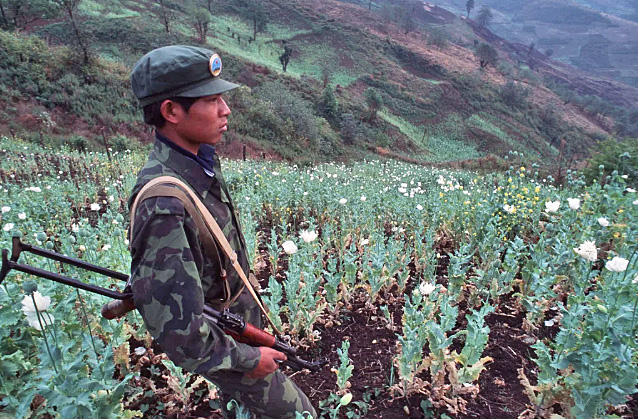
Hmong, Yao, Akha, Lahu, Kayah, Lisu, Wa, Kachin, among other indigenous people, are the traditional poppy farmers of the Golden Triangle. They are subsistence farmers who eek out a living from their small plots of land and provide the raw opium that will be refined into high-grade heroin and smuggled internationally.
Billions of dollars is generated by Golden Triangle heroin refinement and smuggling, but very little is paid to the Hill Tribe farmers who cultivate the poppy crop and collect the gooey latex of opium-the raw ingredient of heroin.
Growing Poppies & Oozing Opium


Golden Triangle opium poppy is a winter crop. It thrives high in the cool mountains of all countries of the Golden Triangle. Broadcast the poppy seeds in November/December. Pray for rain, but not too much, and in 3-4 months the poppies will show off their white, pink or purple flowers. Let the flower petals fall away and the opium is ready for harvest.
The opium farmer cannot just broadcast poppy seed willy-nilly, walk away and return to a field of beautiful poppies dripping with opium. It’s a labor intensive crop. They must first break up the mountain scrabble with shovels and hoes, and keep it constantly weeded. Many fields are not irrigated, so the crop is dependent on fickle rains.


The Hill Tribe poppy farmer is often responsible for collecting the opium. After flowering, the seed pod is carefully lanced multiple times with a special multi-bladed knife. If the cut is too shallow or too deep the precious opium latex will not ooze properly and the seed pod wasted. After lancing, the farmer collects the latex the next day and this is what is sold to a buyer.


Eradication
Eradication of the poppy fields has been a fool’s errand. The drug lords and the money chain of heroin are not affected by the eradication of a few poppy fields. There are always more poppy fields waiting to be tilled and planted. Eradication is often no more than a publicity stunt to show the world that authorities are cracking down.
Eradication merely leaves the poppy farmer and his family poorer, sometimes to the point of hunger. It has never stopped the flow of Golden Triangle heroin.
Opium is often the only cash crop available to a Hill Tribe farmer. The farmer may grow other crops, but it is opium that brings predictable money. When farmers sow poppies, they know they don’t have to trundle off to market to sell their harvest, the buyer will come to their isolated villages with cash in hand.
A poppy farmer uses his opium income for food, health care needs and education for the kids-in that order.
The Opium Buyer



There’s only one reason you buy a farmer’s opium crop-to make heroin.
Buyers in the Golden Triangle are often agents of local militias or war lords, established drug traffickers, agents of government officials or the police, or well-connected merchants. What all Golden Triangle buyers have in common is either open or tacit permission by local and regional authorities to deal in opium.
The central government in far-off Yangon has little if any control over poppy growing in Shan State. The Burmese army (the Tatmadaw) is hated in rural Burma and their presence will often draw hostile fire from the regional militias and insurgencies.
The Burmese Army has historically made the following agreement with the militias: Don’t fire upon us and we’ll turn a blind eye to drug dealing. That is a principle reason that opium grows abundantly in Burma.
Statistics & Damn Statistics


There are statistics and damn statistics. There are percentages, averages, means, assumptions, educated conjecture, expert opinion, margins of error, under counts, over counts and at times no counts at all.
This post is a “data snapshot” of the Hill Tribe opium farmer that relies on two recently published studies by the United Nations Office on Drugs and Crime:
- Myanmar Opium Survey 2019: Cultivation, Production and Implications
2. Opium Poppy Cultivation and Sustainable Development in Shan State, Myanmar 2019
Through all the numbing statistics, we can glean from these newly published studies, an intimate look into the life of a Hill Tribe poppy farmer in the desolate hills and mountains of Shan State, Burma.
Why Burma? (In 1989, the country changed its name to Myanmar.) Because Shan State, Burma is where the vast majority of Golden Triangle opium is grown and refined into heroin.
A 2019 Overview of Shan State Opium


* All amounts of money have been converted into United States dollars.
- One in nine households in Shan State is directly involved in opium poppy cultivation.
- Total area under opium poppy cultivation in Shan and Kachin States is estimated to be 26,000-43,000 hectares (A hectare = 2.5 acres). Shan State grows 85-90% of Burma’s opium poppy. Kachin State in the north of Burma grows most of the remaining harvest.
- Total opium production is 380-672 metric tons annually and results in as much as $1.3 billion (US) in domestic Shan State revenues-the most lucrative commodity of Shan State by far. (This does not take into account the revenues of international heroin dealing.)
- Average Shan State opium yield is 15 kilograms per hectare. This is a 9% increase from 2018. Therefore, even if less land is under poppy cultivation, the total opium yield can still increase.
- An average hectare of Shan opium poppy after refinement will yield 1.5 kilograms of 90%-95% pure (#4 grade) heroin.
- It is estimated that Shan State opium is refined into approximately 55 metric tons of heroin annually, of which 50 metric tons is exported internationally. The remaining 5-6 metric tons is consumed or stored within Burma.
The Poppy Growing Villages


- Of all villages in Shan State, 22% are involved in poppy cultivation. If a village grows poppy then about half the villagers are directly involved. This accounts for one of every nine households being involved in poppy cultivation.
- Opium poppies are grown in the poorest villages. Example: Eastern Shan State is the least developed of any Shan region, but has the highest concentration of poppy villages.
- A poppy growing village is more likely to be under the authority of a regional militia than a non-poppy village. 18% of all Shan poppy villages are controlled by a militia, compared to 9% for non-poppy villages. In northern Shan State, over 50% of poppy villages are controlled by a militia, compared to only 12% of non-poppy villages.
- Most poppy villages don’t have access to any paved roads. They are far more isolated than non-poppy growing villages.
- Over 80% of poppy villages have no access to a healthcare clinic and 30% have no school within the village. Non-poppy villages have slightly higher rates of both clinics and schools.
- 25% of poppy villages practiced open defecation, compared with only 5% of non-poppy villages.
- 95% of poppy villages were not connected to any electrical grid, compared to 69% of non-poppy villages. One in six poppy villages still rely on candles as a principle source for light.
- 16% of households in poppy villages had a television compared with 47% in non-poppy villages. 50% of poppy households had a cell phone, compared to 75% for non-poppy villages.
The Poppy Farmer and His Household


- The average total farm size of a poppy farmer is about half a hectare. On average, the poppy farmer will dedicate slightly less than half his farm land (42%) for poppy cultivation. In northern Shan State a poppy farmer uses more than 70% of his land for poppy cultivation.
- 80% of poppy farmers say that they will suffer a loss of income if they plant a substitute crop. Such a decrease in income often leads to a shortage of food for the farmer’s household.
- An average farm worker in Shan State earns $3.70 (US) per day, while an average poppy farm worker earns $3 per day.
- 55% of poppy farmers had no formal education, compared to 31% of farmers from non-poppy villages. In East Shan State (the poorest region), 71% of poppy farmers had received no formal education.
- In 2019, a poppy farmer received $145 (US) per kilo of fresh opium; two years ago it was double. (In Afghanistan, the world’s leading opium producer, a farmer receives $76 per kilo.)
- The top three uses for poppy income are food, health care and education-in that order.
The Economics of Golden Triangle Opium


Most opium and heroin in the Golden Triangle comes from Shan State, Burma. Shan State militias, war lords, regional strong men and local police control the illicit drug markets. International drug lords operate in the Golden Triangle, but only with the approval of the militias and regional authorities.
The militias and regional warlords (example: The United Wa State Army) tax opium as it’s transported on roads they control. Often the tax is 10% of value, but in lieu of a cash payment, they may take 10% share of the opium. This taxation arrangement will apply as the opium is transported to a heroin refinery within Shan State and then onto Thailand or Laos.
The local Shan militias, warlords and police also provide security for “opium caravans” bound for heroin refineries as another means to extract revenues. And sometimes, these militias and warlords themselves will buy opium from farmers, and transport their own opium to a refinery and onward to international smugglers.
Poppy + Political Turmoil = A Good Harvest


Since becoming an independent country in 1948, the Burmese government has been trying to assert control over its ethnic regions-Wa State, Kachin State, Shan State, and others with limited success. These ethnic states have well-armed militias, insurgencies and warlords that have kept the Burmese Army at bay. The far off central government in Yangon is too weak to enforce its laws in these ethnic States.
Historically, the opium trade generated the needed revenues for a local militia, insurgency, or warlord to buy weapons and pay its soldiers. Opium has always been a substitute for cash in the Golden Triangle for almost a century.
Opium grows best in political turmoil. (Just look to Afghanistan-#1 producer of opium/heroin today.) Shan State has been in political turmoil, often violent, ever since Burma gained independence from Britain.
The Opium-Heroin Value Chain


Following Golden Triangle opium on its journey to become heroin and then distributed internationally to the end user is relatively simple. But trying to find out prices, mark-ups, and profits for opium and heroin is far more difficult. International drug lords who control much of the opium/heroin value chain don’t give interviews and talk freely about the economics of their trade.
But with our limitations in mind, let’s look at the opium-heroin value chain:
- In 2019, a poppy farmer earned $145/kilo of fresh opium.
- The average amount of land dedicated by a farmer for poppy cultivation was slightly less than a quarter (1/4) hectare. (The other quarter hectare is used for rice, beans, vegetables.)
- Since the average opium content of poppy is 15 kilograms/hectare, an average opium harvest for the average poppy farmer is 3.75 kilograms annually.
- 3.75 kilograms of opium multiplied by $145 = $544. That is the average gross opium revenue of a Hill Tribe farmer in The Golden Triangle.
- The average production cost of growing opium poppy is $352 per hectare. This expense pays for farm laborers to plant, weed, water, tend and gather the opium latex.
- Therefore, since the average poppy field is a quarter hectare, a poppy farmer expends $88 to grow his crop.
- The final average annual pay day for a Shan poppy farmer in 2019: $544 – $88 = $456.
The Heroin Value Chain


It takes 10 kilos of opium to make 1 kilo of 90%-95% pure heroin, also known as #4 grade heroin. (Opium is first refined into morphine and then morphine is refined into heroin. The 10/1 ratio for opium-heroin stays the same. Example: 10 kilos of opium = 1 kilo of morphine. 1 kilo of morphine will produce 1 kilo of heroin.)
The Golden Triangle exports #4 grade heroin-considered by many to be the best in the world. No longer is opium smuggled southward into Thailand and then on to heroin refineries in Bangkok, Hong Kong or Saigon. The international smuggling of opium sputtered to an end in the mid-1960’s.


The heroin traffickers got smart and began building and supplying their own heroin refineries within the Golden Triangle. It’s far easier and more lucrative to smuggle heroin than opium as you’re only smuggling one tenth the contraband. And the heroin refineries in the Golden Triangle are far more secure than refineries elsewhere. After all, the heroin refineries are protected by the same militias, war lords, and police officials that protect the poppy fields.
Refining heroin is not simple. You need a skilled chemist and attendants who are experienced in #4 heroin refining or you run the risk of blowing up your refinery. You need chemicals (called precursor chemicals such as acetic anhydride) for refinement and these must be smuggled into Shan State, usually from India, Thailand or China.
Refining opium into heroin adds tremendous value. How much and into who’s pocket goes the money is not an easy question.
Money, Money, Money…but none for the Hill Tribe farmer.
- We know that an opium farmer is paid $145 per kilo of opium and therefore $1,450 will buy you enough opium for 1 kilo of #4 grade heroin.
- Shan (90%) and Kachin States (10%) produces approximately 55 metric tons of heroin annually; or 55,000 kilograms of #4 grade heroin.
- Burma’s total domestic heroin revenues are approximately $1.3 billion with Shan State getting the lion’s share. (This is a top range number.)
- In 2019, total domestic heroin revenues that flowed to all the poppy farmers = $80 million ($1,450 x 55,000 kilos). Therefore Hill Tribe opium farmers received only 6% of total domestic heroin revenues in 2019. A drop in the bucket.
- To account for $1.3 billion in domestic heroin revenue, a kilogram of #4 grade heroin must sell for approximately $23,500 in Shan and Kachin States. (55,000 kilos/ @ an average price of $23,500 = $1.3 billion.) I think of this as heroin’s “refinery gate price”. (Do not confuse domestic heroin revenue with international drug trafficker revenues from heroin. The latter does not return to the domestic Shan/Kachin economy.)
- Therefore, a poppy farmer(s) is paid $1450 for raw opium that the refinery will convert to a kilo of heroin and sell for about $23,500. (The price is actually greater as I have not factored in the cost of domestic confiscation.)
Lets continue on with our value chain and use Australia as our example. Australia gets most of its heroin from the Golden Triangle.
- Shan State heroin is overwhelmingly smuggled south into Thailand where some will be shipped to Australia. 80% of heroin smuggled into Australia enters via a postal or parcel service. (Heroin Markets in Australia)
- A kilogram of heroin smuggled into Australia has a wholesale cost of about $260,000. It has probably been cut once and so now is 70% pure. (United Nations: Wholesale Prices of Heroin)
- This kilo of heroin will be divided up into smaller units and cut at least twice before being sold to the addict at the end of the retail chain. By the time it reaches the addict, the purity will average between 15%-25%. A kilo at 90% purity becomes 4 kilos at 22.5% purity. (The simple math: 1 kilo 90% pure becomes 2 kilos 45% pure becomes 4 kilos 22.5% pure)
- A common retail amount of heroin is a gram. A gram of 20% heroin has a price of $190 (US) on the streets of Australia. A gram is enough for 2-4 doses for an average addict. (Australia Capital Territory Drug Trends 2019)
- The retail sale of 1,000 individual grams (1 kilo) of 22.5% heroin @ $190/gram = $190,000/kilo. Now multiply by 4 because the single kilo of 90% pure heroin when it left the Golden Triangle has now been “cut” into 4 kilos at 22.5%. $190,000 x 4 = $760,000.
- Therefore, 1 kilo of Golden Triangle #4 grade heroin will become 4 kilos of 22.5% heroin that generates $760,000 in gross retail sales at the street level. But the Hill Tribe farmer(s) only received $1,450 of this international value chain.
Opium-Heroin-Morality


Pick any price point in the heroin value chain and it’s obvious that the subsistence level opium farmer receives a paltry sum. Not surprising. The world has never been fair and the poor everywhere are exploited.
But should we have sympathy for a farmer that grows a “poison” that turns humans into junkies? Is the Hill Tribe poppy farmer responsible for recreational drug use in developed countries? Does the Hill Tribe poppy farmer share at least some moral blame for heroin addiction? After all, without their raw opium there would be no heroin.
I can’t answer those questions. Morality from the comfort of my home and well stocked refrigerator is easy and cheap. I do know that if heroin didn’t exist, there would be other drugs that junkies would inject themselves with-like fentanyl-a synthetic opioid.
I do oppose eradication of the poppy fields. It does nothing to stem the flow of heroin around the world and it only further impoverishes the Hill Tribe farmer to the point of hunger.
My suggestion: Just pay the poppy farmer to not produce opium. As I pointed out, the total money paid to all Hill Tribe poppy farmers is a mere $80 million. The average Shan State poppy farmer nets only $456 annually from opium. The world should have a fund from which the farmer is paid NOT to grow poppy. That would be far cheaper than the huge cost of all the drug wars that have resulted in utter failure.
But if we gave $500 annually to poppy farmers to not produce opium, I’m not sure that the people who need opium for heroin profits-the militias, warlords, police, drug traffickers and Shan State authorities-would go along with such an idea.
After all, if there’s no opium, there’s no heroin. And if there’s no heroin, there’s no money.