

Real Thai Food-A Tourists Dilemma
The Problem: You’re a stranger (a tourist) in a strange land (Thailand) and you don’t know any locals. You’re hungry. You want to eat authentic Thai food. You don’t speak or read Thai. You have no idea where the local Thais eat (or what).
The Bigger Problem: Be honest. You really don’t know much about Thai food. Oh sure, you’ve had Pad Thai, Thai Fried Rice, a curry or two, and of course Tom Yum Goong. You even know that Thais don’t eat with chopsticks. But you’re completely unfamiliar with the myriad of Thai foods that Thais eat daily. You don’t realize that Bangkok Thai food is different than Chiang Mai Thai food, which is different than Esaan Thai food.
The Pitfalls: You ask another tourist where to eat. (The blind leading the blind.) That just leads to eating at restaurants where tourists eat. You eat at restaurants that have English menus which again leads you to where tourists eat, not the local Thais. You ask the hotel staff for a good restaurant and they recommend the same place they recommend to all their hotel guests. And so you again end up at a restaurant where tourists eat. All roads seem to lead to restaurants that cater to tourists.
The Solution: There is no single solution to finding authentic Thai food. But there are skills you can develop to lead you to authentic Thai cuisine that the locals eat at local prices.
- Observe who’s eating at the restaurant. Is it Thai people or a bunch of farang backpackers? If the latter, keep moving.
- Is the restaurant busy? If so, this is an indication that the food is good. Lots of Thais eating at a restaurant is a good omen that the food is good.
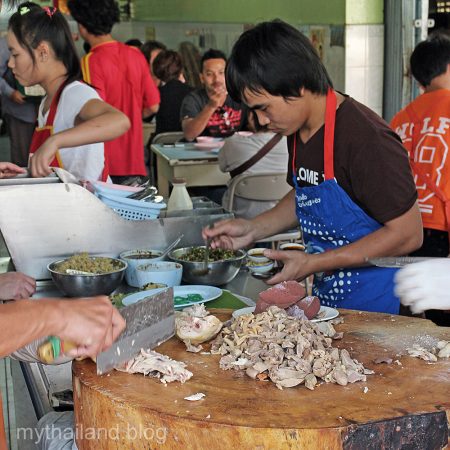
- Don’t read Thai? Then look at the food being prepared. At many traditional restaurants, the food is prepared in the open out front. You’ll see if they’re serving noodle dishes, duck or pork dishes, pad Thai, pad grabao, on and on.
- Point out the food you’d like. You don’t have to speak Thai to order.
Cleanliness

Do not apply Western cleanliness standards to Thai restaurants. Traditional Thai restaurants often can seem dirty and shabby which offends Western sensabilities. The food is served on old plastic plates and the forks and spoons have seen better days. You’re thinking this restaurant would be closed down by the health department if it were in the U.S. or Europe.
If you apply Western cleanliness appearances as a make or break criteria for choosing a place to eat, then you’ll only eat at higher end restaurants. And the vast majority of higher-end restaurants in Thailand don’t serve Thai food anyway. You will also kiss off eating from street vendors, a culinary tragedy if you love Thai food.
If you think you might get sick from eating the food, DO NOT EAT IT! Trying new foods and being culturally adventurous does not include seeing how much bacteria your body takes to get violently ill! (Tip: Eat foods that are prepared hot [I mean the food temperature.] The odds of getting sick from boiled or fried foods is astronomically lower than getting sick from raw foods.) I can honestly tell you that after 25+ years, I’ve never gotten sick from eating at a food stand or traditional Thai restaurant.
Kao Mun Gai (ข้าวมันไก่): A Lesson in Tourist Sensibilities

Factoid: For every plate of Pad Thai eaten by Thais, 100 plates of kao mun gai will be eaten by Thais. Kao Mun Gai is probably the most universally eaten food in Thailand.
Kao mun gai is often called Hainanese Chicken and is ubiquitous all over Indochina.
My favorite kao mun gai (fat rice & chicken) eatery is in Chiang Mai. (See my rare video below!) It’s been dishing up kao mun gai, satay and miscellaneous poultry guts for over 60 years-far longer than Chiang Mai has been a tourist mecca.
This restaurant is well known to all the local Thais- always hustling and bustling. But rarely do White people eat here, just Thais. And that’s the bone I want to pick with you farangs (White people).
From inside, I watch farang tourists stroll by on the sidewalk out front. Most tourists are unaware that they’re even walking past an eatery that the locals consider one of the best fat rice & chicken places in all Chiang Mai. A few farangs stop briefly to look inside, but quickly continue walking.
The white tourist sees only Thai faces eating inside; plucked chickens hanging upside down where the food is prepared; chalkboard menus only in Thai; and an eatery looking dingy and “dirty” to their white eyes. The farang tourists (or at least those who even noticed the restaurant) quickly conclude that this eatery isn’t for them. Thais only.
A cultural divide has cracked open.
Kulture Klash-West Meets East

This cultural divide that stops tourists from crossing into this Thai restaurant quickly becomes a yawning chasm between farang culture and Thai culture. And if you don’t have Thai friends or family, there is no easy bridge to cross into Thai culinary culture.
I find this behavior both understandable, yet quizzical. If you ask a white tourist if they’d like to eat great Thai food, they’d say “of course” enthusiastically. If you ask them if they’d enjoy dining in an old-style Thai manner, they’d say “absolutely”. If you ask them if they’d like to pay $1 for lunch, they’d say “great”!
But tourists don’t eat at this kao mun gai place in Chiang Mai even though they’ve traveled half-way round the world to get here AND Thai food is a top priority for their vacation!
Tourists want a place that has English menus and Westernized Thai food. (Hold the fish sauce and shrimp paste!) A place that fits with their notion of restaurant cleanliness. A place where the mung bean sauce isn’t ladled out of a pink plastic bucket. A place where East meets West and the West wins.
And above all else, most tourists want to eat and hang out where other tourists eat and hang out. The herd mentality.
Here at my kao mun gai place, West just wasn’t interested in meeting East and East didn’t care.
Crossing the Cultural Chasm
So how is it that me, a White guy, not only eats here but craves its authentic kao mun gai especially when I’m far from Thailand?
Anyone who tells you they love Thai food the first, second or third time trying it, either isn’t telling you the truth or they’re eating highly Westernized Thai food. A White person just doesn’t grab a bottle of fish sauce and start guzzling it with gusto. Thai food in Thailand is a long cultural journey.
It took me years to cross the great Siamese cultural chasm. And of course, I have a Thai wife and family that dragged me kicking and screaming across. But farang tourists don’t have decades to acclimate themselves to Thai life, nor a Thai family. So what’s the best way to deal with this cultural chasm?
Simply realizing it exists is the first step. Bon appetit!


Leave a Reply