

I didn’t notice the creeping fog until it had just about swallowed us up in late afternoon. We were high in the northern mountains of Thailand that create the border with Burma. I’ve often seen those fingers of creeping mountain fog from a distance, but this was the first time I found myself in their dense grasp.
We had set out from Fang, a small village near the Burma frontier, planning to visit an ancient temple and its twin stupas called Doi Tung. The temple and stupas known history dated back centuries while its origins were lost to the fog of time. Legends of Doi Tung suggested its origin nearly a thousand years ago.
My wife and I were staying a few days with her brother Benjobe who worked his small orchard just outside of Fang. Benjobe grew citrus and planted teak trees. He also had built his farm house and all the out-buildings. More impressive was the fact that he had built a pretty decent road of about a 1/2 mile to his house from the main road. He liked to boast that in 20 years his teak trees would be worth enough to retire on. Sure enough, 20 years later, he sold the farm, mature teak trees and all for a tidy sum.
During dinner the evening before, I had told Benjobe that I had seen a map of the area with a “historical site” marker on it called Doi Tung. He knew all about the place and had been there years ago. Over a dinner of river fish with spicy mango sauce, northern Thai sausage, and somtom, we plotted our trip for the next day.
The day was cloudless and warm. A good day for a road trip. We left at mid-morning.
Benjobe told us that along with the twin stupas, there was also a Wat or temple. The Wat wasn’t as old as the stupas, but was old enough so that no one really knew any longer just when it had been built. My wife had heard of the temple since she was a child but knew nothing else.
As we drove closer to the Burma border, the mountains seemed more abrupt and loomed over us. Traffic had been light all morning. We passed a village at the foot of the mountains and as the road climbed upward, traffic disappeared altogether. We were approaching Doi Tung from the south which is a seldom taken route.
A paved road gently curved upward. As our elevation increased so did the trees and bamboo until the mountain slopes became forested.
Soon we came to a t-intersection in a saddle of the mountains. To the right led to the Queen Mother’s mountain estate which she had built in the 1960s to ween the local Hill Tribes away from opium cultivation to more “respected” crops. To the left led to Doi Tung. From this saddle I could see west into the wild countryside of Burma. The terrain was ripped with ridges and mountains as far as the eye could see.
This area of the Thai/Burma border at the time was the locus of significant political strife. The Karen Hill Tribeslive on both sides of the border, and they were fighting for independence from the central Burmese government. These Hill Tribe guerrillas were often getting into fire-fights with the Burmese army in these mountains. These mountains were also host to a warren of secret smuggling routes used by Golden Triangle drug smugglers bringing their wares from Burma into Thailand. This of course resulted in Thai army rangers constantly patrolling the area. At times all three groups would take pot shots at each other.
We turned left toward Doi Tung and the road quickly narrowed to one lane. There were no signs. The curves were no longer gentle, but we’re now switchbacks up the mountain side. We gained a ridge line and the road flatten out. The jungle-mountain forest was as dense as anything I’d ever seen. Huge clumps of bamboo, a foot thick at the trunk, shot up at least 75 feet. Much of the forest floor was covered with giant ferns.
The road meandered up and down, twisting and turning for another 10 or so kilometers. It was slow going with potholes and partial wash outs from past torrential rains. Since passing the village far below, we hadn’t seen another car and I didn’t expect we would as the road showed little signs of use.
Benjobe stopped the car so I could closely inspect a clump of giant bamboo which grew at least 50 feet high. Absolute silence. Too silent I thought. Not even the birds were chirping. We climbed back into the car and continued on.
The road dipped downward slightly into a dell and I saw the temple for the first time. We had finally arrived at Doi Tung.
Nearby, were two stupas, conical structures that looked like upside down ice cream cones. Legend was that these ancient stupas contained holy relics of the Buddha. They were about 35 feet tall covered in faded gold paint. In some places, the mortar that covered the stupas had fallen away and you could see the blocks of laterite stone that the stupas were made from.
From what I knew, the stupas had been restored in the 1960s or 50s. Archaeologists had dated the original stupas to be several centuries old if not older, maybe much older. Doi Tung was chosen because it’s a lookout point facing eastward to the sunrise.
The same dead stillness that had surrounded me earlier when we stopped on the road was present here. Nothing moved, not even the towering bamboo. And for no reason, when we spoke, we kept our voices low, just above a whisper.
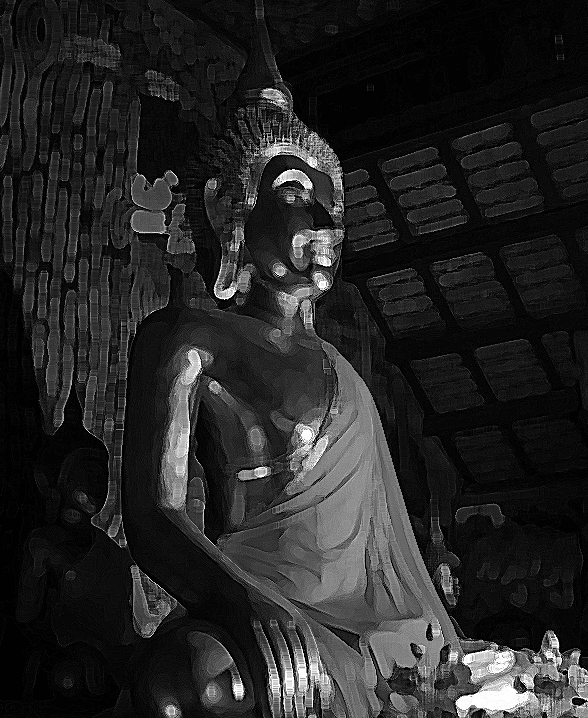
As we walked toward the stupas, I got a good look at the small, open air temple to the right. The Wat had a steeply tiled roof in good repair and three of the walls only came to waist high. A large Burmese Buddha with it’s sad almond eyes dominated the alter with several teak elephant carvings at the base.
I was surprised to smell burning incense and even more surprised when I noticed an old woman praying at the alter. I had thought we were alone. The last car we passed along the road was a couple hours ago and there were no other cars parked nearby other than ours. I had no idea how this woman had gotten there.
The three of us huddled close together and watched this woman for a moment. I shrugged my shoulders and told my wife and Benjobe that I wanted to investigate the stupas first. My wife said she would go over to the Wat and pray. Benjobe followed her.
Yes, the laterite blocks were the originals. I knew because they were rough hewn and not symmetrical. Laterite blocks less than 100-years old are the same shape and size with almost perfect right-angles. Ancient blocks are each slightly unique to the careful eye in both size and shape. These blocks could be easily be a millennia old.
I backed away from the stupas for a better view. I now understood that the “rebuilding” of the stupas 60-70 years ago was really just a cosmetic renovation. Any loose laterite was cemented back in place; jungle undergrowth was cleared away; and a new coat of motar and paint was slapped on. But the stupas themselves that I was looking at were ancient.
I looked over to the open-air Wat and saw my wife and Benjobe talking to the old woman. Not surprising as my wife will start up a conversation with anyone, especially in a setting like this. I walked over to see what was up.
My wife introduced me to the old woman whose name, or more accurately, nickname was “Thomm”. (In Thai the word “thomm” means the sound a drop of water makes in a deep pool. It’s a seldom used nickname.) Surprisingly, she spoke my wife’s northern dialect which meant she was from the Chiang Mai area.
When I joined the group, they stopped speaking dialect and switched to Thai so I could understand. I know a few words of the Northern Dialect and I know it when I hear it, but you’ll lose me fast in conversation.
Thomm had been coming to Doi Tung since she was a little girl. I was hesitant to ask her age even though in Siamese culture such a question isn’t taken in offense. But still I kept to my white upbringing and didn’t ask that obvious question.
She was very old to be sure. Easily 85 if not over 90. Thomm was a tiny woman, 100 lbs at most and not 5 feet tall. Her dark brown face was covered in deep wrinkles and she was missing a few teeth. Although she used a wooden walking stick to help with balance, her gait was still strong and sure.
I asked her how in the hell did she get up here? I expected her to say that a family member had dropped her off and would soon return. I was surprised when she said she walked up here from the village at the base of mountain. I only half believed her as that’s about a 2000 foot elevation gain and almost 10 miles. “By the roadway you walked?” I asked. She laughed at my accent and told me that there’s a pathway from the end of the village to Doi Tung and that she knew it well.
Thomm related to us that she’d been coming to Doi Tung with her family since she was a little girl. Her grandfather had insisted that they always walk up from the village below as part of a family pilgrimage. Her grandfather had told the family that his grandfather adhered to the same tradition generations ago.
I asked her about the stupas and what she knew about their renovation. Yes, she remembered a team of monks that were here during one of her family pilgrimages and repaired them when she was a young woman. The monks just “fixed them up a little bit with some fresh paint.” This was confirmation that the stupas we were looking at were the originals and had only undergone minor repair work years before.
My wife asked Thomm about her family and the two of them fell back into Northern dialect. I guess the question struck Thomm as personal and she felt more comfortable continuing the conversation with my wife. I excused myself and wandered off to explore more of Doi Tung.
I walked past the Wat and the stupas toward the outcropping that was the actual rocky point of Doi Tung. The fog had now crept up the mountain side and beginning to shroud us. My wife and Thomm were only 35 yards away, but already they were fuzzy and disappearing. Benjobe was praying at the Wat.
To my surprise, I came across a line of nine stone Buddhas semi-hidden in a small dell where the fog gathered thickest. They stood at least 10 feet tall and were badly worn. The Buddhas were all in the lotus position and fierce Nagas, the mythological, multi-headed serpent, rose above each of their heads.
Time had turned these Buddhas a mottled black. About half of each Buddha was covered in moss. The detail of the faces of both the Buddhas and the Nagas had been substantially eroded over time. In fact a few of the slender Naga heads had broken off and lay at the foot of their Buddha.
I picked up a small Naga head and ran my fingers over its sharp fangs. Then it struck me that no one had disturbed these nine Buddhas in a long time. I gently put the Naga head back in its original position, clasped my hands together and bowed slightly in apology. I sensed there were spirits here and I had no intention of upsetting them.
I climbed out of the dell and saw Thomm walking away from the Wat. With her hiking stick in hand, she walked with the determination of a person who knows where they’re going. She quietly faded away into the fog. I walked back to the Wat and found my wife praying along with her brother. I waited just outside until they were finished.
“So, what did the old woman have to say about her family?” I asked my wife. “It was very sad”, my wife related. Thomm had outlived her husband, sisters, brothers and cousins. She had no children. Her nieces and nephews and their children had long ago moved away to Bangkok and she lived alone. As far as Thomm was concerned, she was the last of her family. She still made the traditional family pilgrimage to Doi Tung, following the same trail her grandfather had shown her, but because of her age, this was probably the last time she would come.
“Where did she go?” My wife asked. I pointed off to where I last saw her about 10 minutes ago.
“She was walking somewhere over there,” I responded.
“We’ll go find her and see if she wants a ride back down to the village”, my wife ordered.
I walked over to where I had last seen the old woman. Gone. I looked back toward my wife and could barely make her out through the fog. A fresh breeze had now picked up and ushered in an even denser, moist fog. Bamboo loves the fog. Now I knew why the surrounding bamboo forest was the biggest I had ever seen.
I continued heading in the direction I last saw the old woman walking. I continued walking for a few minutes until the mountain side dropped off rather steeply. Still no one. I looked carefully around and to my surprise spotted what looked like a path about 15 yards away.
I quickly approached and sure enough it was a pathway, not wide, but well worn. It led down the mountain side picking its way carefully through the clumps of giant bamboo. I quickly walked about 100 yards down the trail faster than a hobbled, old woman could possibly walk, until it came to a rocky outcropping. The forest path stopped, but a stairway had been hewn into the granite outcropping leading very steeply downward. Still no one.
I look carefully at the hewn stone steps and saw through the fog that someone had built a handrail on the most precipitous parts. Thomm was right…there was a trail that let up to Doi Tung. I walked down a dozen or so steps. Still no one. The going was slow at best and an old woman with a walking stick certainly couldn’t navigate these steps very fast.
I was surprised to see dozens of bells of different sizes, tied with leather thongs to the handrails, swaying in the breeze and softly tinkling. A close-up look at the bells revealed that they were Buddhist temple bells. These bronze bells, imprinted with an image the Buddha, were badly weathered. And there were dozens and dozens of them, gently warning anyone nearby of the precipice just on the other side of the handrail.
I carefully walked down a series of steps to a small landing. No one. The steps continued downward and quickly disappeared into the thickening fog. I yelled out “Thomm! Anybody here!” Silence. From up above, I heard the muffled voice of my wife calling me. I strained my eyes down the stairs before I turned and carefully climbed back up the stairs.
My wife had followed my direction and found the same path as I did, but stopped where the stone steps began their steep descent.
“I couldn’t find her,” I told my wife. “I can’t believe she could walk faster than me.”
“Let’s go. I’m cold and the fog is starting to spook me,” my wife said. “Maybe we’ll see her along the road on the way back.”
We quickly retraced our route back to the car where Benjobe was waiting for us. I took one last look around, marveling at the stupas cast in the foggy dwindling light.
There was something disturbing, even haunting about the Temple of Doi Tung and its twin stupas. But I couldn’t quite put my finger on what. I mentioned it to my wife who chalked it up to a loose collection of spirits she believed were still rattling around the ancient temple complex, trying to find their way home.
As we drove away, we were lucky there was no traffic as we could barely see ten feet in front of us. But the lower we drove, the more the fog dissipated until we finally broke out into a clear sky near the saddle where the main road had forked to Doi Tung. Unsurprisingly, we didn’t see the old woman.
We made it back to the village at the foot of the mountain in time for dinner. This was the village where Thomm had said she set out from on her pilgrimage up to Doi Tung. All of us were starving and ate at the only restaurant in the village. It didn’t matter that this was our only choice as we found the food excellent.
Again, my wife struck up a conversation with the owner of the small restaurant. She told him all about what we had seen at Doi Tung. I asked him if it were true that there were trails that led from the village all the way up the mountain. “Yes indeed”, he replied and proudly told us as a young man he had hiked all the way up the mountain.
My wife then told the restaurant owner about the old woman Thomm. He frowned as she related to him that we had met and talked to her at Doi Tung.
“No one fitting that description came to the village today,” he insisted. “I’ve been here all day and the only bus today came a couple hours ago and two of my cousins got off. I remember your car passing by about noontime. This is the only road through the village, and the only trail that goes to Doi Tung starts here.”
“Maybe the old woman got on the trail before entering the village,” I thought out loud.
“Not possible,” snorted the owner, not at all liking my implied challenge that he may not know everything that passes in his town. “The pathway starts at the far end of the village by that outcropping of rocks over there,” he pointed.
No more than a couple hundred yards away was a unique outcropping of rocks and if you looked closely you could see a path beginning to wind its way into the mountains. “You can’t get to the pathway without me seeing. And if I didn’t see her, there’s village folk who would have and I certainly would have heard by now about such a strange event. An old woman walking up the mountain all by herself”, he scoffed.
The conversation was over as far as he was concerned. He abruptly walked away.
On the drive to Mae Sai none of us spoke much. I was happy to reach our acomodations before nightfall. In fact, since that day, my wife and I have never spoken about our trip to Doi Tung.
Epilogue
Twenty-five years later, my wife and I found ourselves again traveling to Doi Tung. Age had only brought us closer together and more dependent on one another. We were staying with my wife’s great niece and her husband in Chiang Rai and had an open day. I told them about visiting Doi Tung many years ago and they readily offered to drive us up there.
As we drove through the village at the base of the mountain, I thought back on the restaurant where we had dinner and its owner. I’d be surprised if were still alive. My brother-in-law, Benjobe, had died years ago.
The road from the village up the mountain was now busy with traffic. The old one-lane road from the mountain saddle to Doi Tung was now a modern two-laned roadway with a broad shoulder. The steep grade and hairpin switchbacks had all been engineered away into gentle turns. In fact, we passed several large tour buses headed back down the mountain.
The parking area for the temple complex was now large and paved. We had difficulty finding a place to park. The day was warm and sunny. There were families, kids and tourists everywhere, laughing and having a fun day in the mountains.
I thought back on that silent, foggy day decades ago when we came to Doi Tung and stood at this exact same spot. I began to question my memory. But my wife quickly assured me that my memory was still sharp about that strange day.
The old open-air Wat was gone and had been replaced with a new temple. My wife went inside to pray and I waited for her outside. Some things don’t change.
There were still twin stupas, but they had been moved about 100 yards from where I remembered them. They were covered in a flawless gold paint that was so bright in the afternoon sun that you needed sunglasses to even look at them. There was a railing around the stupas with signs that warned people not to walk any closer.
I found the dell where the nine Buddhas quietly sat in the dense fog with the broken Naga heads at their base. The Buddhas were gone. No trace of them at all.
When my wife came out of the Wat, we strolled over to where I had found the well worn path leading to the precipitous stone stairway. It was now a paved ashphalt path that was better constructed than the old one lane roadway we drove to get here decades ago.
The paved path veered away from the precipice. Although older, my sense of adventure was still that of a young man. I convinced my wife to leave the paved pathway and try to find the old hewn stone stairway.
At first my wife and I couldn’t orient ourselves to exactly where we were 25 years ago. But we stumbled upon that same well worn trail that we had last seen Thomm walking on. The trail was now mostly overgrown. If I hadn’t been on it before and searching for it, I never would have found it.
“The old woman, Thomm.” I said to my wife, “This is where I last saw her”.
“I remember she just vanished into the fog that day,” my wife responded.
We followed the old path a short distance to the precipice. The noise and commotion of the new Doi Tung faded away to almost nothing. Someone had piled up boulders and logs to block the path just before the precipice. I climbed over and stared downward. Sure enough, after straining my old eyes for sometime, I could see the stone stairway. But the handrail and bells were gone.
“There’s the old stairway!” I shouted to my wife. She seemed unimpressed.
“Come on back. I’ve seen enough,” my wife said.
We returned to the paved pathway and I heard the sound of bells clanging. I told my wife to wait here for me. We quickly walked about a quarter mile down the pavement where I saw young children striking large bells with sticks that had been arranged along the paved pathway. The children were laughing and screaming with their parents running after them. Tourist were taking photos of themselves with the bells. The bells were shiny and new.
We found our niece and her husband near the twin stupas. They were surprised when we told them we were ready to leave.
“Something wrong?” my niece asked my wife.
“We’ve seen it all before”, she replied unconvincingly. I nodded my head in agreement.
I strained my eyes into the bustle of tourists going here and there. I sadly realized that my wife and I were the oldest people here. I scanned the scene even more intently, not sure what I was looking for.
“She’s not here”, my wife said softly. “I’ve been looking for her the moment we arrived.”

Leave a Reply